
Self-Awareness
Motivation

MINDS ON
 Definition of Motivation
Search online for several different definitions of motivation. Identify three or four common terms/keywords used in the different definitions you found.
Using those three or four common terms/keywords, write your own succinct definition for motivation. Highlight in your own definition the common terms/keywords that you identified.
Save this definition for the next part of the activity.
 Defining Motivation
In days of old a wandering youth happened upon a group of men working in a quarry. Stopping by the first man he said: “What are you doing?” The worker grimaced and groaned as he replied, “I am trying to shape this stone, and it is backbreaking work.” Moving to the next man, the youth repeated the question. This man showed little emotion as he answered, “I am shaping a stone for a building.” Moving to the third man, our traveler heard him singing as he worked. “What are you doing?” asked the youth. “I am helping to build a cathedral,” the man proudly replied.
What does the above anecdote suggest about work and motivation? Do you agree?

ACTION
Motivation
Are you motivated by rewards? That is, do you perform certain actions because of something you get as a result of performing that action? A reward is an outcome that has some sort of positive value to an individual or group.
IntrinsicExtrinsic
 Two Biographies
While reading the following two biographies, consider the following:
- Is the individual intrinsically, or extrinsically motivated?
- Explain, in detail, why you feel they are intrinsically or extrinsically motivated.
- Can you think of any limitations to focusing only on extrinsic factors?
- Create a biography of your own that demonstrates an example of intrinsic or extrinsic motivation. This can be an example based on your own experience or it can be a hypothetical situation. Be sure to identify whether the individual in your biography is motivated intrinsically or extrinsically or potentially a bit of both, and explain why.
Sheila

Sheila was a teacher but retrained a few years ago as a fitness instructor. She runs classes every evening and on weekends and also trains in the gym most days. She is highly committed to exercise and sees it as the centre point of her lifestyle: “For years, working as a teacher, I used to exercise as much as I possibly could but never felt I was doing enough. So that’s why I gave up teaching and got into this new career. I know what you’re thinking, but it’s definitely not that I am addicted to exercise or obsessive about it or anything like that. It’s just that, well, it’s hard to explain, but being an exerciser, being a fit person, is a big part of who I am, if you see what I mean. If I had to stop tomorrow, it wouldn’t exactly be the end of the world but it would mean that I’d have to do some serious thinking about my life and I’d find it difficult to readjust. It sounds silly, but it’d be a bit like losing my name or something. I wouldn’t know who I was any more.”
Lenin

Lenin is a construction worker. He loves physical activity of all sorts. He usually plays basketball or racquetball once a week, runs often, taking part in his city’s annual 10 km fun run every year. “I’ve always been into sport and exercise,” he says. “It’s not as if I’m really all that good at it. I mean, I never had any illusions about playing professionally or anything like that. It’s just great to go out and kick a ball around or run in the park or whatever, have a laugh with your friends, and just forget about work and everything for a bit. I love it.” When asked if he thinks exercising is good for your health, he says: “Well, yeah, I suppose it must be. But that’s not what it’s all about for me, to be honest. I don’t worry too much about the future and all that, you know. I just like having a good time. I mean, if I started thinking like, ‘Oh, this’ll stop me from getting a heart attack,’ or whatever, I think it would end up being just like work. I’d hate to get all obsessed about it like some people. It wouldn’t be any fun then, would it?”
Motivational Theories
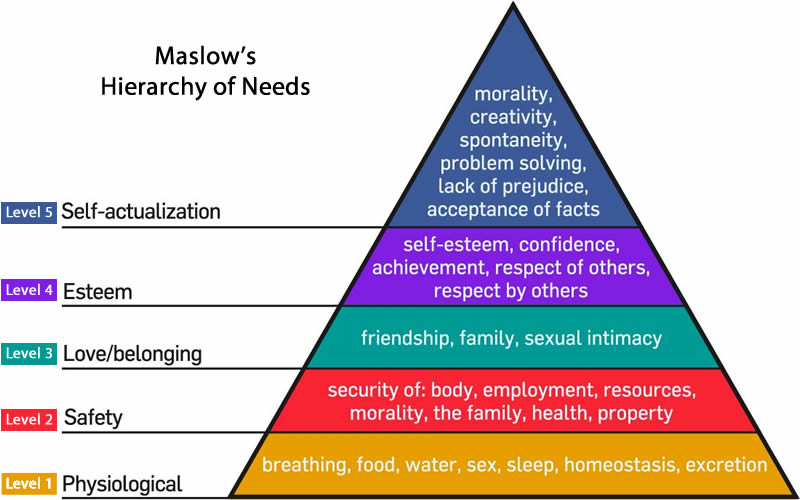
Various theories of motivation are approached and explained through the lens of personal needs. That is, they suggest that people are motivated to take action and do things by unfulfilled physiological or psychological needs or desires. One of the most famous and widely applied theories of motivation is Maslow’s Hierarchy of Needs theory (1943, 1964). Abraham Maslow was an American Psychologist, Author, and University Professor.
Maslow’s Hierarchy of Needs theory suggests that people are motivated to do things as a result of their human needs. His theory is based on a pyramid structure or step up scenario, where people cannot progress to higher levels needs, Esteem and Self-Actualization, unless lower, previous levels needs, Physiological, Safety, and Belonging, have been attained or satisfied first. Here is a visual representation:
Read this article, Motivating your staff from BBC News (Original article)
If you want to view any links in this pdf, right click and select "Open Link in New Tab" to avoid leaving this page. (View the original article.)
Motivation Reflection
Respond to the following questions.
- Why is it important to motivate staff? What are the benefits to the business or organization?
- Why can it be easier for a big company to motivate staff than a small one?
- How does a business you know motivate its staff? Provide real examples with explanations. Attempt to identify how those examples fit into Maslow’s five levels.
- What would motivate you to do your job and perform well on a regular basis? List 5 things you see as the most important motivators for you at a potential job. For each, classify them as intrinsic or extrinsic motivators, and also classify them according to level of Maslow’s Hierarchy.
Save your work to your Portfolio for later reference.
What motivates us?
Watch the following video: Drive: The surprising truth about what motivates us, by Dan Pink.
Drive Reflection
What surprised you about the video?
Are the Extrinsic rewards typically provided to employees (good pay, benefits, vacation time, social opportunities, etc.) enough? Based on Dan Pink’s discussion, what else do employers need to provide to truly be able to motivate employees?
Self-Inquiry: Interested in reading more, visit Dan Pink - Drive: The Surprising Truth About What Motivates Us
Read the following article, Struggling to lead? Turns out, people like being treated like people (here’s how) from Mashable and think about the connections made to Dan Pink’s revelations about motivation, reward and performance.
If you want to view any links in this pdf, right click and select "Open Link in New Tab" to avoid leaving this page. (View the original article.)

CONSOLIDATION
Case Study
Imagine you are the manager of a successful graphic design business with a staff of 20 employees. Productivity and employee morale seem to be at an all-time high. Employees seem to be quite happy with their work, and they are always working hard to meet deadlines and produce exceptional work.
Your company’s workload is heavy and you have many large and important clients.
Your objective is to keep this high level of productivity and morale with your staff. Describe what you would do to encourage your staff to continue to work hard and stay as productive as possible. You also want to make sure your staff members are happy and are always in good spirits, but also don’t want them to be too social and wasting company time. How do you ensure that a good healthy balance is achieved?
As the manager what do you do to keep this group happy, productive, and motivated?
Prepare a two-page written business report outlining:
- What actions will you take?
- How/why will those actions keep your employees happy, productive, and motivated?
- Make connections to the theories of motivation you examined in this activity (Maslow, ERG, Herzberg) in order to support your suggestions.
- Even though your employees might be quite different (ages, sex, ethnicity, backgrounds, etc.), how will you ensure they all stay motivated equally?
- Explain the relationship that exists between your motivation strategies, employee rewards, and job performance.
Writing a Business Report Resources
 Learning Goals and Success Criteria
 Learning Skills and Work Habits