
Planning
Strategic Planning

MINDS ON

 Strategy Definition
Based on the completed mind map, with all the insights, terms and examples shared by you and your classmates, write a brief definition for the term “Strategy.”
Based on what you have already learned about planning and your overall knowledge of organizations and business at this point:
What does the word STRATEGY mean in this context?
What other terms, phrases, examples come to mind?

ACTION
Strategy
By now, you are aware that strategy is really a comprehensive action plan that identifies the long range direction for an organization. Strategy guides how organizations make use of their resources, including money and capital resources, in order to achieve their goals and objectives.
Competitive Advantages
One way most organizations attempt to do that is by sustaining a competitive advantage. A competitive advantage is a position in which an organization performs better than their competitors allowing them to secure their customers.
For example, Apple has a highly educated and creative research and development (R&D) department. This is one of their strongest competitive advantages because it allows them to develop new products based on highly innovative technologies and to be able to do so relatively quickly. As a result, customers line up for hours for the latest Apple product. Therefore, Apple’s strong R&D department allows them to have a competitive advantage over many of their competitors.
Some examples of competitive advantages are:
- Low Cost
- Quality
- Knowledge
- Speed Quick to market advantage
- Barrier to entry
- Financial position advantage.
Maintaining a competitive advantage while developing a long term strategic plan can ensure the ongoing and far reaching success of an organization. Making clear decisions regarding where you want to be and how you are going to get there can lead to more success and overall profitability.
Levels of Strategic Planning
Most organizations are guided by three forms of strategy; they are corporate strategy, business strategy and functional strategy.

Corporate Strategy
As described in the video, corporate strategy guides the organization as a whole. These are top level plans, put into place by top level manages, to set broad and overriding goals for the organization. The major focus of corporate strategy is deciding what the organization does and will continue doing. This often refers to the types of business the organization is involved in, what products and services they sell, and what consumer needs and wants they are meeting in the marketplace.
One specific example of a strategy that is considered corporate and is developed by top level managers, are mission statements. A mission statement is typically used to guide and identify the reason and purpose for an organization’s existence. It is just what it sounds like - a brief statement outlining the mission of an organization. This mission statement is then used to help guide all other plans and decision making.
Recall from the last activity, the notion of vision statements - a clearly defined organizational purpose and an expression of what it hopes to be in the future. In essence, it summarizes the overall strategy and direction of an organization. A vision statement is often referred to as the “What.” It is a quick snapshot of the long term plan of the organization. This is slightly different from a mission statement. Mission statements are often referred to as the “Why,” that is, why the business exists, and why they do what they do?
Check out these examples of organizational mission statements and see if you can guess who they belong to.
MissionStatements
Business Strategy
Business strategy and planning is a more focused and specific form of decision making. The focus here is more on individual business units, and how the organization is going to compete within that one unit or product line.
For example, Apple might have a corporate strategy that identifies it as a leading technology company and that it will continue to develop innovative computing and Internet-based devices. The business strategy would then focus on planning for individual product lines. How is it going to compete in the mobile phone industry and what decisions and plans have to be made to remain competitive with iPhones? Business strategy is often set and planned for by middle-level management.
Functional Strategy
Functional strategy takes a business strategy and focuses it even more by planning how to use and allocate resources in order to implement the business strategies. This is where the focus shifts to functional organization decisions; remember that you explored different types of organizational structures earlier in the course.
One example might be how the Marketing department will plan and make decisions to support the release of the newest Apple iPhone version.
Another example might be how the Human Resources department may need to hire more staff to support growth in a certain division. Functional strategies are usually set and and planned for by front-line managers and supervisors.
Complete the following review activity to demonstrate your understanding of the three levels of strategy.
Strategies
Strategic Plans
In addition to levels of strategy, there are also various types of strategic plans. These plans can be used in different situations and within varying contexts. Not all organizations use the same strategic plans, at the same time.
Types of Strategic Plans
Strategic plans often start with an overriding intent or grand plan: growth, retrenchment, or stability are the most common.
Growth
A growth strategy is one that attempts to expand and increase the size of the business or organization. This might relate to growth in sales, market share, or perhaps number of physical locations. Growth strategies are often referred to as scaling the business. A common growth strategy is the acquisition of competitors.
Watch the following video to learn more about the growth strategy:
 Organic and Inorganic Growth
What is the difference between organic and inorganic growth? In addition, provide two potential examples of both organic and inorganic growth for businesses or organizations of your choice.
Retrenchment
A second basic type of strategic plan is a retrenchment strategy, sometimes also referred to as a renewal strategy, or a defensive strategy. This strategy is a plan that attempts to fix problems - identify weaknesses and problems and effectively overcome them. This often means reducing or removing an element of the business, scaling back or becoming smaller. Examples might be reducing the size of your workforce, ending the production of a certain product line, or closing some retail locations.
Watch the following video to learn more about retrenchment strategies:
Stability
The basis of a stability strategy is to maintain the status quo - that is to make no major changes and keep doing what has made you successful in the first place. This is a common strategy when economies are performing poorly or when it is anticipated that there may be a future slip in economic performance. It also occurs when an organization is satisfied with its current performance and really doesn't want to take on too much risk right away.
e-Commerce
Another very common and important strategy today is e-Commerce (eCommerce). Retailing has become a very challenging and competitive industry in North America, largely the result of e-Commerce. Retailers that are not selling online are losing business to those that are. Amazon has quickly become the largest retailer in the world and provides consumers the flexibility to shop and purchase from home.
If you want to view any links in this pdf, right click and select "Open Link in New Tab" to avoid leaving this page. (View the original article.)
Direct to Consumer Retail
Take a moment and reflect on how your family relies on the Internet and online retailers for your consumer needs and wants.
How many things do you purchase online?
Does your family purchase more services or goods online than in-store?
Are there any retailers where you shop in person that do not provide consumers the ability to make purchases online? Should they?
Save your thoughts to your portfolio.
Strategic Planning Management Tools
Deciding on a general and specific strategy is not an easy task. Managers spend considerable time and effort attempting to formulate guided and conducive strategies. They often use some valuable planning tools in order to get it right.
SWOT
The most common approach used to identify the best strategy moving forward is a technique called SWOT - a way to identify the organization's Strengths, Weaknesses, Opportunities, and Threats. A SWOT analysis usually looks like a grid that contains four quadrants. These quadrants are used by managers to brainstorm and identify internal and external elements of the organization that translate into strengths, weaknesses, opportunities and threats.
Strengths and weaknesses are considered a part of the internal environment - factors inside the organization that are easily identified by managers and employees. Strengths are things you are good at, or do well, and weaknesses are those things you do poorly or have a large amount of potential improvement to accomplish.
Opportunities and threats are considered a part of the external environment - outside your business in the marketplace or society in general. Opportunities are areas where possibilities exist - opportunities for increasing market share, sales, acquiring new consumers, entering new markets, etc. Threats are factors that could potentially cause damage to your organization. Things like changes in consumer tastes and preferences, changes to rules, laws, and regulations, or the potential for a poor performing economy, can all negatively affect an organization, and what they do.
Take a few minutes to practice your overall understanding of SWOT by completing the following activity. Read each statement and move it into the most appropriate location on the SWOT grid.
SWOTAnalysisPractice
Porter’s Five Forces Model
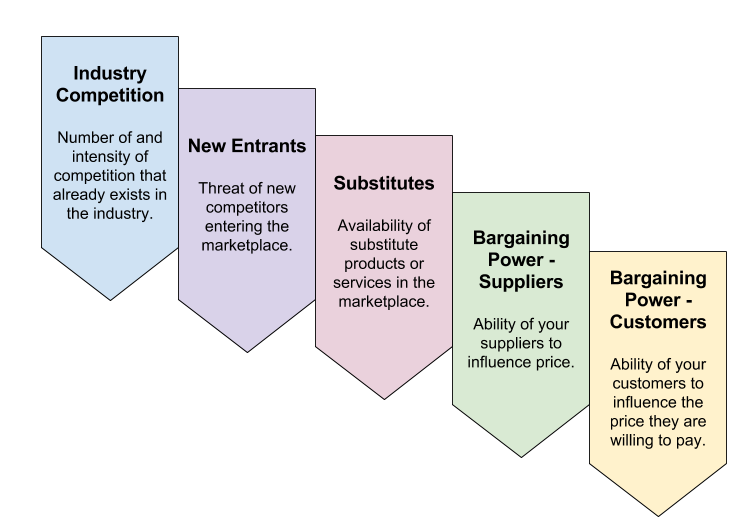
Another common managerial tool used to help guide strategy is Porter’s Five Forces Model. This tool is used to analyse competition and can help managers develop strategy to position their organization in their particular industry.
The five elements of Porter’s Forces Model are:
Corporate Culture
One last attribute of strategic planning is known as corporate culture. Corporate culture is a feeling, a sense of what someone sees and hears while being a part of an organization. Corporate culture is really the combined set of beliefs and behaviours that are implied within an organization. An effective and healthy corporate culture has the ability to improve employee productivity and increase organizational success.
Watch and hear about the corporate culture at Google:
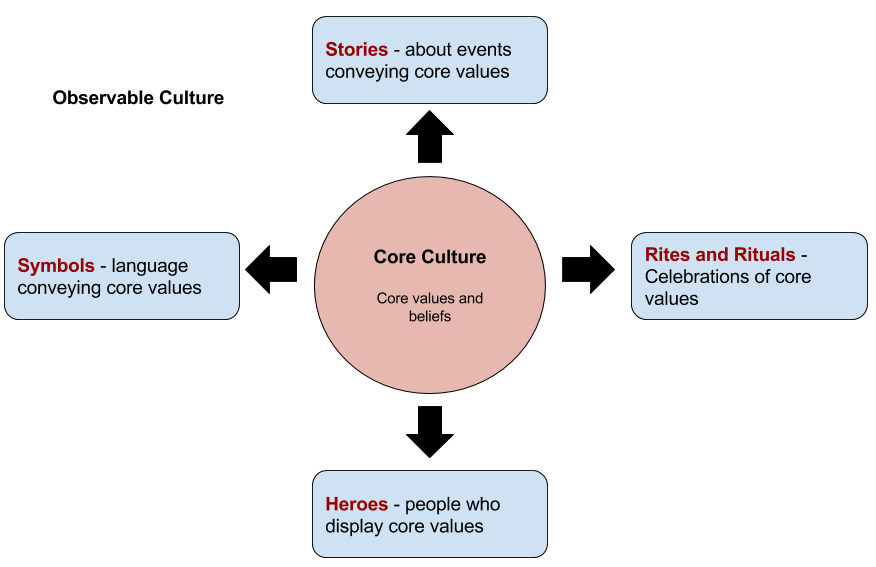
Corporate culture is often described through two lenses or perspectives. The outer perspective is called the observable culture, and the inner perspective is called the core culture.
Observable Culture
The observable culture is the part of an organization’s culture that is clearly visible. It is seen and heard in all aspects of the workplace and within personal interactions. It relates to how people dress at work, how the employees work together, how customers are treated, and how managers lead.
Observable culture consists of four essential elements - Stories, Heroes, Rites and Rituals, and Symbols:
Core Culture
The second element of an organization’s corporate culture is considered its inner culture, and is known as core culture. These are the sets of beliefs and values, and underlying assumptions and beliefs that guide people’s behaviours. Most successful organizations identify their own unique set of core cultural beliefs that help guide the organization.
 Corporate Culture
If you want to view any links in this pdf, right click and select "Open Link in New Tab" to avoid leaving this page. (View the original article.)
Respond to the following:
- How are corporate culture, employee happiness and productivity connected?
- Would you pick a job offer with an organization that appears to have a better culture, over another job offer with an organization that will simply pay you more? Why or why not? Explain.
- How are strategy and corporate culture connected?
- Who is responsible for creating a positive culture in the organization? Explain.

CONSOLIDATION
SWOT Analysis
You will now be using your strategic knowledge and skills to develop a SWOT analysis and identify Porter’s Five Forces based on a real organization of your choice. Task requirements:
- Select an organization - this might be a business, nonprofit, or other organization. Make sure you state the name of the organization and provide a brief description of what they do.
- Complete a SWOT analysis on your selected organization. Use the following template to guide the organization of your analysis. Aim to have at least 4 elements identified for each of strengths, weaknesses, opportunities and threats.
| Internal Environment | |
|---|---|
|
Strengths
|
Weaknesses
|
| External Environment | |
|
Opportunities
|
Threats
|
- Briefly identify and explain each of Porter’s Five Forces based on your organization.
- Identify elements of core and observable culture that exist within your organization.
SWOT Analysis Checklist
| Criteria | |
|---|---|
| Have I included the name of my chosen company with a description of what they do? | |
| After completing my SWOT analysis, do I have at least 4 strengths? | |
| After completing my SWOT analysis, do I have at least 4 weaknesses? | |
| After completing my SWOT analysis, do I have at least 4 opportunities? | |
| After completing my SWOT analysis, do I have at least 4 threats? | |
| Have I identified and explained each of industry competition? | |
| Have I identified and explained each of new entrants? | |
| Have I identified and explained each of substitutes? | |
| Have I identified and explained each of bargaining power - suppliers? | |
| Have I identified and explained each of bargaining power - customers? | |
| Have I identified both observable and core culture within my organization? |
 Learning Goals and Success Criteria
 Learning Skills and Work Habits