
Earth Connected: How We Rely on the Earth and Each Other
How Did Natural Processes Worsen the Fukushima Disaster?

MINDS ON
You can look anywhere on Earth for the beginning effects of sea level rise, but what better place to start than our own backyard, right here in Canada. Read the CBC news article about Lennox Island, P.E.I. and their battle with rising sea levels.
Stop, and take a moment to consider the global picture of this situation.
- The small population of Indigenous peoples on Lennox Island contribute minimally to the scale of human activity that is causing sea level rise. But, because of their geographic location, they are dealing with an uneven share of the effects. Simply, the repercussions of decisions made by the rest of humanity are now theirs to deal with.
- Climate change is an unfair process. It impacts everyone, but the severity of its effects are not equal. Some people contribute more to climate change and feel few of the effects while others contribute little and feel major effects.
 Impact of Climate Change
Activity 2 looks at the connections between the “victims” and “villains” of global climate change. Answer the following question in the discussion.
What other issues might arise due to inequitable impacts of climate change?
Choose an impact of climate change that fits a geographic perspective (Social, Environmental, Political and Economic) and briefly discuss the issue using these sentence starters. Save your comments in your Portfolio.
You may begin your comment on climate change by choosing ONE of the following:
- Climate change could create political tensions between countries when/because…
- Climate change could create economic disparities between countries when/because…
- Climate change could create social unrest between countries when/because…
- Environmental disasters caused by climate change could…

ACTION
The root causes for phenomena like changing global weather patterns, atmospheric hazards and melting icecaps are not as easy to pinpoint when compared to a situation like a factory spilling pollution into a river. When we look at cause and effect relationships some are direct (definition:refers to a local change/impact that is easily attributed to a specific human action), and others are indirect (definition:a human action in one part of the world contributes to an effect somewhere else).
 Example
| Direct (Local) | Indirect (Global) |
|---|---|
| The creation of a dam upstream reduces the water levels flowing to a city downstream and impacts the availability of water. | North American reliance on motor vehicles releases a disproportionate amount of CO2 that contributes to ocean acidification and global temperature rise. |
| Point source Industrial activity like refining oil or smelting metals release pollution that falls as acid precipitation downwind. | Emissions from the animal livestock industry release the strong greenhouse gas methane, impacting global warming trends. |
| A nuclear power plant meltdown releases radioactive particles that land in the direction of prevailing winds. | Your everyday decisions about energy use and resource consumption eventually result in a wide variety of environmental impacts. |
| CONTEXT: If you can point a finger to prove responsibility, it is easier to hold a guilty party accountable for their actions. | CONTEXT: Hard to point a finger at a guilty party. Less likely to see a change of practice due to the lack of obvious responsibility. |
Unfortunately for our planet, the human activities that contribute to climate change and its effects are more likely to be perceived as indirect. This has resulted in a delayed global response to what is truly the worst natural hazard or human-caused disaster that we might ever experience. Climate change is a natural and human hazard far worse than earthquakes, tornadoes, volcanoes, or any location-specific natural event. This is because climate change affects everyone on our planet.
In this activity, it is now time for our class to divide and conquer the global responsibility and impact of climate change.
Your task will be to:
-
choose a country with a coastline;
-
research its contributions to climate change. Include this country’s actions which have led to climate change, as well as its actions to fight or limit climate change. Many countries will have actions that fit both! (Include variety of stakeholder groups such as the government, non government organizations or NGOs, and prominent activist groups.);
-
research the effects of sea level rise and other climate change hazards your chosen country will endure; and
- analyse your chosen country’s unique geographic perspective on climate change. Note that there may be multiple perspectives and issues within a single country.
You will then:
- Share your story at a global forum with other countries to discuss the specific issue of sea level rise and other climate change hazards.
Choose Your Country
Each student will choose a country to research the implications of climate change. Countries are reserved by posting a claim in the class discussion. Country choice will be determined on a first come, first served basis.
 Part 1: Using Maps to Identify Sea Level Rise
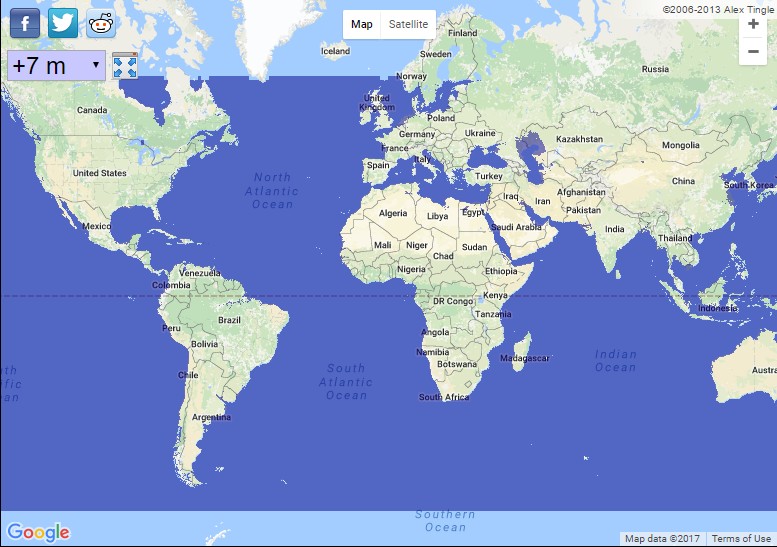
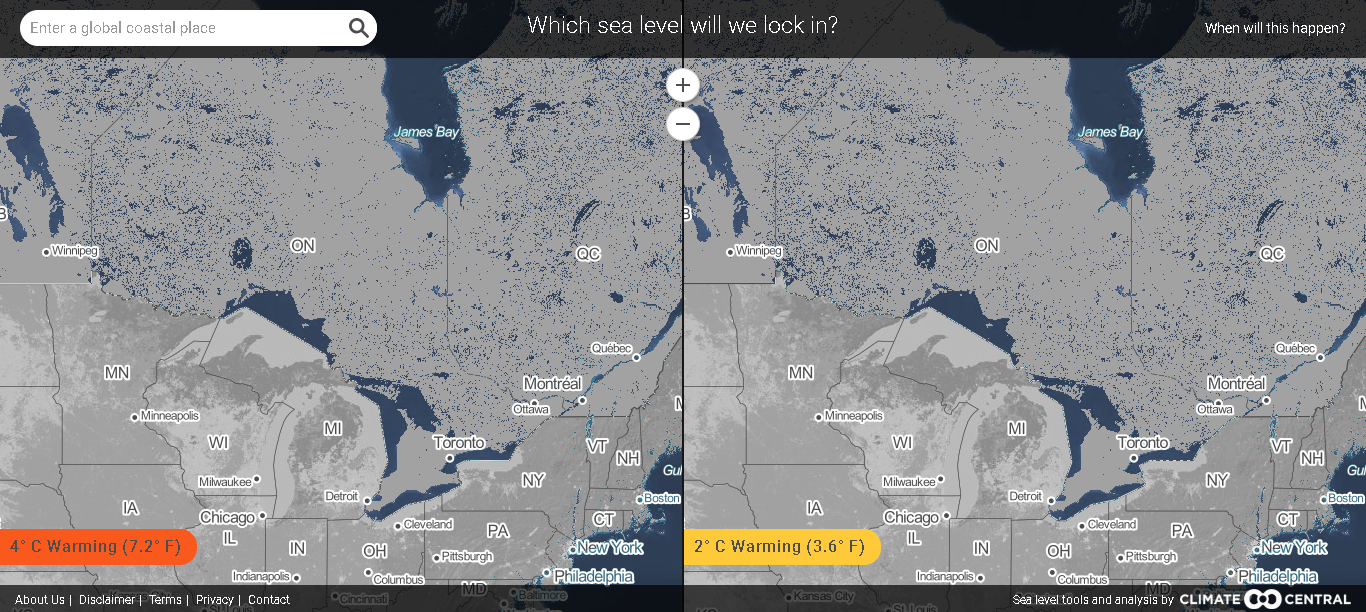
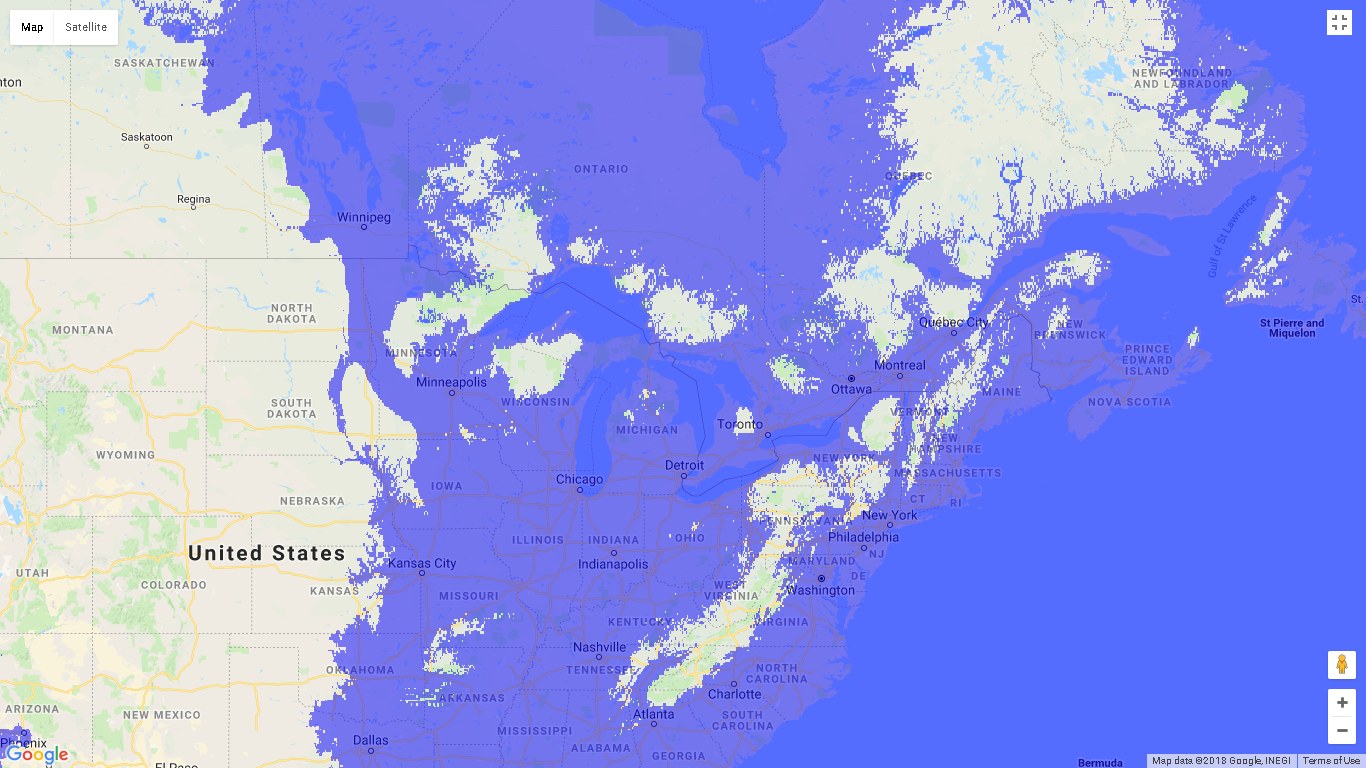
Since the global forum will have a focus on sea level rise, the following maps can be used to assess the risk of sea rise hazards (flooding, storm surges, cyclones, tsunamis) to your country. The maps predict how sea level will change coastlines under various future scenarios using metres (m) of increase or an amount of temperature change. It is important to identify what scenario is being considered because the amount of future sea level rise could vary widely between a few metres and a maximum of 70 metres. For simplicity, we will establish three scenarios.
- Best Case scenario: 0-10 metres of rise (or <2 degrees Celsius/3.6 degrees Fahrenheit)
- Dangerous scenario: 10-50 metres of rise (or between 2 and 4 degrees Celsius/7.2 degrees Fahrenheit)
- Worst Case scenario: 50-70+ metres of rise (or above 4 degrees Celsius/7.2 degrees
Fahrenheit)
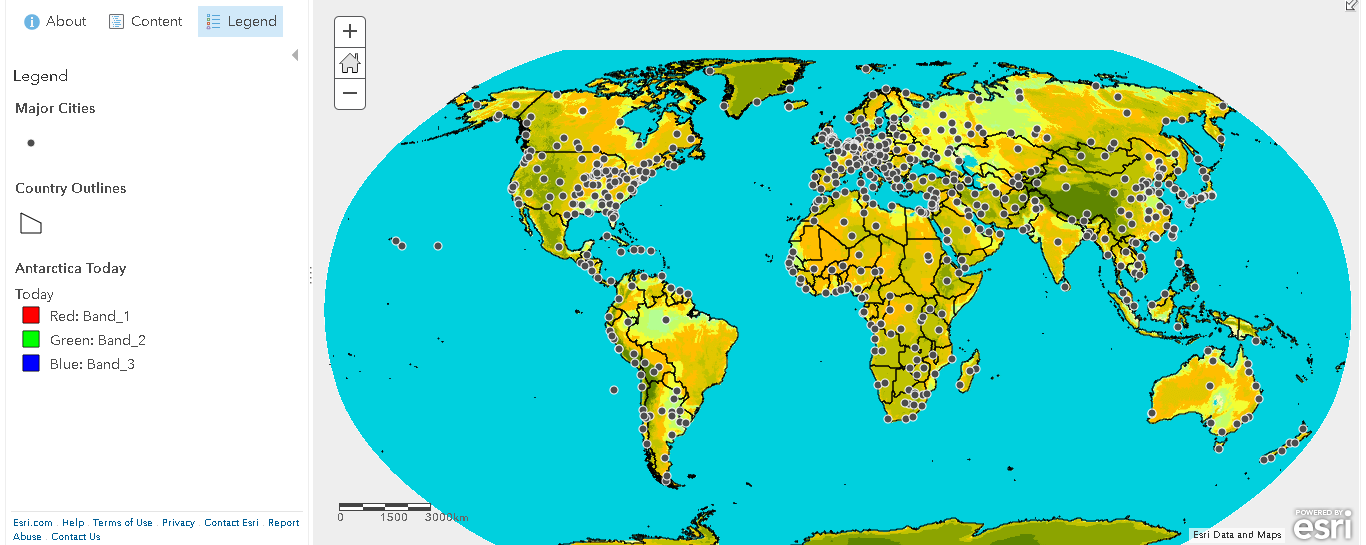
Use the maps to analyse the severity of sea level rise in your country by zooming in and observing coastal changes. Gather screenshots that show coastal flooding and use the available layers to gather information such as risk to major cities. Record your findings in this graphic organizer. An exemplar organizer has been created to assist you in completing your research.
Sea Level Rise Map 1
Sea Level Rise Map 2
Sea Level Rise Map 3
Sea Level Rise Map 4
 Part 2: Guided Research
Use the following information to fill out the corresponding sections of the graphic organizer. Completing this research will reveal the role played by your country in climate change.
Planet Warming Emissions/Ecological Footprints:
Where does your country rank in the world? Check out this interactive graph to gauge your country’s contribution global emissions.
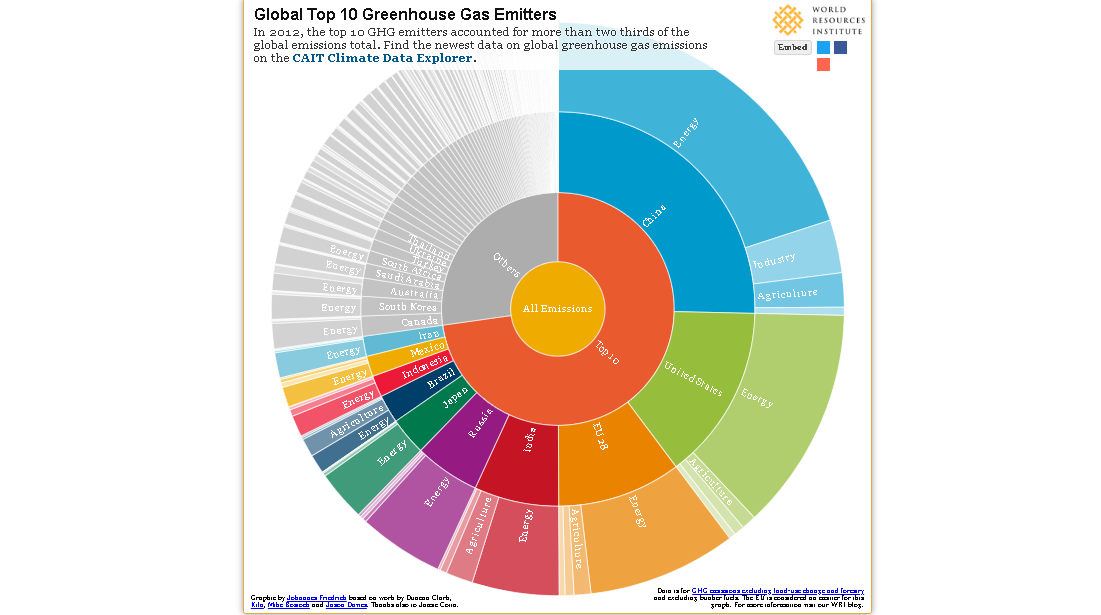
Emissions are only part of the story. The impact a country has on climate change can also be explored by looking at ecological footprints. Footprints quantify resource consumption including energy use, agricultural demands and lifestyle choices that have environmental impacts. Find your country and compare it to others using this interactive map of ecological footprints. A country’s ecological footprint can be seen as an indirect way of measuring activity that contributes to climate change and in particular, sea level rise.
Fighting Climate Change:
Though having a large ecological footprint and greenhouse gas emissions are bad, a country can also be a leader in fighting climate change if the political will exists. This interactive site compares a handful of nations based on their policies and decisions to fight climate change. Conduct some additional research on the level of climate activism taken by your country. Collecting this information will be important in defending your country’s actions at the global forum.
Effects Beyond Sea Level Rise:
Conduct additional research beyond the effects of sea level rise and expand your research to include a widespread collection of impacts climate change will bring to your country.
Global Interdependence:
What does the world rely on your country for? Understanding how climate change may affect your country and its ability to provide its goods and services is key to understanding the future. Exports are goods and services that are sent to another country for sale. Look deeper into your country’s most important exports by locating it on this list, and analysing the exports by value in US dollars by the thousand. If you are now interested in what your country relies on the world for, find your country on this list to explore your imports (definition:goods created in another country and shipped to your country) and the balance between imports and exports.
Report to UN Forum
Complete your official U.N. report using this template.
An exemplar "UN report for The United Kingdom" has been created to demonstrate what your final product should include.

CONSOLIDATION
The global forum is over and each country's report has been analysed. Based on your classmates’ research and the findings they have posted, you will step away from the perspective of your chosen nation and analyse all countries at the forum. A country can fall under one of the following categories when you consider its place in the climate change story. Notice that these labels are not the simple (social, economic, environmental, and political) ones used in earlier lessons.
A climate criminal is a country that stands out as having made major contributions to the negative impacts of climate change (socially, economically, environmentally and/or politically).
A climate victim is a country that stands out as being unfairly impacted by negative impacts of climate change, considering its minimal contributions to these causes (socially, economically, environmentally, and/or politically).
A climate activist is a country that has stepped up and made serious efforts to reduce its impact on climate change (socially, economically, environmentally, and/or politically).
Climate Criminals, Victims and Activists
Use this document to organize the countries that participated in the global forum based on the categories above and then complete the reflection questions.
 Consider this:
 Learning Goals and Success Criteria
 Learning Skills and Work Habits