
The Power of Stewardship
Canadas Role in Global Sustainability

MINDS ON
 Canada's Commitment to the Environment
Complete the following interactive. Be sure to take a screenshot of your work (summary slide) as you will need it later in this activity.
CanadaCommitmenttoEnvironment

ACTION
Canada has played a role in many different international environmental protection efforts, including agreements, conventions and conferences. Intergovernmental Agreements are often reached by the global community after a series of meetings, and each country or party involved is left with a certain target or goal that they must meet in order to improve the environmental standards within their own country. When all parties follow through with their targets it leads to a more sustainable future for the entire planet.
Here’s an example of how many international environmental agreements flow:
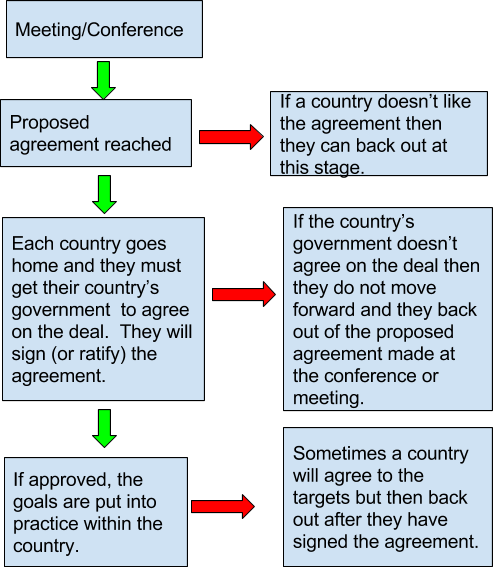
Canada’s Role in International Agreements
There are many historical examples of environmental agreements that Canada has played a role in. Some of them include:
- The Montreal Protocol on Substances that Deplete the Ozone Layer.
- Convention on the Control of Transboundary Movement of Hazardous Waste (Basel Convention.
- Convention on Biological Diversity.
- Convention on International Trade in Endangered Species of Wild Fauna and Flora (CITES).
Check out this video which highlights one of these agreements, The Montreal Protocol.
 Exploring International Agreements
Choose one of the environmental agreements listed above and explore Canada’s role in it. How did Canada help to establish this agreement and how has this agreement impacted the environment, our country and the global community? Do you think this agreement has been effective?
Backing out of a Promise
We know that Canada has played a part in establishing and adopting many environmental agreements, but there have also been agreements that Canada has originally signed on to participate in but eventually pulled out of. One example of this is the Kyoto Protocol which was a climate change agreement that came out of a series of meetings in Kyoto Japan in 1997. The agreement set emission targets for countries and came into full effect in 2005. While Canada attended the meetings in 1997 and did originally commit to the agreement, they exercised their legal right to back out of the agreement in 2011.
The reasons the Canadian Government gave for backing out of the Kyoto Agreement were:
- They did not feel the agreement was meeting the real challenges of global climate change.
- They felt it was targeting countries that were relatively small global emission polluters.
- They were concerned that the agreement did not target the United States which is responsible for nearly 20% of global emissions.
The Paris Agreement
Canada received harsh criticism from some countries for backing out of the Kyoto Agreement, but more recently they have received praise for signing on to the Paris Agreement which came into effect in 2016. The Paris Agreement is an international agreement that is aimed at combatting climate change and helping developing countries adapt to its effects. Their target is to keep the global temperature rise this century to below 2 degrees Celsius. To meet this target each country that has signed on has “nationally determined contributions” which are emission reduction goals.
Here's a short video to tell you more about The Paris Agreement:
Currently 166 countries have ratified the Paris Agreement, which means they have received their country’s government approval and have agreed to these targets. Canada is among the parties to ratify, which means now that Canada has committed to this agreement we must take actions within our own country to limit emissions being produced. Along with what is occurring at the national level, the Canadian Government is also investing $2.65 billion to help developing countries reduce their emissions, and they have partnered with the European Union to work towards investing more money into clean energy.
Carrying Out The Promise
All of this sounds like a strong commitment to a greener future for both our country and the world, but what if our government changes its mind and decides to back out of the agreement? Can that even happen? As we have seen with the Kyoto Protocol in the past, it is possible and every country can make its own decision based on what it feels is best for its country.
The United States had signed on to the Paris Agreement, but then changed its mind once a new president came into power. Check out this article from Maclean’s magazine which explains why the President of the United States decided to back out of the Paris Agreement and why Canadians should think critically about our role in this agreement.
If you want to view any links in this pdf, right click and select "Open Link in New Tab" to avoid leaving this page. (View the original article.)
 Carrying Out The Promise
After reading the article, what thoughts and questions are you left with? Are you optimistic about Canada reaching the targets that we have committed to?
Interrelationships Between Countries
Why is having an international agreement on the environment so important? As you know, borders are human made; therefore environmental issues don’t stop to show their passport before they pass from one country to another. So many of the resources we require to survive are shared between countries so it is important that as a global community we set expectations and targets and hold each other accountable.
Let’s explore how one country’s actions may impact another country far from its borders.
Step 1: Choose a scenario - This scenario should be a negative environmental action that has been taken in one part of the world. An example of a scenario could be the burning of coal in a factory in China.
Step 2: Analyze the impact and interrelationships - How do you think this action could affect other countries around the globe? Make a mind map of all the environmental impacts you could foresee occurring as a result of the scenario you chose. Examine these impacts in detail.

CONSOLIDATION
Have your opinions changed?
Remember the slider activity you did in the Minds On section? How have your opinions changed since then? Complete the following interactive again remembering to take a screenshot of the your work (summary slide).
Open each screenshot and compare how your opinions have changed after learning more about Canada’s role in environmental sustainability.
Summarize your comparison.
CanadaCommitmenttoEnvironmentConsolidation
The World Needs Canada
We all know that it takes a strong leader/nation to provoke change, and on the global scale Canada could be that leader to emerge and take a strong stance on climate change. However, at this point in time Canada is not a leader in regards to our environmental practices. In fact, we lag behind many other developed nations in establishing practices which would lead to a great reduction in carbon emissions and meet the goals set out in the Paris Agreement. We have done things like ban coal powered plants in certain parts of the country, yet we are happy to sell our coal to other nations who then burn it, leading to an increase in global carbon emissions. While this may not add to Canada’s contributions of emissions, it certainly adds to our global contributions. The world needs Canada to step up and make wise choices for the planet in order to meet the Paris Agreement targets.
 Learning Goals and Success Criteria
 Learning Skills and Work Habits