
CGW4U
World Issues: A Geographic Analysis
Unit 1: Understanding World Issues
Activity 1: What issues arise from a global commons on a finite planet?

In the 1960s, for the first time, as humans raced into space we gained a new perspective of our planet. The concept of Spaceship Earth, popularized at this time, is a metaphor about the way we use, and abuse, the resources and natural environment of the Earth. It required us to imagine that Earth is a rocketship hurtling through space. Like a spaceship, we cannot add more resources if we overuse or waste those we have and we have to survive living in any pollution we create. Our Earth is a closed system.
James Lovelock, also in the 1960s, wrote his Gaia Hypothesis. He saw the earth as a living entity, an organism working for its own survival. His concerns grew out of the notion that our growing populations reduce the Earth’s ability to function in a healthy and sustainable way. He called these restrictions “limits to growth.” Both Spaceship Earth and Gaia illustrate our attempts to understand the earth and our place on it.
In this course we will investigate a variety of world issues. Our goal will be to deepen your understanding of some of the most complex issues facing our world today.
Astronauts often comment about how fragile earth looks when seen from space.
We should set some ground rules before we go too far in this World Issues class. We must be paying attention to detail yet not lose sight of the big picture. This can be a daunting task. Watch this video to see how well you can do both.
It is easy to miss something you’re not looking for. Remember this as we study complex issues. We need to be vigilant and gather data and information that create as true an understanding as possible. In a similar light, we need to consider where our information comes from, who it represents and what story it ultimately tells. This video will give you some interesting insight into how we are impacted by who is telling a story.
Think of the problems that would occur if complex world issues were studied from a single perspective. Later in this unit we will come back to this idea about the particular way that geographers approach and learn about any given world issue.

One topic we will revisit throughout the course is our use of natural resources. In most cases this is a national decision, but there are resources that are not bound inside the borders of any one country. We refer to this area as the commons.
These are natural resources such as air and water that are not owned privately or by a government
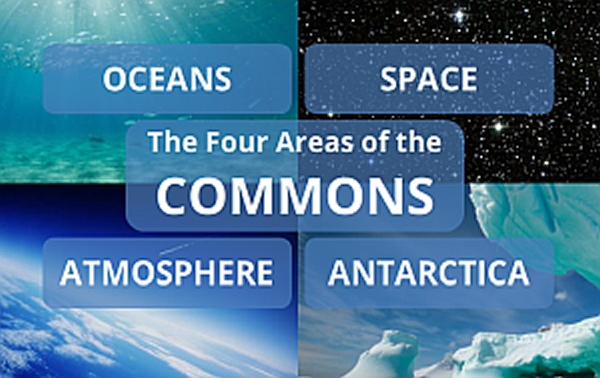
To be sure, we have made some mistakes when managing our spaceship and our commons. The overfishing of the cod stocks off the coast of Atlantic Canada is just one example of our overuse of our natural resources. This is also an example of what Garrett Hardin, in 1968, termed a “tragedy of the commons.”
 Issues Café: Tragedy of the Commons
Watch the following two videos and take a moment to summarize your thoughts on the meaning and significance of people taking without limits from a finite resource.
Throughout this course, you will find topics for reflection. Use this opportunity as a time to think about what you're learning and the broader impacts it may have.
Consider how the Tragedy of the Commons may be (or is already being) displayed in your own community. Give an example that demonstrates the significance and potential implications of people taking without limits from a finite resource.
 Athabasca Oil Sands
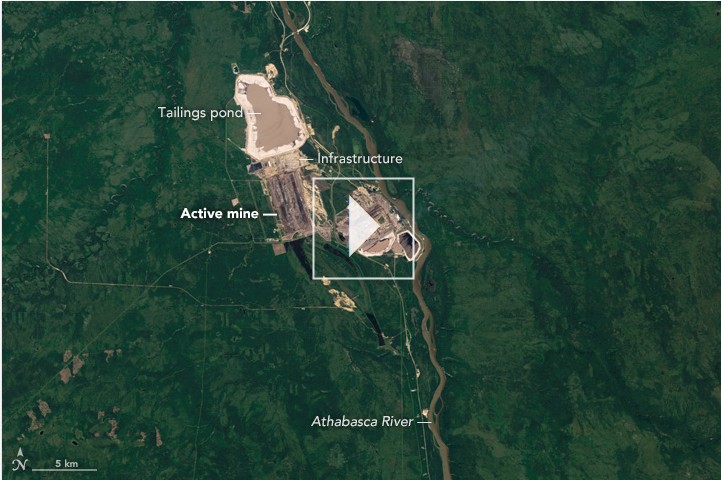
Closer to home is Canada’s Oil patch and the Athabasca Oil Sands. Look through the images that illustrate the development of this mega-project, and read the text that is below the images. As you read, consider:
-
Whether the Athabasca Oil Sands is or is not an example of the tragedy of the commons.
- If you would support an expansion of the area being mined? Why or why not?
World Issues are messy. They are about cause and effect. When we consider our use of resources, the ideas underlying the tragedy of the commons quickly surface. Questions about property governance, rights, and ownership surface.
What do you think? Who, if anyone, should control water supply for a community? What is the best way forward? If you learn about attempts at controlling parts of the commons you may be better able to determine which side of the issue you personally support. Cochabamba Bolivia is often used as an example of all the problems that can be created when a global commons (in this case water), is privatized. Read about water privatization in Cochabamba, Bolivia, South America’s poorest nation. If you want to follow any links in the document, right click and select "Open Link in New Tab" to avoid leaving this page.
Corporate self interest is a powerful motivator. Bechtel, driven by profit motive, set the ground for what many called a “water war.” Is this our only option when we are working to share the commons?

For an alternative approach, consider Bolivia’s new Mother Earth law.
 Issues Café: Thinking Log
Consider the future of our global commons. Should water be owned? What solutions could have been employed other than military responses to protesters in Cochabamba? Should ownership of the commons be private or public? How successful do you think Bolivia’s Mother Earth forest law is/will be?
There are so many ways to consider these complex ideas. Throughout this unit we will look at three frameworks that will be useful for the duration of this course. These include:
-
Geographic Thinking Concepts;
-
Inquiry Process;
- The structure of a position paper.
 Introduction
 Learning Goals
 Learning Skills
 Rubric 1