
CGW4U
World Issues: A Geographic Analysis
Unit 2: Asia
Activity 2: Does a government have the right to regulate population size through policy?

Can you think of any problem in any area of human endeavour on any scale, from microscopic to global, whose long-term solution is in any demonstrable way aided, assisted, or advanced by further increases in population, locally, nationally or globally?
There is no question that the population of the planet is growing. There is also no question that our species has and is changing the planet in a range of ways, many permanently. As early as the 1960s the term "anthropocene" has been used to describe the current geological epoch. This time period started with the industrial revolution and is characterized by the measurable and significant impact human activity has on the natural environment.
While the term of the Anthropocene may be debated, the notion that human populations are physically changing the world is perhaps not that surprising.
 Should Population be Controlled?
What consequences of population (either an increasing population or a decreasing one) have you seen in your own community?
From a geographic perspective (social, political, economic and environmental), should population be controlled?

The earth may not be overpopulated but in places it certainly is overcrowded. When it comes to the Anthropocene, we can see how our needs and wants permanently scar our natural environment. This begs the question: what do we do about it? If we maintain the argument that our natural systems, global commons and resources are threatened by our sheer population, does a government have the right to implement policies that regulate population size? Before you answer that question keep in mind that population policies don’t always work to reduce population size (antinatalist); some are designed to grow populations (pronatalist)!
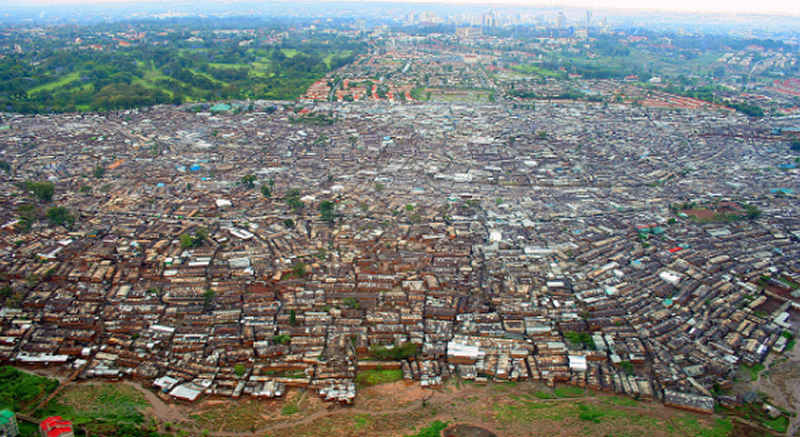
Kibera, a neighbourhood in Nairobi Kenya, even from the air may be a bit deceiving. It is the largest slum in Africa and is home to over 1 million people. How would you describe the standard of living here?
Wikipedia
Did the first image make you think any of the following? Severe poverty and crowding. Scarcity of resources including water and food. Rampant disease. Uncontrolled crime including rape and assault.
Now, examine Kibera close up.
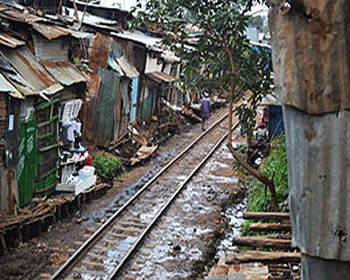
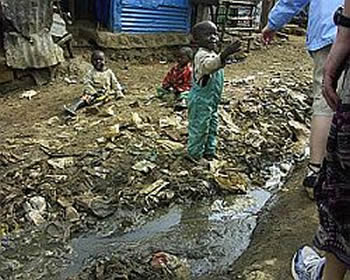
All of these are issues that are facing this large community.
If we recall the Demographic Transition Model, you will remember that the decline of the Death Rates and continued elevation of the birth rates caused a population explosion. Why is it that so many nations didn’t reach a stable or declining population level of post transition? They may become stuck in what has been called the “Demographic Trap."
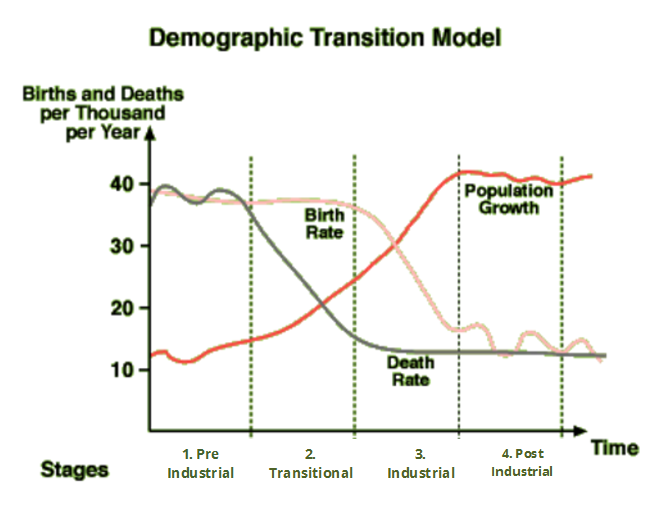
Demographic Trap
When there is a relatively low death rate (DR) and a still-high birth rate (BR), the resulting high natural increase is the root of the problem. Any economic growth ends up being used to support the needs of the booming population – there is nothing left over to promote the economic and social development that is necessary for the country to proceed to post transition. The fear is that the country’s BR will stop declining and the population explosion will continue until a Malthusian collapse becomes inevitable. This devastating collapse would occur because the population has grown so much that it exceeds the carrying capacity of the area.
Population size
There are significant differences in demographic transition model between More Economically Developed Countries (MEDCs) and Less Economically Developed Countries (LEDCs). Population size and birth rate is much greater in LDC.
| MEDCs | LEDCs |
|---|---|
|
|
|
|
As growth rates continue at 2% (or higher) populations soon begin to overwhelm ecological life support systems and the global commons.
Eventually this will lead to reductions in both per capita food supply and income; therefore it is hard to reach economic and social gains necessary to lower BR and consequently population growth stays high.
Ecological and economic decline create the trap and they develop slowly (self reinforcing). More people, therefore greater consumption (especially food and water), and land is over burdened causing runoff and erosion. As food production declines, it becomes necessary to import food.
How do governments move their populations in a different direction?
Should governments develop population policies or is this an abuse of human rights?
Approaches to Population
Compile a comprehensive list of reasons that support both a pro-natalist approach to population and an anti-natalist approach to population.
- Reasons for a pro-natalist approach to population;
- Reasons for an anti-natalist approach to population.
 China's One-Child Policy
China’s one-child policy is perhaps the best known attempt at population control. Use the following resources to:
- Gather and organize information about the policy and its consequences.
- Interpret and analyse the advantages and disadvantages of this policy and also the intended and unintended impacts.
- Draw your conclusion about this government population policy for controlling population growth and assess the impacts. Below are some resources to get you started, however, do look for resources on your own as well.
-
Britannica: One-child Policy Chinese Government Program
-
Economist: No tears for the enforcers
-
BBC China to end one-child policy and allow two (Article and video)
-
National Geographic See How the One-Child Policy Changed China
- Globe and mail The ghost children: In the wake of China's one-child policy
 Population Control Policies
Consider:
- Should countries be allowed to have population control policies?
- Are the consequences of pro- or anti-natalist policies worth the intended benefits?
Consider:
- The global population and the stress it places on our natural resources and global commons.
- Reasons countries implement pro-natalist national population policies.
- Reasons countries implement anti-natalist national population policies.
Ask yourself:
- Is population control a human rights violation?
- Should any country be able to have a pro-natalist policy which will ultimately impact and draw down our global commons?
- Is controlling population growth a matter for a country or for the world and therefore, should we have just one world population policy?
 Introduction
 Learning Goals
 Learning Skills
 Rubric 1