
CGW4U
World Issues: A Geographic Analysis
Unit 4: Environmental Sustainability
Activity 4: What do we have to sacrifice to get sustainability?

Canada does pretty well on most global rankings. Does this mean that we can just maintain the status quo, or does it mean that we need to see ourselves as world leaders and demonstrate how we earned our place on the global stage?
Earlier in this unit, you calculated your personal ecological footprint. Now we want to use this idea, but with a community, national or international focus.
Canada is the “Bigfoot” of ecological footprints! We are a small population in a huge country and, on average, we use more resources and create more waste than the planet can manage. The question is: what do we do about this situation? Currently, we are not leading sustainable lives. What do we have to sacrifice to become sustainable?...Or do we have to sacrifice at all?
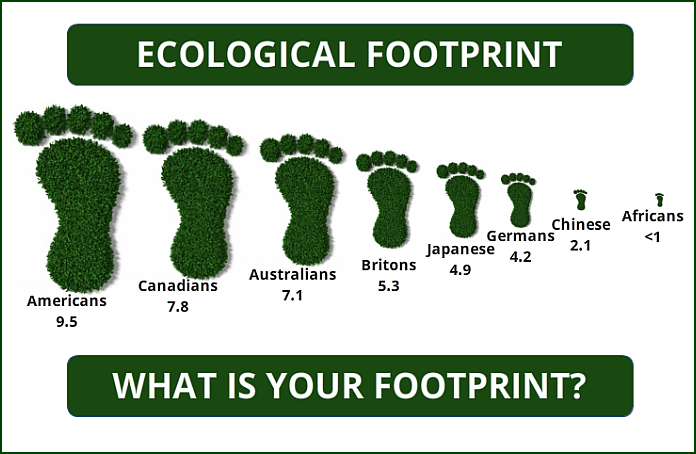
Review your personal ecological footprint from Unit 4 Activity 1. As you move through this activity think about the concepts of sustainability, stewardship and carrying capacity.
You have been taught to be good stewards, to do your part in taking care of the environment. Turning off lights when you leave a room, turning off the tap when you are brushing your teeth. You know the drill, you know how to reduce your EF!
But how do we go beyond that to reduce the EF of our community or our country or the world? As citizens, we have powers you might not have even realized we have.
Take a moment to consider in particular, the comparison between a society addicted to slavery and a society addicted to oil. Today, as back in the era of the pre-Civil War America, how can we continue with the unsustainable system we find all around us?
Let’s consider what we are sacrificing if we shift our paradigm about how we want to live, what we value and what we want to leave for our children and grandchildren.

What do we have to sacrifice to get sustainability? Your EF was measured using 5 components: food, energy, goods and waste, transportation and shelter. You may be aware that depending on the EF calculator you use, the components may be different than these five. Also, they may give you a result in hectares rather than planets. These differences are not right or wrong; they all communicate the sustainability of our interrelationship with the natural world.
As you complete this activity, you will notice that we have selected one or two topics for your consideration within each EF component. You will learn about some of the ways that each component can be reduced. This is by no means an exhaustive list of all the ways EFs are being reduced around the world. In addition, we have included some examples where our efforts may not yet be substantial enough. In these cases, you will have to decide for yourself the best next step.
 Sustainability
As you read through the five categories below, you will notice that each has a reflection question(s) following the content. Respond to the one that most interests you.
Food
Depending on where you live there are many ways to increase your sustainability and shrink your EF, without sacrificing anything. We can make our diet much more sustainable by altering it - no sacrifices, just adaptation.
Use these resources to deepen your understanding of what can be done, or done differently, to reduce your community’s EF. If you want to visit any links in the following pdfs, right click and select "Open Link in New Tab" to avoid leaving this page.
Eat as much local food as possible. Eat food that has had the least processing. Eat what is in season whenever you can. Reduce the amount of meat you eat. Buy only the food you are going to eat to reduce the amount of food waste. These are simple changes that will make a real difference to our sustainability.
Barriers
What are some institutional and individual barriers and/or challenges that might prevent your community from acting with more sustainable intent when it comes to local food and food waste? Would this work in your community? Why or why not?
Goods and Waste
We buy it, use it and then throw it out. It almost doesn’t matter what “it” is. That’s the pattern of consumerism. How can we change our thinking on this endless cycle? If we value clean air and water and believe that there are resources for future generations, something has to change.
Which people, or organizations, have influenced others to move towards environmental sustainability? What responsibility do governments have for the consumerism of their citizens?
Use the following resources to deepen your understanding of what can be done, or done differently, to reduce your community’s EF. If you want to visit any links in the following pdfs, right click and select "Open Link in New Tab" to avoid leaving this page.

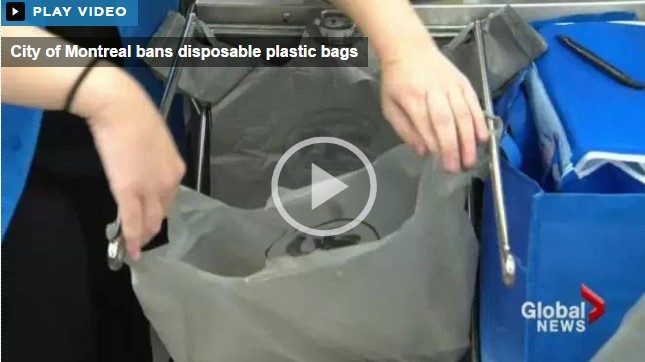
Reduce buying or using single serve water bottles; carry a reusable water bottle. Get and use a cloth bag for your shopping. Increase your sustainability and shrink your EF while you save money. Not much of a sacrifice there.
Bans
How might responses to a water bottle or plastic bag ban be different in an LEDC versus an MEDC?
What responsibility do businesses have to ensure that they do not cause environmental damage in the countries in which they operate? Is this different if it is a local business as compared to a trans-national business?Shelter
Of all of the components of your personal EF this is likely the one you have least control over. You didn’t chose the home you currently live in. Nor did you pick the community. The reality however, is that your home contributes to your EF.
What are the trends around housing that could reduce your EF?
Use these resources to deepen your understanding of what can be done, or done differently, to reduce your community’s EF. If you want to visit any links in the following pdf, right click and select "Open Link in New Tab" to avoid leaving this page.

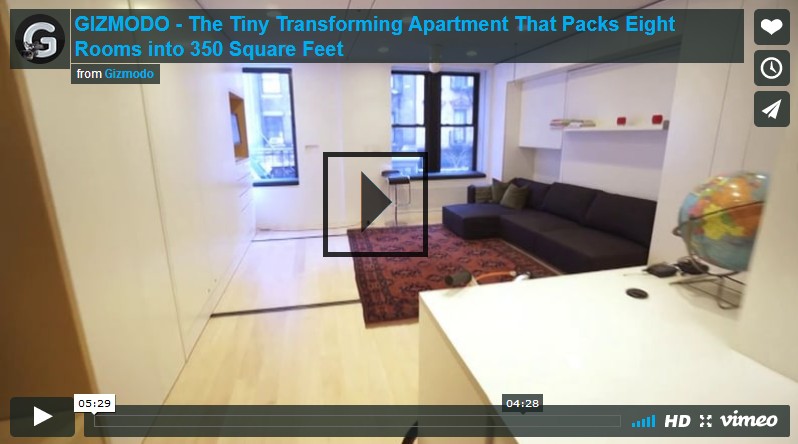
It is never too early to be thinking and planning your future. Could some of these ideas be incorporated into your dream home?
Tiny Homes in Your Community
While there is no doubt that these types of homes result in a lower EP, they are not an exciting prospect for everyone. What would have to be done in your community to make these houses appealing to more people? If you were in charge of promoting this lifestyle to your neighbours, where/how would you start?
Transportation
In a country the size of Canada, transportation infrastructure and systems are critical components of how we live and the size of our EF. What roles and responsibilities do companies and governments have to protect the natural environment they move through? Also when you are shopping for pineapples from Hawaii, or that cute top you found in Walmart that was made in China, do you stop to think about the transportation network that brought it to your community?
Use these resources to deepen your understanding of what can be done, or done differently, to reduce your community’s EF. If you want to visit any links in the following pdfs, right click and select "Open Link in New Tab" to avoid leaving this page.

You know walking or taking public transit are ways to reduce your EF. There are however, times when and places where that isn’t an option. When you think about the food you eat and the stuff you buy, try to think about the transportation for those items. Is there any way to reduce your EF in those situations?
Obligations
Can you (without doing any research) name and speak with confidence about companies who are or are not environmentally responsible? Do you believe the average person can?
What legal and moral obligations do companies have with respect to the environment?
Why is it good for a company to be seen to be environmentally responsible?Energy
You will recall the video from the beginning of this activity. Among other things, the presenter compares our dependence on fossil fuel based energy systems to the system of slavery in pre-Civil War America. The challenge is not just to imagine what a different energy system looks like but also to plan a way to that future (hopefully without the horrors of the American Civil War and its aftermath). A plan must be found if we are to achieve our goal of sustainability.
Use these resources to deepen your understanding of what can be done, or done differently, to reduce your community’s EF. If you want to visit any links in the following pdfs, right click and select "Open Link in New Tab" to avoid leaving this page.



The opportunity exists for individual action but the enormous complexity and interdependence of the current energy system requires collective action: action from governments (local, regional, national and international), businesses and individuals as well. What is the most effective way forward? What is the role of government or the market?
Carbon Tax or Cap and Trade
Which countries may be hesitant to sign a protocol on climate change? Why?
How could an individual or community benefit from either a carbon tax or cap and trade system? ...Or is it just something a company can profit from?
How To Reduce the EF
Consider the following before composing your response:
| I can: | Check |
|---|---|
| ask and respond appropriately to factual, comparative and causal questions; | |
| summarize and use evidence from different sources to reach and support a conclusion; | |
| communicate my ideas in a written, visual or audio format; | |
| state specific examples of effective (start/continue) and ineffective (stop) agreements; | |
| list who is responsible for sustainable practices at the individual, community, national and international level; | |
| provide examples of effective and ineffective government and local policy/program/initiative for each of the 5 Ecological FootPrint Components; | |
| explain why these examples are effective (should start or continue) or ineffective (be stopped). |
From all the suggestions in each of the 5 EF components (food, goods and waste, energy, transportation, shelter) you were asked to consider some strategies that would reduce the EF. Specifically identify a strategy that you feel should be:
-
“Stopped” and explain why.
-
“Started” in more places and explain why.
-
“Continued” and your reasons why.
Remember to consider the credibility of the sources. Be ready to communicate your thinking with accuracy, even citing a specific article, website, video or infographic.

 Best Way Forward
Now that you have all of the information, it's time to recommend our “best way forward” to a smaller EF and greater sustainability.
-
You may use the table provided to summarize your thoughts or write a series of paragraphs for your stop, start, continue recommendations.
- Also provide a rationale for your recommendation Stop, Start, Continue list.
| Stop | Start | Continue | |
|---|---|---|---|
| Name and describe the Policy, Program or Initiative. | |||
| Why do you think that? Provide your rationale or opinion. | |||
| How do you know this is true? Provide 2 pieces of supporting evidence. | |||
| Tell me more. Add an alternative piece of data or resource point that supports your opinion. | |||
| What questions do you still have? Offer a question you would have about the outcome of the change. |
Position Paper - Interview
During this unit, you have also been working on conducting research for your position paper.
You will also choose any 5 of the 10 questions below to answer along with your completed essay outline and submit this to your teacher. Proceed with your final essay only when you have received feedback on your outline.
-
What are your three arguments?
-
Are these arguments supported with evidence that is not used for another argument?
-
Do your arguments relate closely to your position?
-
Are there connections between the arguments and evidence?
-
Does the evidence build on the arguments or overlay ideas?
-
What has been your most useful resource?
-
When was the resource written/published? Is the resource still relevant?
-
Did your resource use at least three different other resources?
-
What challenge did you encounter during your research?
-
Did your position of an issue change due to your research?
 Introduction
 Learning Goals
 Learning Skills
 Rubric 1