
CHY4U
World History Since the Fifteenth Century
Unit 2: 1650 - 1789: What's Worth Fighting For?
Activity 3: Innovation and Origins of Industrialization

India has produced cotton for thousands of years. It is still a big producer of cotton today, but Indian cotton farmers are facing several challenges. Watch the video below to learn more about these challenges, but keep in mind that, historically, the production and sale of cotton has generated tremendous wealth.
 Cotton in India Today - Progress and/or Decline?
After you watch the video, reflect on the following questions:
- Which groups in the Indian cotton industry are experiencing progress?
- Which groups are experiencing decline?
- How did you make this determination?
- What questions does this video raise about the historic cotton industry?

|
Trade (including the slave trade) brought greater wealth to 17th century Britain. This wealth gave rise to consumerism, which occurs when the wealth in an economy is generated by the constant buying and consumption of goods by the public. For the first time, the “middling”, those between the rich aristocrats and the destitute, had disposable income. Increasingly, this group spent this income on specialized furniture, porcelain from China, and clothing items, like undergarments, previously worn only by the rich. One of the keys to the rise of this new middle class with a consumer culture was the availability of cotton. The East India Company brought cotton goods to Britain from India, where cotton had been harvested for thousands of years. Before the East India Company’s access to Indian markets, cotton was a rare and valuable commodity in Europe. Indian cotton, however, was cheap and plentiful. It could be decorated with intricate designs at the fraction of the cost of other methods, providing consumers with plentiful options for clothes and bedding. Unfinished cotton, which had a rough, uncoloured look, was an even cheaper alternative for the poor. |
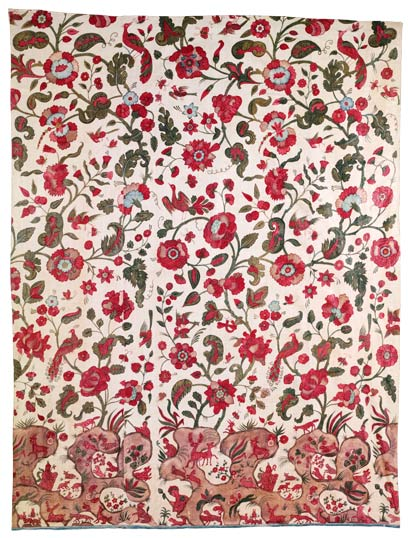
This is a piece of painted cotton from 17th century India, intended for British markets.
However, cotton was not welcomed by everyone. Indian cotton arrived in Britain in the form of garments and cloth, meaning that production was handled by skilled Indian labour, not British workers. Growing cotton in the American colonies was possible thanks to weather conditions and slave labour, but the colony lacked the means to effectively produce cloth; thus, Britain consumed Indian cotton instead, with most profits going to the East India Company and India.
Wool, the traditional material for most European clothing, was heavily impacted. Wool producers in Britain were unable to compete with cotton, which was cheaper, decorative, and comfortable. Concerned about their livelihood, they petitioned the crown for protection for their products. Below is an excerpt from one of The Burial in Woollen Acts (1666-1680), these were a series of Acts of Parliament in England.
And it is hereby enacted [...] that from and after the first day of August 1st 1678, no corpse of any person or persons shall be buried in any shirt, shift, sheet or shroud or any thing whatsoever made or mingled with flax, hemp, silk, hair gold or silver or in any stuff or thing other than what is made of sheep’s wool only or be put in any coffin lined or faced with any sort of cloth or stuff or any other thing whatsoever that is made of any material but sheeps wool only upon the pain of forfeiture of five pounds of lawful money of England to be recovered and divided as is hereafter in this Act expressed and directed.
While it is extremely difficult to calculate the value of 17th century currency in the 21st century, a conservative estimate would put the value of 5 pounds in 1678 to well over $1000 Canadian.
How Could This Happen?
The Burial in Woollen Acts were followed by the Calico Acts in (1690-1721) which banned cotton imports altogether. However, less than a century later, cotton would be the key component in Britain’s Industrial Revolution. How could this happen? After you have examined the timeline below, you will use the Say Something prompts to address this question.
- Highlight a key idea or point
- Ask a question
- Clarify something you misunderstood
- Make a comment or observation
- Make a personal connection
- Make a prediction
Progress or Decline?
In the second half of the eighteenth century, a number of innovations fundamentally changed production in Britain. In the timeline below, you will be introduced to several key inventions from this era. As you examine each invention, add to the timeline by dragging relevant groups to the areas above or below the timeline: the area above the timeline is for those who benefited from the invention, while the area below is for those who suffered because of the invention.
How did it happen?
The repeal of the Calico Acts and the new production methods fundamentally changed the cotton trade. Britain could circumvent Indian production entirely by importing cotton picked by slaves in the colonies and refining it in British factories. This created a closed loop through which Britain controlled the acquisition of the resource, the transportation of the resource, its production into goods, and finally its sale in various markets. This loop was the backbone of the Industrial Revolution, leading to unprecedented economic growth in Britain. Even after the American War of Independence, this trade was so profitable that cotton shipments continued to fill British vessels. However, as you will see in Unit 3, these changes were not beneficial for all.

In this activity, you have learned about how cotton, a cheap and versatile fabric, set the stage for the Industrial Revolution. You also had two opportunities to generate questions that would help you investigate cotton’s impact in more detail. Finally, you also considered how the growth of the cotton industry in Britain could mean progress for some but decline for others.
 Inquiry Question: Cotton and Britain
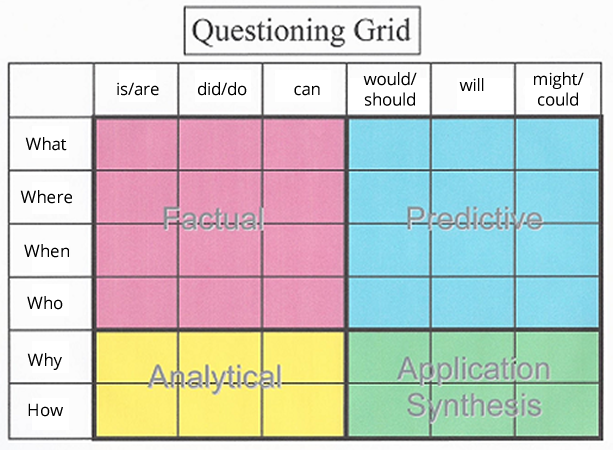
Using the Question Grid below, generate one inquiry question that you could use to further your learning about the impact of cotton on 18th century Britain.
 Your What is Worth Fighting for? Question
Think about what you have learned in this activity.
Who was fighting for what?
Generate and save 1 or 2 inquiry questions to your Portfolio based on your learning in this activity.
 Introduction
 Learning Goals and Success Criteria
 Learning Skills
 Rubric 1