
Fundamentals of Economics
Growth and Sustainability

MINDS ON
When you think about a traditional classroom, a common object found there is a chalk brush like the one below. While it is a very simple object, there are many steps in producing and delivering it to the chalkboard ledge in a classroom.

 Brainstorm
Create a step by step plan that ended with that chalk brush in a classroom.
Hint: think about the materials that make up this product.
To get this chalk brush to your classroom, a lot of factors were required. Organize them into some sort of categories.
Factors of Production
What do you think about when you hear the word productive? Perhaps a teacher or parent asks if you were being productive? In economics, productive resources are an important concept, which means anything that can be used to create or manufacture valuable goods or services. They are also known as the factors of production. The factors of production are land, labour and capital.
- Land - includes not just the soil, but resources found in or below the surface of the earth such as mineral deposits, groundwater, fossil fuels.
- Labour - includes not just physical labour, but also mental effort and entrepreneurship.
- Capital - refers to goods that aid in the production of other goods and services, such as factories, warehouses, machinery, (real capital), but also the money available to acquire these goods, called money (or financial) capital.
 Land, Labour, Capital
Below is a table showing examples of each of the factors of production. Add one example for each factor or suggest an alternative argument.
| Land | Labour | Capital |
|---|---|---|
|
Oil discovery offshore Newfoundland |
Auto workers in Windsor |
New electric transport trucks |
|
Wineries in southern Ontario |
Foreign workers in agricultural areas |
Highspeed wifi in all workplaces |
|
? |
? |
? |

ACTION
Externality
Externality - An impact, positive or negative, on any party not involved in a given economic transaction or act.
A positive externality (also called "external benefit" or "external economy" or "beneficial externality") is the positive effect an activity imposes on an unrelated third party.
Similar to a negative externality, it can arise either on the production side, or on the consumption side.
|
Negative Externalities |
Positive Externalities |
|---|---|
|
Air pollution from burning fossil fuels. |
Education which helps individuals and also provides an improved workforce for businesses. |
|
Climate change as a consequence of greenhouse gas emissions from burning oil, gas, and coal... |
Walking to work which is good for a person’s health and budget and reduces greenhouse gas emissions. |
|
Water pollution by industries that adds effluent, which harms plants, animals, and humans. |
A person may keep bees for her own enjoyment, but gardeners in the area benefit because their flowers are pollinated. |
Analysing Externalities
Answer ONE of the following:
- What negative externalities are associated with the tobacco industry? Who bears the costs associated with these externalities? What are some government policies that attempt to reduce these costs?
- What are the positive and negative externalities associated with constructing dedicated bicycle lanes in a city?
Reflection
Look at the cartoon below and watch the short video about the Kitimat LNG pipeline project. As you look and watch, make notes using the following questions:
| Primary Questions | Secondary Questions |
|---|---|
|
|
|
|
|
|
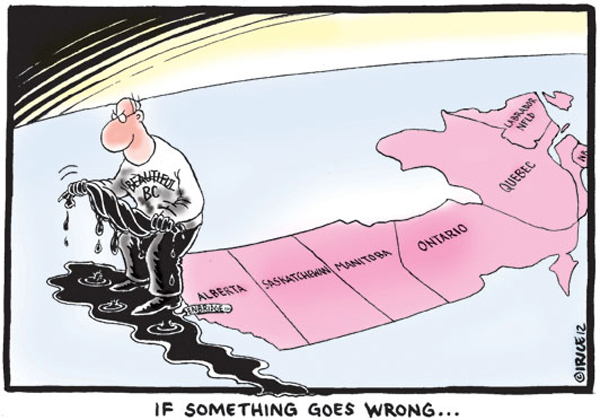
 Analysing Costs and Benefits
For the following article, highlight all economic concepts (create a note):
- Identify the various economic stakeholders and economic perspectives.
- Identify the impact of socio-economic/cultural issues and externalities.
- Demonstrate economic concepts by challenging evidence with data from other sources (fully sourced).
- Using the information provided, create at least one supply/demand graph to explain a concept/event.
- Check for updates since article was published (e.g., new policies/events).
If you want to view any links in this pdf, right click and select "Open Link in New Tab" to avoid leaving this page. (View the original article.)

CONSOLIDATION
Sustainability
Respond to ONE of the following:
- What are the implications of the scarcity of land for economic development?
- What might be the long-term effect if land is not used in a sustainable way?
- What are some ways in which governments try to ensure that there are enough skilled workers to support economic development?
Externalities
Respond to ONE of the following:
- What positive and negative externalities are associated with mining in the Circle of Fire in Northern Ontario? Who bears the costs associated with these externalities? What are some government policies that attempt to reduce these costs?
- What are the positive and negative externalities associated with closing nuclear power plants in Ontario?
 Learning Goals and Success Criteria
 Learning Skills and Work Habits