
Global Interdependence and Inequalities
Theories and Models of Trade

MINDS ON
In this activity, we are thinking about the world outside of Canada, and the economic and social impact of the relationships we have with other countries. If you look at your clothing labels, what do you notice? Where did the clothes you are wearing today come from? How did they get here?
To review, imports (M) are goods/services that are consumed in one country, but are produced in other countries. Exports (X) are goods/services that are produced in one country and are sold and shipped to purchasers in another. A good/service sold as an export by one country is purchased as an import by another.
 Import/Export
Goods are visibles, services are invisibles. For example, if your cousin from the United States came to Toronto to watch a baseball game, their purchase of a baseball ticket is invisible, but money came to Canada, so it is an export (invisible).
What would each of the following be? Answer in your notes using this worksheet which is the same as the table below.
|
|
Import or Export |
Visible or Invisible |
|---|---|---|
|
Dividends from American stock investment |
|
|
|
Purchase of maple syrup in Quebec by resident of Maine |
|
|
|
Canadian purchases new camper in New York |
|
|
|
Canadian travels to Florida for holiday. |
|
|
See, Infer, Wonder
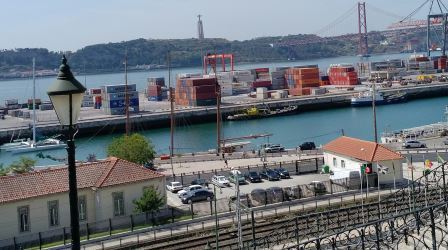
Look at the photo above. What do you SEE? What do you INFER(definition:Means to conclude from your reasoning, using evidence.)? What do you WONDER (what questions do you have)? Use an organizer like the one below to take notes.
|
What do you SEE? |
What can you INFER? |
What questions do you have? |
|---|---|---|
|
|
|
|
 Trade in My Community
Find another photo (one that you have taken or on the Internet) that shows how trade is part of a community; include the source/photographer. Reflect how trade benefits or harms the community.

ACTION
Economic Thought: David Ricardo
“
The same rule which regulates the relative value of commodities in one country, does not regulate the relative value of the commodities exchanged between two or more countries. Under a system of perfectly free commerce, each country naturally devotes its capital and labour to such employments as are most beneficial to each. This pursuit of individual advantage is admirably connected with the universal good of the whole. By stimulating industry, by regarding ingenuity, and by using most efficaciously the peculiar powers bestowed by nature, it distributes labour most effectively and most economically: while, by increasing the general mass of productions, it diffuses general benefit, and binds together by one common tie of interest and intercourse, the universal society of nations throughout the civilized world. It is this principle which determines that wine shall be made in France and Portugal, that corn shall be grown in America and Poland, and that hardware and other goods shall be manufactured in England. In one and the same country, profits are, generally speaking, always on the same level; or differ only as the employment of capital may be more or less secure and agreeable. It is not so between different countries. If the profits of capital employed in Yorkshire, should exceed those of capital employed in London, capital would speedily move from London to Yorkshire, and an equality of profits would be effected; but if in consequence of the diminished rate of production in the lands of England, from the increase of capital and population, wages should rise, and profits fall, it would not follow that capital and population would necessarily move from England to Holland, or Spain, or Russia, where profits might be higher.
~ David Ricardo, Chapter seven, The Principles of Political Economy and Taxation, 1817
If you want to view any links in this pdf, right click and select "Open Link in New Tab" to avoid leaving this page. (View the original article.)
Why trade?
Before we learn about economic theories, what is Canada’s trading relationship with the world? In Economics, there are many theories and models, which are used to explain economic concepts. Your task is to understand why countries trade. Watch this video to identify arguments why trade is good for economies.
Why trade?
What is the most important argument for trade? Think of a relevant example for Canada.
Arguments Against Trade
Even though there are sound economic arguments for trade, there are also arguments against trade.
Protectionism represents any attempt to impose restrictions on trade in goods and services.
 Barriers to Trade
Using the Barriers to Trade Worksheet, show the impact on aggregate supply and aggregate demand, and explain the effect on GDP, unemployment and inflation for each of the barriers to trade.
Case Study
Read the following case study, and determine which trade barriers apply.
If you want to view any links in this pdf, right click and select "Open Link in New Tab" to avoid leaving this page. (View the original article.)
The Key Stakeholder
Record your ideas from the role of a key stakeholder who wants to settle the issue.
Extend Your Learning
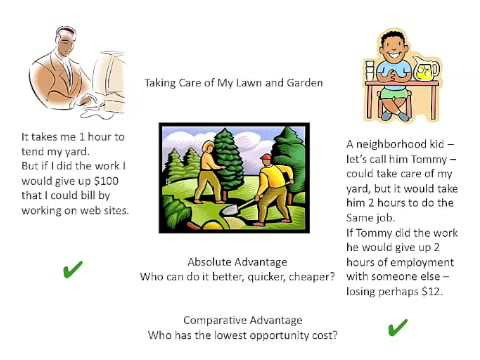
As you have seen throughout this course, economists often use mathematical examples to illustrate theories. This is also true of the argument for trade. In the opening, you learned about Ricardo’s theory of comparative advantage. He noted that while one country may be able to produce all of its needs, it may incur a high opportunity cost to do so. Let’s take the example of Canada and Brazil. Brazil is the second largest producer of bananas globally and Canada is a large producer of steel. Each of these countries could produce both products, but at what (opportunity) cost? It is better for them to produce one of these products and trade for the other, but let’s prove it mathematically. The chart below shows the total production each country could produce if each country were to produce only these 2 goods using all of their resources. Canada has an absolute advantage in the production of both goods, so it would seem they don’t need to trade, but let’s look more closely.
|
Country |
Bananas (tonnes) |
Steel (tonnes) |
|---|---|---|
|
Brazil |
10,000 |
1,000 |
|
Canada |
12,000 |
6,000 |
Canada is able to produce more of each good, but when we look at the opportunity cost, there is a difference. We want to look at the ratio of steel to bananas to see the opportunity cost.
For each tonne of steel that Brazil produces, they give up 10 tonnes of bananas (10,000/1,000 = 10) while Canada only gives up 2 tonnes of bananas (12,000/6,000 = 2).
On the contrary, for each tonne of bananas Brazil produces, they give up 0.1 tonnes of steel (1,000/10,000 = 0.1) while Canada gives up 0.5 tonnes of steel (6,000/12,000 = 0.5).
Thus, Canada has a higher opportunity cost when producing bananas and Brazil has a higher opportunity cost in producing steel. It makes sense for Brazil to produce bananas and Canada to produce steel then trade. By moving the resources currently used for the product that is less efficient to the more efficient one, there will be more of each product produced.
Should They Specialize and Trade?
Using the data below, should these countries specialize and trade? Prove your answer mathematically.
|
Country |
Oranges
|
Cars |
|---|---|---|
|
Canada |
1,000 |
2,000,000 |
|
USA |
2,000 |
5,000,000 |
Fair Trade
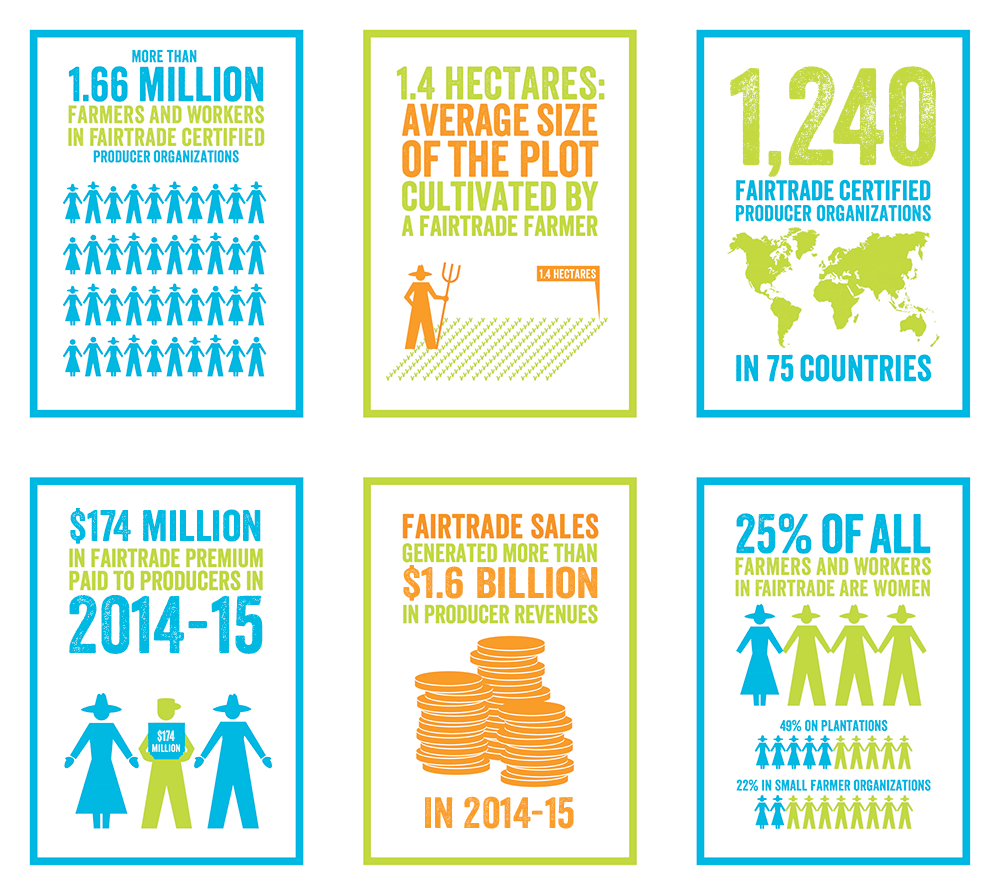
Almost 7,000 products from coffee to flowers are Fairtrade certified in Canada, so when you shop, look for the FAIRTRADE mark.
Fair Trade
Take a look at the FairTrade website: fruits and vegetables, chocolate and cocoa, coffee, tea, sugar, flowers, nuts, oilseeds and coconut, cotton, sports balls, herbs and spices, gold, or wine. Choose one of the Fair Trade products.
As you read about your product, take notes as follows:
- what connections can you make,
- the Most Important Points, and
- your Questions.
Fair Trade
Reflect on this questions: To what degree are Fair Trade products a barrier to trade.
Exchange Rate
The exchange rate is the value of one currency for the purpose of conversion to another. If you travel to another country, and you want to purchase any goods/services, you need to use the currency of the country you are in. Before you go, you would exchange Canadian dollars into the currency of your destination. You can do this at a variety of financial institutions. The value of a currency changes, compared to another, depending on market forces (supply and demand). If the currency varies depending on the market, it is called a floating rate. Sometimes, countries will not allow the exchange rate to float, and choose to have a fixed exchange rate.
The Impact of the Exchange Rate
How does the exchange rate impact trade? The economy? Use the sources below to answer these questions.
Read this article, At 80 US cents, the loonie is up 10% since May: Who wins and who loses? from Global News (Original article)
If you want to view any links in this pdf, right click and select "Open Link in New Tab" to avoid leaving this page. (View the original article.)
If you want to view any links in this pdf, right click and select "Open Link in New Tab" to avoid leaving this page. (View the original article.)
If you want to view any links in this pdf, right click and select "Open Link in New Tab" to avoid leaving this page. (View the original article.)
The Impact of An Appreciation
Explain the impact of an appreciation (definition:an increase in the value of an asset over time. The increase can occur for a number of reasons, including increased demand or weakening supply, or as a result of changes in inflation or interest rates.) of the Canadian dollar on imports and exports.
Trade Agreements
Trade between nations is an important part of world economies. Many countries and regions enter into agreements to enhance trade and boost their domestic economies. You will have the opportunity to investigate several trade agreements that Canada has signed with different nations.
You will be examining several major trade agreements to determine economic significance. The focus is not just on defining/explaining, but on analysing the significance to Canada of these selected trade agreements.
 Practice
Use the checklist below to analyse the NAFTA infographic. For each criteria give a score of 1-5 with 1 being poor and 5 being excellent.
|
NAFTA Infographic Effectiveness Scale |
||||||||
|---|---|---|---|---|---|---|---|---|
|
Criteria |
Poor
|
|
|
|
Excellent
|
|||
|
Highlights a great deal of reliable and interesting data. |
|
|
|
|
|
|||
|
Focuses on important or relevant topic. |
|
|
|
|
|
|||
|
Presents information simply (and visually). |
|
|
|
|
|
|||
|
Creatively visualizes data and information. |
|
|
|
|
|
|||
|
Focuses on one topic. |
|
|
|
|
|
|||
|
Uses accurate and current statistics visually. |
|
|
|
|
|
|||
|
Provides sources (credibility is important). |
|
|
|
|
|
|||


CONSOLIDATION
Candlestick Makers' Petition
Using the source below, prepare a response for Canada in the 21st century. Include evidence from this module to support your arguments.
Candlestick Makers' Petition
Frederic Bastiat (1845)
We are suffering from the ruinous competition of a rival who apparently works under conditions so far superior to our own for the production of light that he is flooding the domestic market with it at an incredibly low price; for the moment he appears, our sales cease, all the consumers turn to him, and a branch of French industry whose ramifications are innumerable is all at once reduced to complete stagnation. This rival, which is none other than the sun, is waging war on us so mercilessly we suspect he is being stirred up against us by perfidious Albion (excellent diplomacy nowadays!), particularly because he has for that haughty island a respect that he does not show for us.
We ask you to be so good as to pass a law requiring the closing of all windows, dormers, skylights, inside and outside shutters, curtains, casements, bull's-eyes, deadlights, and blinds — in short, all openings, holes, chinks, and fissures through which the light of the sun is wont to enter houses, to the detriment of the fair industries with which, we are proud to say, we have endowed the country, a country that cannot, without betraying ingratitude, abandon us today to so unequal a combat.
Source: bastiat.org
 Learning Goals and Success Criteria
 Learning Skills and Work Habits