
CLN4U
Canadian and International Law
Unit 5: International Legal Issues
Activity 1: Protecting the Environment?


North Korea is highlighted in red.
Free World Maps
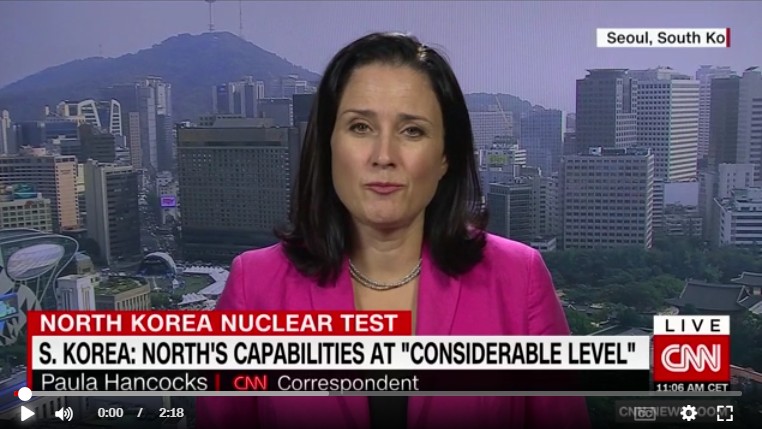
On September 10th, 2016 CNN reported North Korea claims successful test of nuclear warhead. Please watch the video and read the article that accompanies it.
 Check Your Understanding
What type of sanctions has the international community imposed upon North Korea?
AnswerThe sanctions included banning Pyongyang from exporting most of its natural resources, prohibiting the supply of aviation fuel and the sale of small arms to North Korea, and requiring the inspection of all North Korean planes and ships carrying cargo abroad.
This issue is of grave concern to the world community as it threatens stability and peace. In 1968 the world signed the Treaty on the Non-Proliferation of Nuclear Weapons (NPT).
The NPT is a landmark international treaty whose objective is to prevent the spread of nuclear weapons and weapons technology, to promote cooperation in the peaceful uses of nuclear energy and to further the goal of achieving nuclear disarmament and general and complete disarmament. The Treaty represents the only binding commitment in a multilateral treaty to the goal of disarmament by the nuclear-weapon States.
Despite the fact that 190 countries have signed the agreement, including states that possess nuclear weapons, North Korea continues to develop nuclear technology.
Governments around the world are struggling to create a plan; foreign policy or legislation, to cope with this type of threat. Several years ago the United Nations passed a resolution to impose sanctions against North Korea. In 2006 North Korea began to expand its nuclear program. The sanctions have been increased over the years as North Korea continued to test weapons.
As a member of the UN and a signatory to the NPT, Canada is obliged to create laws that are in keeping with the goals of the United Nations. In Canada, the United Nations Act, allows for Canada to create regulations that are in accordance with our responsibilities to the United Nations. One example of such regulations would be the sanctions imposed against North Korea.
Read the following from the Government of Canada Global Affairs website. Ask yourself:
- What is the purpose of these specific sanctions?
- What do the countries hope to achieve?
Though the concerns around this issue centre upon global security, there are profound environmental implications as well. Have a look at this presentation. It presents necessary background information on the health and environmental effects of the production, testing, and use of nuclear weapons.
 Extend Your Learning
Want to know more? Have a peek at the Legacy of Nuclear Testing.
 What do you think?
Take a close look at the actions of North Korea, the sanctions created by the international community, including Canada, and the impact upon humans and the environment. Please consider the questions below:
- What is Canada hoping to achieve by implementing these sanctions?
- Why would some exemptions be made? (Hint: Connect to international humanitarian law.)
- Considering all of the sanctions already in place, what other options do you think the world community has to consider in order to address the concerns regarding North Korea? What are some of the dangers involved if stronger measures were used?
- Of the human and environmental threats, which concern you the most? What actions would you like to see taken by individuals, groups, the Canadian government and the world community to address the issue?


GFDL CC-BY-SA-3.0 or
CC BY-SA 2.5-2.0-1.0,
via Wikimedia Commons
Problems and disputes among nations can be addressed through peaceful means such as the creation of international law that is binding upon those who ratify the agreements. Sometimes it can be very challenging to compromise or agree upon a course of action to solve a difficult problem. As you discovered in the North Korean example, sometimes different nations choose not to follow the agreements. Participation in these agreements is voluntary.
Fortunately, there are many ways to come to an agreement over disputes caused by such issues as trade, use of resources or environmental protection.
Non-judicial means of dispute resolution; negotiation, mediation and conciliation, and judicial means; arbitration and adjudication, are peaceful methods of dispute resolution. They are used in a variety of ways in both domestic and international law. Sometimes you will hear it called Alternate Dispute Resolution because the solutions are often found outside of a traditional court. ADR can save both time and money.
Imagine that you have a dispute with a friend.
- Your first course of action would be to deal directly with your friend. It is an inexpensive and direct method of solving a problem. This is negotiation.
- Should you not be able to approach the situation on your own, you may choose to invite another person who is impartial. This person can meet with each side individually to create a mutually acceptable solution to the problem. This is mediation.
- Perhaps your dispute with your friend has escalated to deep resentment, tension, threats or perhaps violence. You and your friend may be referred to a group of people who will hear both sides and offer a solution. The solution is non-binding. This is conciliation.
All of the above methods of dispute resolution happen informally. In these non-judicial methods, each party has control over the outcome and solutions can generally be solved quickly. Nations use these methods frequently.
Other problems require a judicial, or more formal, process. Arbitration (A form of alternative dispute resolution (ADR) is a technique for the resolution of disputes outside the courts. The parties to a dispute refer it to arbitration by one or more persons.) and adjudication (This is the legal process by which an arbiter or judge reviews evidence and argumentation, including legal reasoning set forth by opposing parties.) are examples of judicial methods of dispute resolution. Once the process has begun and the states have agreed to participate, the parties are obligated to follow through to the end. The solution in each is binding upon the parties or states.
Though neither these methods nor sanctions have worked with regards to nuclear testing in North Korea, there are many instances in which they have been used effectively.
ADR is one method of solving disputes, what are our other options? Let's look at environmental issues. What is another way to address our shared concerns?
Some people argue that the world needs a specialty court to adjudicate environmental issues. The International Court for the Environment Coalition, for example, is promoting such a court because
(1) A specialized judiciary is more likely to understand and apply scientific evidence effectively, as it relates to the substance of transboundary environmental disputes, than a general international court or tribunal; and
(2) states, but also non-state actors, should be given standing to bring cases against states for alleged non-compliance with international legal obligations.
Click on each green bar below to find out more about possible solutions for environmental problems.
Humans are hard-wired to respond to threats we can sense. We’re not so good at responding to threats we can’t see, hear or touch: Pollution of air and water, toxic chemicals in products we buy, climate pollution.
Data has a long history of leading to environmental solutions. But sophisticated, inexpensive sensors are making the invisible visible, and have the potential to help solve some of our toughest environmental challenges.
1980s: Illuminating the cause of acid rain
Thirty years ago, taller smokestacks on the east coast were reducing local air pollution. But an unexpected byproduct was killing forests and aquatic life — acid rain.

Some people said that too little was known about the causes of acid rain to warrant doing anything. EDF scientists responded by assembling multi-year data on smokestack emissions and comparing the up-and-down pattern with acid rain data.
An irrefutable correlation emerged, helping to break the policy logjam in Washington. In 1990, Congress passed a law to cut acid rain pollution in half.
To do this analysis in the 1980s, the scientists needed to take over EDF’s entire computer system. “Today,” one of the scientists said, “I could do it all on my phone!”
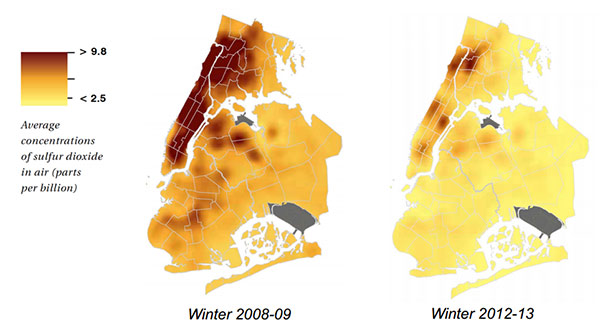
2008: Cleaning up New York City’s air
Nearly a decade ago, dozens of volunteers fanned out across New York City wearing backpacks with instruments to measure air pollutants. Unlike the few stationary rooftop monitors installed at the time, they took measurements near eye level and followed routes typical of an older adult’s day or a child’s walk to school.
The study led to more research that revealed a surprising new finding: just 1% of New York City’s buildings were spewing more soot into the air than all the city’s cars and trucks combined.
EDF worked with then-Mayor Michael Bloomberg on a program called Clean Heat, which uses private financing to help building owners convert to cleaner fuel.
Six thousand buildings have made the upgrade and now, New Yorkers breathe visibly cleaner air.
2010: More data means smarter energy choices
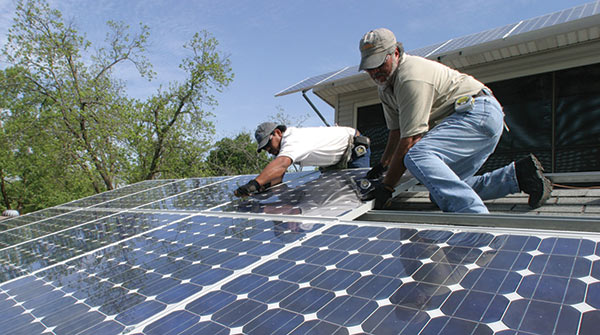
Meter readers used to check your energy consumption once a month. Now, smart meters check every 15 minutes.
In Austin, Texas, EDF’s Pecan Street smart grid project takes residential energy monitoring even further with sensors that take measurements every 15 seconds. This project yields the largest database of energy use on the planet.
When the Texas Advanced Computing Center analyzed this data, they discovered a simple change to solar panel installation would increase efficiency. In the summer, electricity demand peaks in the late afternoon as people return home and turn up the air conditioning. Even though south-facing solar panels produce more total energy, their energy output drops in the afternoon. Western-facing panels better match supply with peak demand.
The more we know about energy use, the more efficient we can make our electric grid.
2013: How do you plug a gas leak you can’t see?
Methane is responsible for one-quarter of the global warming we’re experiencing today. While you may associate methane with cows, leaks in our natural gas system are actually a huge source of methane emissions.
Many methane leaks are easy and cheap to fix — if you know where they are.
In these side-by-side pictures, an infrared sensor shows what the naked eye can’t: A large cloud of methane escaping from a wellhead.
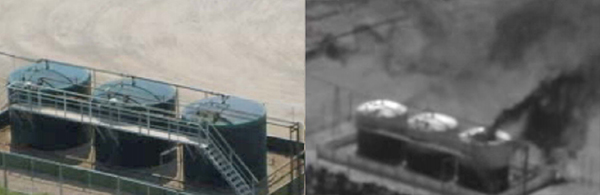
Photo Credit: TCEQ
Over the past two years, EDF has coordinated a series of studies to pinpoint where methane is leaking, including a global competition to design inexpensive detectors—essentially smoke alarms—for these invisible leaks.
Today, natural gas well pads are checked a few times a year, at best. Imagine how much pollution we could prevent if detectors scanned continuously for leaks on every well pad.
2014: Mapping methane leaks with Google
EDF has partnered with Google Earth Outreach to track methane emissions from natural gas distribution pipelines by attaching detectors to Street View cars. Unlike conventional methods for measuring leaks, which are slow and cumbersome, our method can take city-wide surveys to determine the combined climate impact of these leaky pipe systems.
We’ve produced maps that have made this previously invisible source of climate pollution all too apparent.
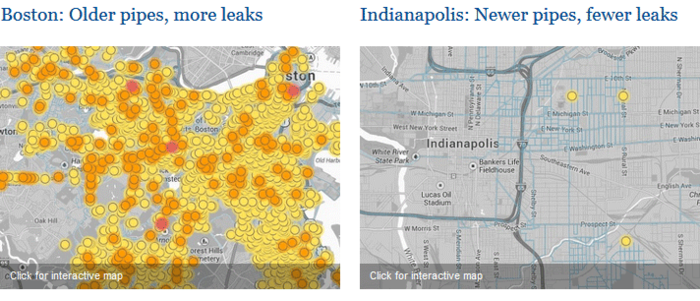
In Boston alone we found more than 2,300 leaks—one leak per mile we drove. Just one of the high-level leaks emits roughly 60,000 liters of natural gas each day. Compare that with Indianapolis, which has replaced its older pipes, where we detected just one leak per 200 miles driven and all leaks were low.
2014: Treat your asthma while tracking pollution
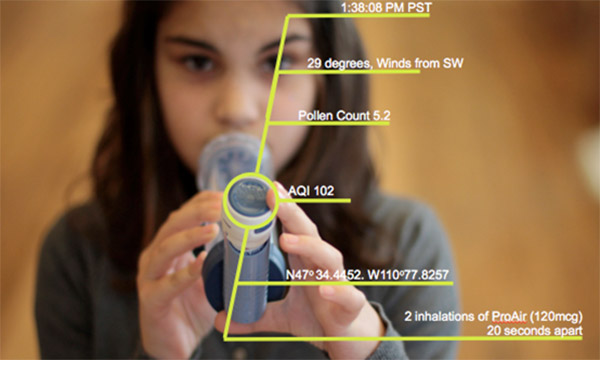
Photo Credit: Propeller Health
The city of Louisville, Kentucky, is equipping inhalers with GPS units that send a signal whenever they’re used. Patterns in this data can help us identify asthma hotspots.
In the future, if Louisville gets more street-level air quality monitors, the inhaler usage data could be mapped against neighborhood air pollution, spurring action to reduce the pollution.
Mom’s Clean Air Force is a network of 500,000 parents that are fighting for air pollution limits. Imagine if these parents had data in their hands that directly connected asthma attacks to air pollution in cities across the U.S. when they met with EPA administrators and lobbied on Capitol Hill. The need for cleaning up our air would be hard to refute.
2015: Wearable sensors detect toxic chemicals

This year, EDF conducted a pilot project to show how wearable sensors can illuminate unseen chemicals, many of them hazardous, all around us. Simple silicone wristbands act like sponges, capable of detecting up to 1,400 different chemicals that people might come in contact with in their environment.
The results were troubling. The 28 participants, many of whom already take steps to avoid chemicals in everyday products, each came in contact with an average of 15 chemicals. Many of the chemicals are known to have hazardous health effects, from negative reproductive effects to cancer.
I can tell you, I certainly didn’t spray any flame retardant on myself, but there it is on the wristband, triphenyl phosphate.”
What if these sensors were as ubiquitous as fitness trackers? That data would be a powerful tool in our fight to remove toxic chemicals from our environment.
The future: Many more sensors to come
There are countless other examples of sensor technology in the works that can help solve a host of environmental challenges:
- Water meters that detect leaks
- Traffic sensors to help reduce congestion
- Real-time fishing data radioed from ship to shore, to help manage catch limits
- GPS-enabled tractors that could prevent farmers from using too much fertilizer
- Wearable air pollution sensors that would crowdsource pollution hot spot data
- Imagine how powerful the new world of information will be when low-cost sensors can provide data directly to citizens and advocacy groups.
The ICE Coalition organize and participate in public lectures, collaborate on projects with different groups, and meet with stakeholders representing many different interests in the international legal order.
Read some of the articles and working papers The International Court of the Environment (ICE) has produced over the years to get a sense of how we envisage an international court for the environment contributing to a more effective international environmental rule of law.
They propose several different templates for an ICE that are built on two guiding principles:
- Needs to be specialized so the judiciary is more likely to understand and apply scientific evidence effectively, and
- states, but also non-state actors, should be given standing to bring cases against states for alleged non-compliance with international legal obligations.




 Did You Know?
 Introduction
 Learning Goals and Success Criteria
 Learning Skills
 Rubric 1