
EWC4U
Unit 2: Narrative Fiction
Activity 4: Analysing and Acknowledging Authors

The greatest part of a writer’s time is spent in reading; in order to write, a man will turn over half a library to make one book.
 Did You Know?
How many books have you read? Do you keep count? What would you guess the number is? Have you ever wondered how many books have been published?
Well, according to a relatively recent Google algorithm, over 130,000,000 books have been published! That’s certainly too many to read in one lifetime. However, if you’ve ever wondered at what point in human history there were too many (English) books to be able to read in a person’s lifetime then you’re in luck! Check out Reading Every Book.
The Epic of Gilgamesh
Do you remember the first story that was ever read to you? Or the first story you ever read? Whether we know it or not, the stories we hear and read influence who we become. Indeed, according to Owen Flanagan of Duke University, a leading consciousness researcher, “[e]vidence strongly suggests that humans in all cultures come to cast their own identity in some sort of narrative form. We are inveterate storytellers.”
One of the first (surviving) great works of literature is the Epic of Gilgamesh. Discovered on clay tablets in the 19th century, but dating back to 2100 BCE, this epic story tells the tale of a warrior-king named Gilgamesh who struggles to discover the secret of immortality. While this might seem like a simple quest narrative, embedded within it are insights into how the Ancient Sumerians addressed complex concepts such as:
- the roles of men and women;
- the importance of civilization, and the sacrifices required to be a part of it;
- our relationship with nature;
- our fear of death and curiosity about the afterlife;
- the dangers of arrogance;
- the importance of friendship; and
- social structures and hierarchies.
Ultimately, like so many stories, it attempts to answer these four questions.
- Who are you/we?
- What do you/we want?
- Why are you/we here?
- Where are you/we going?
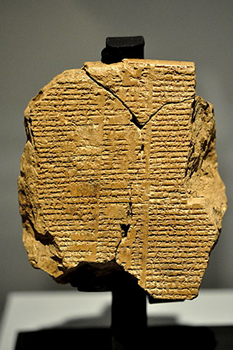
Reading in ancient times was a lot ‘heavier’ than it is today!
Wikimedia
 Writer’s Notebook
As you continue your own writing journey, it’s important to remember what came before. Not only does the past provide insight into ourselves, but also, it allows us to build on and add to a rich, vibrant literary legacy! How many unique stories can there be? Grab your Writer’s Notebook and, if you choose, start the timer below. Write down as many types of stories as you can (for example, the Hero Journey)! If you're working on a tablet, click here to open the following interactive in its own window instead of using the embedded version below.
Now take a look at what you wrote.
- Can you see any patterns?
- Are they similar or varied?
- Did they have a common style or genre?
- What does this tell you about how you understand stories?

One, Finite, or Infinite?
Writers and academics often discuss (sometimes argue) how many original stories there can be. For some, the answer is simple: one.
Famed author John Steinbeck once proclaimed, “I believe that there is one story in the world, and only one. . . . Humans are caught—in their lives, in their thoughts, in their hungers and ambitions, in their avarice and cruelty, and in their kindness and generosity, too—in a net of good and evil. . . . There is no other story. A man, after he has brushed off the dust and chips of his life, will have left only the hard, clean questions: Was it good or was it evil? Have I done well—or ill?”

Do you see a single sky at night, a multitude of individual stars, or the rest that remains unseen?
Not surprisingly, not everyone agrees. Famed author, Kurt Vonnegut, believed that there was only a small set of stories available. Watch his informative and amusing lecture.
However, you don’t need to take Vonnegut’s word for it. In Adrienne Lafrance’s The Six Main Arcs in Storytelling, as Identified by an A.I. article she explains and explores how advanced computation algorthims have arrived at the same conclusion.
If you want to view any links in this pdf, right click and select "Open Link in New Tab" to avoid leaving this page.
Let Me Give You Some Advice...
As much as writers disagree as to how many stories that can be told, they (mostly) all agree that they love to give advice! In Kurt Vonnegut’s introduction to his short story anthology, Bagombo Snuff Box, he lists eight tips showing how to write a good short story.
- Use the time of a total stranger in such a way that he or she will not feel the time was wasted.
- Give the reader at least one character he or she can root for.
- Every character should want something, even if it is only a glass of water.
- Every sentence must do one of two things–reveal character or advance the action.
- Start as close to the end as possible.
- Be a sadist. No matter how sweet and innocent your leading characters, make awful things happen to them–in order that the reader may see what they are made of.

Going through one door doesn’t mean you can’t open another.
- Write to please just one person. If you open a window and make love to the world, so to speak, your story will get pneumonia.
- Give your readers as much information as possible as soon as possible. To heck with suspense. Readers should have such complete understanding of what is going on, where and why, that they could finish the story themselves, should cockroaches eat the last few pages.
 Authorial Advice
However, Vonnegut isn’t the only writer to give authorial advice. Research an author’s advice on writing and condense it into a shareable summary. You can structure the advice any way you’d like (point form, top ten list, paragraph, faux interview, etc.) but you must include the author’s name and a two or three sentence summary of one of her/his significant literary contributions.
Make sure that you record the advice of five other authors in preparation for your upcoming assignment.
To assist you with your research, you may want to review this YouTube playlist.
 Enrichment
Reading, or in this case listening to, other authors’ stories can be both entertaining and educational. So why not check out some short stories available online?
 Researching Authors
Now it’s time to learn more about the authors, themselves. When you are ready, choose the name of a narrative author to research. After you are finished, design a presentation.
Your presentation should include:

So many choices...
- the author’s biographical details;
- a list of the author’s works;
- the main genre(s) in which the author wrote;
- the context in which the author wrote;
- the author's beliefs about writing;
- specific experiences the author may have had that influenced his/her writing;
- an explanation of how the beliefs, experiences, and the context within which your author wrote influenced her or his writing. Give specific examples from her or his work;
- three famous quotes from the author, along with a brief explanation as to why they are significant;
- an explanation of how your writer has contributed to narrative fiction; and
- a brief account of the contribution they made to writing as an art, craft, and/or career. How do you think this could influence your own writing?
- Optional: If you have read any of your chosen author’s works, include a brief review of it.
Genre means the type of art, literature or music characterized by a specific form, content, and style. For example, literature has four main genres; poetry, drama, fiction, and nonfiction.
 Metacognitive Moment
For this Metacognitive Moment, you have two aspects on which to reflect.
- Determine whether, and if so, to what extent, you believe an author can advise another writer.
- Create a 2 - 3 paragraph response where you share what you’ve learned about different narrative writing styles, and how reading different authors can influence your own writing. Make sure you include specific references to what you’ve learned throughout this activity.
- What have you learned about writing as an art, a craft, and a career as a result of your reading?
- What new ideas have you encountered that you might incorporate in your own narrative writing?
- You've researched how an author's experiences, beliefs, and the context within which she or he wrote influenced her or his writing. How do your own experiences, values, and beliefs influence your personal writing?
Remember
Assess: to make a judgement about the nature or quality of something. Oxford Learners Dictionary
Analyse: to examine the nature or structure of something, especially by separating it into its parts, in order to understand or explain it. Oxford Learners Dictionary
In their book, Writing Analytically, Rosenwasser and Stephen set out a process for analysis:
- Suspend judgement
- Define significant parts and how they’re related
- Determine the meaning that is implied
- Look for patterns or things that seem out of place
- Keep asking questions and formulating meaning
Enrichment
Why not pick some authors you are unfamiliar with to read up on yourself? Not only will you have a chance to read some truly engaging stories, but also you’ll diversify your own skills and tools! Plus, reading authors that you don't typically read may help encourage you to move out of your reading and writing ‘comfort zone,’ which will introduce you to new styles and perspectives that you may not have otherwise considered.

Reading can be comfortable, but writing requires change.
 Introduction
 Learning Goals and Success Criteria
 Learning Skills and Work Habits
 Rubric 1