
GWL3O
Unit 1: Looking Inward
Activity 3: Decisions, Decisions, Decisions


Ayehsha is 18 and has almost completed all of her high school credits for graduation. Until recently, she has not thought much about what she wants to do after graduation or what she wants to do for a living. She has been very busy working in her family’s small bakery with her older brother, as well as helping her parents by tending to her younger sister each morning before school while they are at work. Ayehsha’s parents would like for her to keep working at their small bakery, and perhaps take it over someday with her older brother. Ayehsha has not said anything, but she is not sure that this is what she wants to do. She knows, however, that it would be very difficult for her parents to manage both the bakery and her younger sister if she were to go away to continue her education.
The Guidance Counsellor at the Alternative and Continuing Education Centre that Ayehsha attends has been very helpful, having her complete various career matchmaker tools and providing information on post-secondary programs, residence options, financial assistance programs, etc. Despite this, Ayehsha is feeling a little overwhelmed by a number of factors that are influencing her thinking, making it difficult for her to make a choice.
I am not a product of my circumstances. I am a product of my decisions.
Think About It: Internal and External Influences
Above is a small glimpse into Ayehsha’s circumstances and her dilemma. By no means is she unique - everyone has factors that have an impact on their career decisions. What influences can you think of that may be affecting Ayehsha’s decision making? What advice would you have for Ayehsha? Looking at your own situation, what factors have influenced, are influencing, and/or may influence your career decisions?
Inquire About It: Factors that Influence Career Decisions
The third stage of the Inquiry Model asks you to interpret information. Consider the topic, ‘factors/influences that impact career decisions’...
-
If you were to conduct an inquiry on ‘factors/influences that impact career decisions’, what are the questions that would guide your inquiry?
-
What do you already know about these questions? What do you need to know?
-
List the resources you would consult to find the answers.
-
How do you know these are valid?
-
How could you interpret the information that you found?
- What information did you acquire that supported what you already knew?
- What information did you acquire did not support what you already knew?
- Have new questions arisen as a result of your inquiry?

Learn About It: Career Change
Deciding on a career can be a daunting task. However, in no way should you worry that the decisions you make today are absolutely permanent.
Career change statistics suggest that the average person will be making a career change approximately 5-7 times during their working life. With an ever increasing number of different career choices on offer, about 1/3 of the total workforce will now change jobs every 12 months. By the age of 42 you will probably already have had about ten jobs.

There is seemingly no limit to the possibilities when deciding on a career to pursue.

A more detailed report on the above statistics can be found in these two brief articles. If you want to follow any links in the documents, right click and select "Open Link in New Tab" to avoid leaving this page.
Interested in learning more about how many jobs you may hold during your career, and what your work may look like? Check out the following brief article. If you want to follow any links in the document, right click and select "Open Link in New Tab" to avoid leaving this page.
Even though most career decisions may not to be permanent, they should be approached with care. After all, the job you choose will affect many facets of your life, including where you live, what you spend your workday doing, your level of income and the resulting lifestyle that it can support, and other opportunities that may become available to you.
The most difficult thing is the decision to act, the rest is merely tenacity.
Learn About It: Factors that Influence Career Decisions
Before jumping into career exploration and decision making, it is wise to consider those factors that may influence your career decisions.

There are many factors that influence the career decisions we make. This image above shows just some of these factors. Think for a moment, “How have, are, and/or will each of these impact your career decisions?” What other influences can you think of?
The following articles and videos address factors that influence career choices. Read at least one of the articles and reflect on the results of the inquiry that you completed at the start of this activity. If you want to follow any links in the documents, right click and select "Open Link in New Tab" to avoid leaving this page.
Some factors that influence career decisions can be viewed as internal (inside ourselves) and others as external (outside of ourselves). Given what you have learned from the articles and your inquiry, complete the interactive below. First record as many internal factors as you can think of that influence career decisions, then click Compare to see a full list of internal factors. Next record as many external factors as you can think of that influence career decisions, then again, click Compare to see the full list of external factors.
Now that you have an understanding of the internal and external factors that influence career decisions, take a moment to reflect on the degree to which you, personally, are influenced by these factors, as well as the degree to which you feel you have control over them.
For each of the factors listed:
- drag the first slider to rate the degree to which the factor currently influences, or may influence in the future, your career decisions (0 - ‘not at all’ to 5 - ‘enormously’).
- drag the second slider to rate the degree to which you have control over the factor (0 - ‘not at all’ to 5 - ‘enormously’). For instance, while you do not have control over the influence of ‘Industry and Economic Changes,’ you do have control over ‘Skills.’
Learn About It: Choosing a Career and Knowing Oneself
The most important part of making career decisions is knowing oneself. Taking the time to reflect on and identify precisely who you are (what are your experiences, strengths, skills, interests, preferences, values, and vision) is essential in helping you to make informed career-related decisions and to set appropriate and realistic goals.
Find out what you like doing best, and get someone to pay you for it.
There are many tools (e.g., self-assessments or inventories) and resources available to help you discover your skills, aptitudes, values, preferences, etc., the career options that align with these, and related training and educational programs. These tools and resources are available to you both online or via your school, community services and counselors.
Inquire About It: Portfolio - What Occupations Align With Who I Am
Using the full Inquiry Model, develop an understanding of the following:
-
Who are you? (e.g., your skills, aptitudes, values, preferences, etc.)
-
What occupations align with who you are?
-
Which of these occupation(s) appeal to you?
-
What educational and training programs are available to prepare you for the occupation(s) that appeal to you?
-
What is the feasibility of you pursuing the occupation(s) that appeal to you? For instance, what are the ‘internal’ barriers (e.g., skill gaps, health problems, etc.) and/or external barriers (e.g., financial constraints, lack of local opportunities, cultural differences, etc.) that could interfere with your pursuit of this occupation(s)? For each, develop a strategy that will help you to reduce the barrier.
A few of the seemingly endless sources that you may consult during this inquiry include, but are not limited to:
Government of Canada - Job Bank
Ontario Ministry of Advanced Education and Skills Development
Community Employment Services and Career Counsellors
Your School’s Guidance Counsellor
School Resources:
- Career Cruising
- My Blueprint
Once you have completed your inquiry by answering the questions above, compile your results into a mind map (also often called a concept web).
a diagram used to organize information visually; typically, it has a main term, concept, idea, or question at the middle, then others branching outward; placement often illustrates hierarchy (e.g., ‘bigger’ ideas are often placed closer to the centre and finer details are placed in the periphery); lines or arrows are usually drawn to show relationships or connections between two or more terms, concepts, ideas, or questions; sometimes these ‘connectors’ may have phrases written in or in them, describing the relationship; often graphics are used to illustrate the topic(s); mind maps represent large amounts of information visually, capturing the way we think
Here is an example of a very elaborate and artistic mind map about Procrastination:
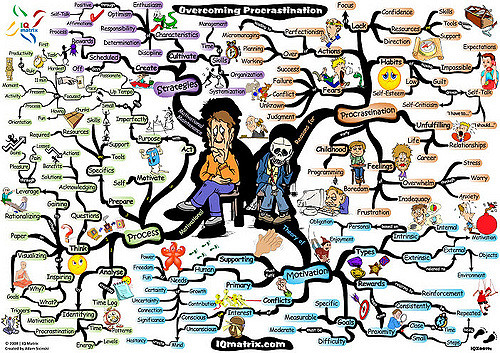
Mind Maps offer a visual representation of our thinking, identifying key concepts, organizing them in a hierarchical manner, and connecting those that are related. Some mind maps, like this one, introduce an additional visual element by incorporating artistic graphics.
Some Mind Maps, however, are much simpler in form. Here is another example of a Mind Map on Procrastination:
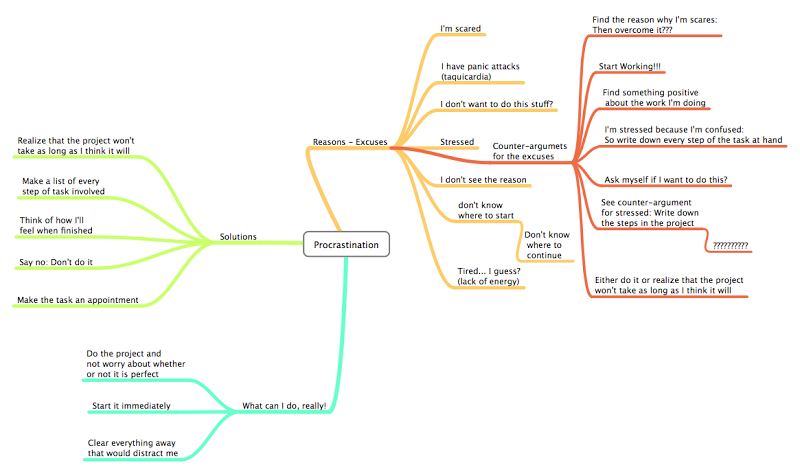
Notice the similarities between this Mind Map and the one above. Both contain the critical attributes of a mind map, as described previously, but this one does not introduce the artistic component.
Source: Norman's Video Art Place: Mindmapping
You can produce your Mind Map:
- by hand;
- using a program you have available on your computer at home or at school (such as Paint, Word, PowerPoint, Publisher, etc.); or by
- using one of several online programs (such a Mindomo, Bubbl.us, MindUp, etc.). Mindomo should be available in your school as it has been licensed by the Ministry of Education for use by all students. Ask your teacher for more information.
Title your Mind Map file ‘Who I Am and the Careers That Interest Me.’
Write a reflection about your inquiry, naming it ‘Who I Am and the Careers that Interest Me - Reflection.’ Questions you may want to consider as you reflect on your inquiry include, but are not limited to the following.
- What did you discover in your inquiry that surprised you? didn’t surprise you? disappoint you?
- Did you find the inquiry was beneficial to your life and career planning?
- Was it accurate?
- Did the inquiry, in your mind, accurately reveal ‘who you are?’
- Do you feel the suggested occupations align with ‘who you are’ and the areas that actually do appeal to you?
- What did you learn about yourself as a learner through this activity?

Consider for a moment, “What do you imagine for yourself in your future?”
The Importance of Self-Awareness When Making Career Decisions
In this activity, you learned about the internal and external factors that influence career decisions. You also completed an inquiry to identify your skills, aptitudes, values, preferences, etc., the career options that align with these, and related training and educational programs. Lastly, you reflected critically on both the process and the results.
Record your thinking to the following questions and add to your Portfolio.
- What is the value of taking the time to reflect inwardly, identifying who you truly are, before making important educational and career decisions that may impact heavily on your future?
- How did the self-exploration you conducted in this activity impact you? For instance, did you learn something new about yourself? Did the self-exploration and inquiry impact your educational and/or career decisions in any way? Or, did it perhaps help to confirm your current understanding of yourself and support your future plans?
 Introduction
 Learning Goals and Success Criteria
 Learning Skills and Work Habits
 Rubric 1