
HHS4U
Unit 1: How do Social Scientists do their Work?
Activity 1: Exploring the Social Sciences

Studying Individuals, Partners and Families
The poem below represents much of what we will be studying in this course. We are going to examine many of the ways in which individual people, partners, and families live in Canada. We will also be exploring how unique experiences can shape the behaviour and lives of people throughout their lifetime.
Read the following poem. When you have finished reading it, click on the chalk brush that says "Substitute" and read the next poem. Continue clicking on the chalk brush and reading the poem that appears until you return to the original.
If you're working on a tablet, click here to open the following interactive in its own window instead of using the embedded version below.
 Consider
Consider each of the questions below:
- Pick one specific line of the poem. How does the meaning of the line change when you use a different word to replace ‘children’ in the poem?
- Do you agree or disagree with the messages in this poem? Explain why.
Research in Social Science
Social Science is a broad field of study that focuses on human behaviour. With this in mind, consider the poem you just read. Do some lines immediately make sense to you? Many people might describe the content of the poem as merely “common sense” or ideas that just seem to be accurate.
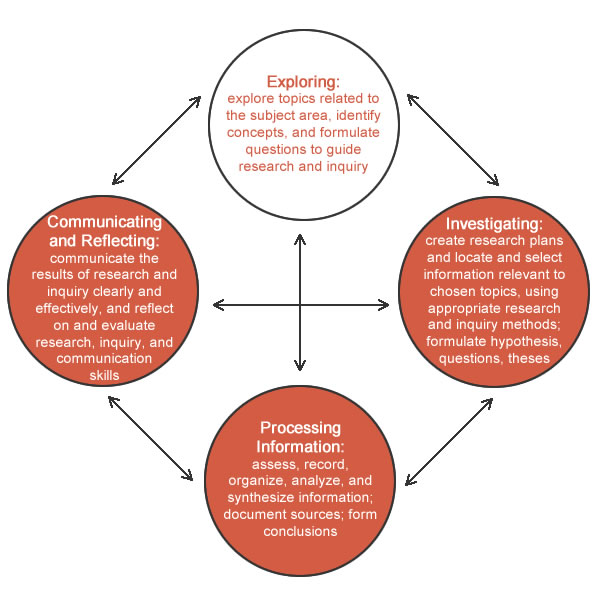
Often, people base their opinions on their own experiences - and those experiences are unique to each person and have shaped his or her own thoughts. Thus, in reality, what you think about the poem or about life is not factual; rather, it is what you believe. Beliefs are not facts. Social scientists want to go beyond the beliefs to uncover the facts or the reasons why people behave the way they do, so they utilize a systematic approach of research and analysis to study human beings. The approach is called the Research Inquiry Process.
Research Inquiry Process
We will explore each step in the Research Inquiry Process as we progress through this course, but for now, let’s take a closer look at the first step.
Step One: Exploring
The first step of the inquiry process is to explore. When exploring a topic in social science, you must identify key concepts and formulate questions.
Identifying Key Concepts
What is a key concept? The word "concept" means a general notion or idea. The term "key" means important or essential. When we combine the terms, key concepts refer to the most important ideas. When you conduct research, you must be able to research the most important ideas of a topic. Key concepts can be used to help you investigate topics. To do this, you need to look at the nouns and verbs to give you clues. They should help to define the key concepts.
For example:
Drug addiction costs Canada billions of dollars in health care services.
In this sentence the key concepts, or most important ideas, are:
- drug addiction
- Canada
- Health Care Services
 Key Concepts Quiz
Check your ability to identify key concepts by completing the following.
If you're working on a tablet, click here to open the following interactive in its own window instead of using the embedded version below.
When first investigating a topic, you can use the key concepts to help you generate key terms. What are key terms? If we break it down, we know ‘key’ means important. ‘Term’ means a word that stands for something. Therefore, ‘key terms’ are the important words you use to search for a topic and guide your research. In fact, they are often called keywords. From the example above we know:
Drug addiction is on the rise. It costs Canada billions of dollars to support health care industries and support community intervention strategies.
In this sentence, the key concepts or most important ideas are:
- drug addiction on the rise
- Canada
- Health Care Industries
- Community intervention strategies
In this sentence, the key terms or keywords are:
- drug addiction
- Canada
- Health Care
- Community
- Intervention
In general, the more words you use, the fewer results you will get in a search. Sometimes a search will reveal nothing, so you need to reword the key terms. Essentially, you are looking for synonyms or words that have the same meaning. In the example above, you might search for the following:
- Instead of drug addiction: drug abuse, substance addiction, substance abuse
- Instead of Canada: Canadian, CA
- Instead of Health Care: OHIP, Health Services, Medical Care
- Instead of Community: municipality, provincial, neighbourhood
- Instead of Intervention: prevention, involvement, support, connection
Formulating Questions:
The second task when exploring topics is to formulate research questions.
What is a research question? It’s a question that can be answered through research. It should be a question that requires more than a couple of facts to answer it, but it should also be focused and not so broad that you need to find volumes of information to come up with an answer.
For example:
This research question is good but still too broad.
Is television a bad influence?
This is a better question.
Are violent cartoons on television exerting a harmful influence on children?
This is a best question.
Do children act more aggressively after watching violent cartoons?
Good, Better, Best
You will notice that for each group of examples there are questions that are good, better and best.
- A good question will elicit an answer that may be too brief (such as yes/no), or is one that can be answered with simple facts or descriptions.
- A better question elicits an answer that asks for an opinion. It may require you to think a little deeper about the answer, but it still does not provide a specific focus for the research.
- The best questions are complex but also focused.
Using the example from above, the best question stretches the better question by specifically asking about aggression rather than the more general “harmful influence.” The best questions will still allow for multiple answers that depend on using a variety of perspectives, but it will provide a focus for the researcher to fully engage with the question.
| Good | Better | Best |
|---|---|---|
| What was the Battle of Vimy Ridge? | Why was Vimy Ridge an important battle to Canadians? | How did the Battle of Vimy Ridge help shape Canada as a nation? |
| Why is body image important to talk about? | How does watching television help children with understanding body image? | Are adolescents who understand the nature of media less prone to its negative effects on body image? |
| Are video games good for you? | How do video games help children with learning? | What are some of the positive physiological effects on male toddlers who play video games? |
 Supplementary Reading
Here is some helpful information that will further assist you in writing a good research question. If you want to view any links in this pdf, right click and select "Open Link in New Tab" to avoid leaving this page.
This document outlines how to fine-tune a succcessful research questions. If you want to view any links in this pdf, right click and select "Open Link in New Tab" to avoid leaving this page.
 Good, Better, Best
For each of the questions, identify whether it belongs in the good, better or best column.
- Why are girls teased more than boys?
AnswerGood
- How does violent television viewing influence the aggressive behaviour of school-aged boys?
AnswerBest
- How does witnessing abuse impact children?
AnswerBetter
- What makes a good father?
AnswerGood
- What health problems do girls who begin smoking in their pre-teen years experience over their lifetime?
AnswerBest
- How does adoption influence the growth and development of personal identity?
AnswerBest
- Why is anorexia a dangerous eating disorder?
AnswerBetter
- How does having an autistic child impact the functioning of the family?
AnswerBest
- How does Down Syndrome occur?
AnswerGood
- How does drug use impact health?
AnswerBetter
 Identifying Key Concepts and Creating Research Questions
Reread the poem from the beginning of this activity.
If you're working on a tablet, click here to open the following interactive in its own window instead of using the embedded version below.
Select two lines from the poem. For each line, answer the following questions and submit your responses.
- Identify the key concepts. Create a list of the key terms/keywords you could also use for research.
- Type your key terms into a search engine. Read a few of the results to help you generate ideas, then create three research questions: one good, one better, and one best.
 Introduction
 Learning Goals and Success Criteria
 Learning Skills and Work Habits
 Rubric 1