
HHS4U
Unit 1: How do Social Scientists do their Work?
Activity 5: Learning to Research


Research Inquiry Process
Step 2: Investigation
The second step of the research inquiry process in social science is investigation. In this step, researchers have to locate and select relevant information and use appropriate research and inquiry methods.
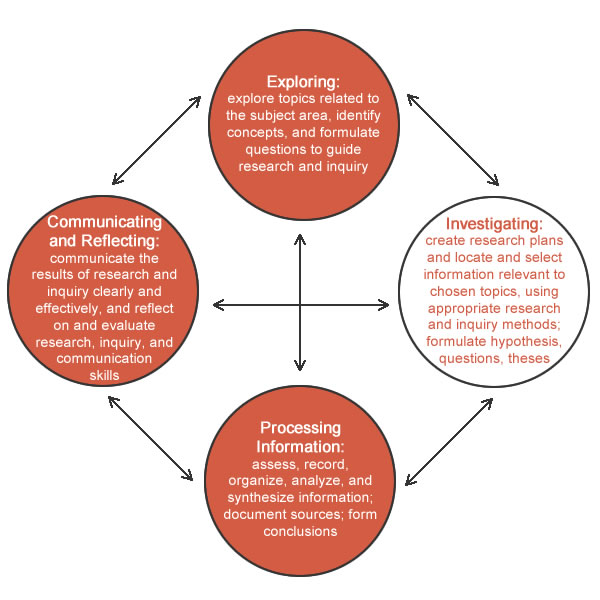
Not every question or topic can be tackled in the same way by social scientists. For this reason, a number of different research methods and sources of information are utilized. Click on the text in each shape below to learn more about research methods and information sources.
Whether you are conducting research using primary sources, or interpreting information from secondary sources, it is very important to avoid bias and to evaluate sources of information for validity.
Bias
Bias is defined as having opinions or feelings that are determined without full consideration of all of available facts and information. Bias may include a preference for one thing over another, or it may pertain to a social or cultural group. Some of these instances might be innocent, such as believing that your sports teams are the best, or that you have the best recipe in existence for your favourite dish. On the other hand, some instances might have more serious implications and consequences, such as believing that you have selected the right political party in the upcoming election. Most of the time you are not even aware of our own biases, but they can creep into what you say and even how you say things. Consequently, it is important to understand what bias is so you can learn how to detect and avoid it.
The video below explains why it can be difficult to obtain true, bias-free knowledge. Bias can be found in places you might not even consider, so as you watch the video, think about how search engines can contribute to bias.
For more information on the ways in which the media can influence bias, visit this University of Michigan website.
Bias can also be found around us on a daily basis in the media. When writers or reporters select which events to share with their readers or viewers, they are able to create public awareness of certain topics while ignoring others. They may also utilize wording that will influence the views of their audience. The synopsis below from the Manitoba Ministry of Education outlines different forms of media bias.
Most people understand that an individual's website, blog, and social media accounts contain the personal (and biased) views of the person who writes them. The reader can then take this into account when reading them.
Bias can also be found in research. Sometimes, the researchers biases are evident in the content they write, the content they ignore, or the way something is written. In social science, we want to obtain information that is comprehensive and as free from bias as possible. This means that you need to be mindful of bias and search for all the places bias might be found.
Evaluating Information for Validity
As researchers investigating topics in social science, all sources of information require that you be critical consumers of media and that you use your own judgement to detect bias. This is how you ensure that information is valid.
When evaluating information, consider the following:
sound, or well-founded.

Before you can even begin to evaluate your information for bias, you have to be able to locate the research. If you are searching for videos or newspaper articles, using an Internet search engine with your topic keywords should work just fine.
Using Databases
However, in social science researchers often like to use journals and articles, and those are more difficult to find through a search engine query. Journals and articles tend to be more reliable if they are peer-reviewed. If a work is peer-reviewed, it means it has been evaluated by a group of experts in the field. Researchers use databases to find relevant research in the form of peer-reviewed journals and articles.
A database is a password-protected compilation of many types of articles, journals, news sources, books chapters, etc. that have been reviewed by editors and/or other experts in the field.
When using databases, type your keywords into the search box. Always try to locate the advanced search option so that you are able to select the "full-text" box, otherwise you will end up with just the abstract (a short summary) of the article.
The following sites are examples of databases that have open access and provide free full-text articles. You can also use a search engine to find social science research databases using the terms: social science, research databases, free, full-text.

Databases
One of the most important tasks of a social scientist during the investigation phase of the inquiry process is to document or cite their sources. You must always document where you found your information. In social science we use APA formatting style to correctly cite information. A citation will provide all the necessary details about a document that would allow the reader to locate the source for themselves. The following is an example of how to correctly write citations for a variety of sources. Please use this document as a resource when writing your own citations; you can also use this document to check those citations created for you by an online source.

Citing Sources
There are several free citation websites you can use that will help you to generate a proper reference in APA style format. However, you must remember that no website is foolproof, and it is always your responsibility to check over your citations to be sure they are correct. Here are a few citation websites that you may wish to try:
 Supplementary Resources
 Finding and Documenting Sources
Let’s practice what you’ve learned.
- Select one of the following topics:
- Child Poverty
- Teenage Pregnancy
- Homelessness
- Divorce
- Use a search engine to find either a book title, a magazine or journal article, a newspaper article or a video clip that relates to the topic. Use a citation website to create a correct citation in APA format.
- Use a database to find one journal or article that is peer reviewed on this topic. Provide a citation in APA format.
Using Databases and APA Citations
For this task, you will use and consider what you have learned about databases and citations to complete the assignment.
- Select a topic that interests you. It should relate to human behaviour or society (e.g., drug addiction, immigration policies, juvenile delinquency, mental illness, high school graduation rates).
- Use search engines and at least one database to find one resource in each of the following categories. Provide a citation in APA style format for each.
TOPIC:_________________________
Book
Magazine or Journal Article (not peer-reviewed)
Newspaper Article
Website
Database Journal/Article
Film/Video
 Introduction
 Learning Goals and Success Criteria
 Learning Skills and Work Habits
 Rubric 1