
Sociology
Socialization And Social Institutions

MINDS ON
Take a look at this cartoon.
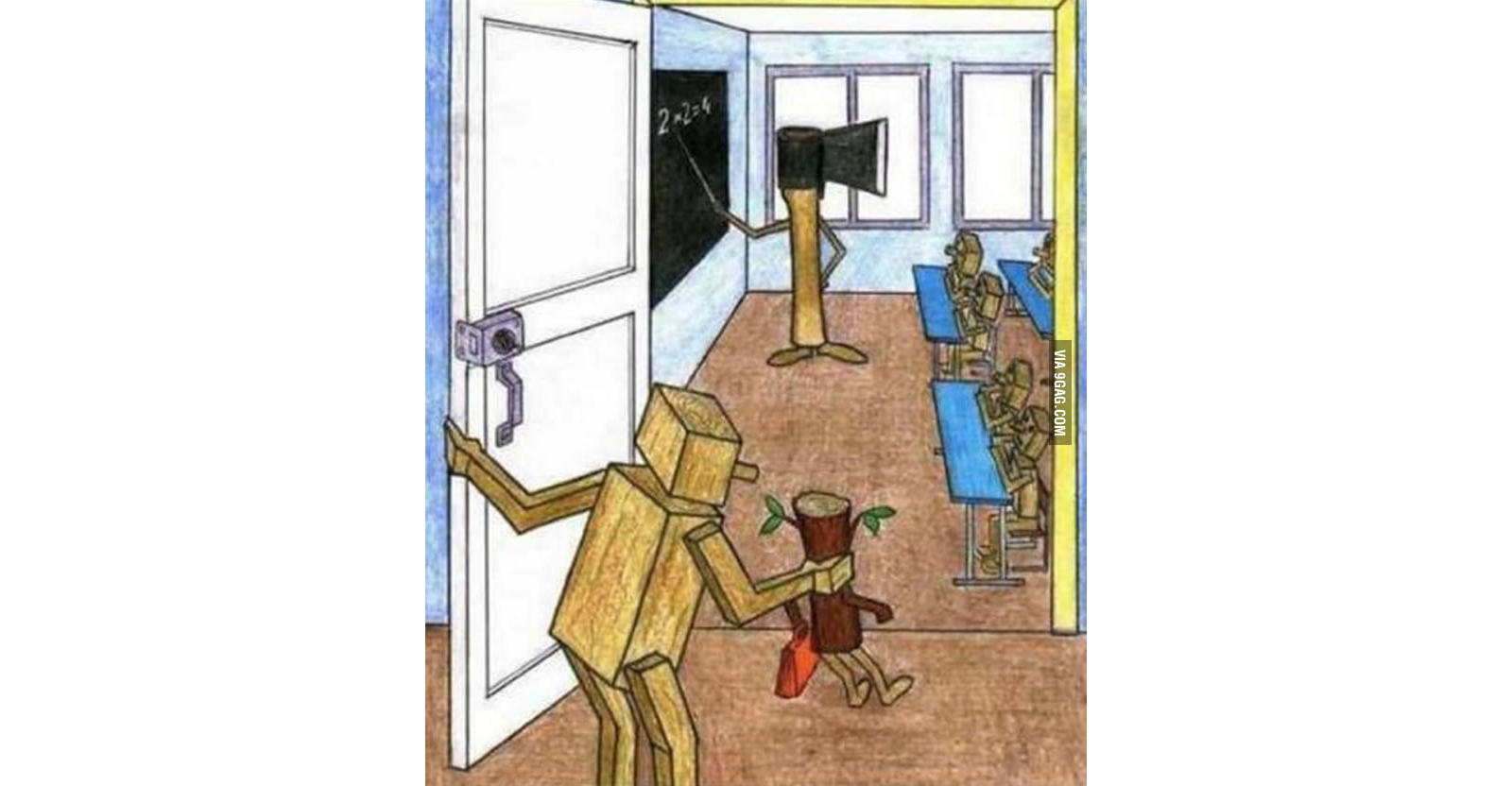
 Socialization And Social Institutions
Choose one of the two questions below and write a one-sentence response to it.
- Is the author trying to persuade, inform, or entertain the reader?
- What message does the author want the reader to know?
The education system and our experiences in school have a big impact on our lives. This activity will explore how different social institutions and agents of socialization (definition:)contribute to our identity as we move through our lives.

ACTION
This activity explores a significant concept in sociology: socialization. Socialization is a term that describes the process of how people learn the attitudes, values, and behaviours that are both appropriate and expected by other members of their culture and their community. Socialization is an important part of people’s healthy development because it is how we learn to become productive, responsible members of society. Sometimes it’s not until we come across people that lack (definition:are missing)socialization skills that we realize the importance of the process of socialization. Genie’s case (recall from Unit 2) illustrates this point. Because Genie wasn't exposed to different agents of socialization at early and important times in her life, she didn't learn how to act and behave in expected ways.
As always, essential questions will guide this activity. This activity has two essential questions, ‘What social institutions and aspects of socialization have the biggest impact on human development?,’ and, ‘How do socialization and interaction with others influence our sense of self?’
As you work through this activity, be sure to use the self-reference effect that you learned about in Unit 2. Apply the theories and ideas that you are learning about to explain your own socialization and social development.
Socialization and Social Interaction with Others
If someone were to ask you ‘‘who, or what, are you?’ would you have a good idea of your answer? Not the literal answers, of course (your actual name or that you are a human!) but rather, an answer that reflects who or what you consider yourself to be - the values and beliefs that you have. For example, do you believe in advocating for the rights of others? Do you value honesty and trustworthiness? Do you have integrity(definition:the quality of being honest and having strong moral principles)? Our self image is an inward reflection of the attitudes and values that we believe we have.
Our identity - how we think about and see ourselves - is made up of our values and attitudes that we develop through social interaction with other people (and in different situations) throughout time. Or, at least it has been in the past.
Have you noticed that the (social media) sites you use to access and spread information are different than the social media sites your parent(s) or guardian(s) might use? According to Snapchat CEO Evan Spiegel, people’s identities (arguably the younger generation’s) are an instant expression, that is, who they choose to be in the moment - rather than amassed (definition:gathered together)over time (as they were, or have been in the past). The idea that social identity (for younger generations) is here and in the moment reflects (cultural, social, and technological) social change in our society - issues that you learned about in the last activity. It also shows how social institutions, such as the media, respond to changes in society, as well.
Watch or listen to this video where (Snapchat) CEO Evan Spiegel explains how identity is ‘at the core of social media:'
Socialization and Social Interaction with Others
What do you think about Spiegal's comments? In a sentence, explain a connection (or lack of connection) you made with Spiegel’s explanation.
Development of Self
Two renowned (definition:talked about by many people or famous)sociologists have proposed theories that have helped explain how we see ourselves and other people around us.
Charles. H. Cooley - How do others see us and how do we see ourselves?
Charles Horton Cooley was a sociologist who thought that our self-growth and self-identity are products of our social interactions with other people, and other people’s perceptions (definition:what other people think or how they interpret something)of us. Cooley believed that we let other people’s opinions of us influence how we see ourselves. An interesting point to note is that how secure or insecure we are with our self concept (or identity) comes from what we believe other people think of us. According to Charles H. Cooley, what other people think of us has a significant impact on how we see ourselves.
This short video illustrates this point quite well:
Cooley called his theory, The Looking Glass Self. There are three main ideas or components to this theory:
Three_Mirrors
Even though Cooley proposed The Looking Glass Self theory back in 1902, do you believe that it is still relevant today?
Watch or listen to this student’s video. It applies Cooley’s theory to today’s technological world:
The Looking Glass Self
Do you agree or disagree with the author’s application of Cooley’s theory to our (society’s) use of social media? What makes you say that?
George H. MEAD - How do we see ourselves and others?
George Herbert Mead also proposed a theory that explains how we view and understand ourselves. Like Cooley, Mead thought that our ‘self’ is socially constructed. That is, our self-identity or self-concept comes from our environment; it is learned - and not biologically determined when we are born. We construct the idea that we have of ourselves through interaction with others, and then, as we go through life, we edit it with different interactions, experiences, and activities in which we take part. So, the ‘self’ is dynamic. This means that it changes: it’s not static or fixed.
Watch or listen to this video that explains G.H. Mead’s theory of The Self:
As you watched the video, you may have noticed the influence of Cooley’s work on Mead’s theory (an interesting side note: Mead and Cooley were known to be friends outside of their academic studies, which might explain that influence!). You may have observed some unique aspects of Mead’s theory, as well. For example, the idea that we develop our sense of self in stages.
Both Mead and Cooley’s theories examine the self and the impact of social interaction. Stop and think for a moment: How do you think they came up with their individual theories? What research methods do you think they would have used? If you said observation, then you're right. Both men were known to have used their observations of others to inform the development of their own perspective or personal theories about our self-identity.
Primary and Secondary Socialization
Socialization is a lifelong process. From our earliest years to our last years, we are continually learning the values, beliefs, and behaviours that we are expected to have through different social interactions.
When we learn the values, beliefs, and expected behaviours in a culture or community as children this is called primary socialization. Our parent(s) or guardian(s) are referred to as our primary group, because they are usually the ones to teach us the important aspects of socialization in our home environment first - before we enter the bigger world of school and friends. Can you recall your parent(s) or guardian(s) teaching you important lessons as a child? Some of these lessons might have been about learning manners, religious beliefs, respecting others, and other, similar lessons.
Secondary socialization happens to us as we get a bit older - in adolescence and the years beyond. Secondary socialization occurs when we become part of groups in the larger society and we learn more specific (behaviour) expectations for the specific job or role that we have (e.g., part-time jobs, members of extracurricular teams at school, new groups of friends). Every time we join a new group, we have to learn the expectations of the group, and we learn about how that group interacts with other groups in society, as well. Think about your adolescent years: what new groups have you been a part of? What new behaviours, attitudes, or values did you learn as a member of that new group? You don’t need to answer these questions now, but you are already likely realizing that the socialization process is never-ending. As we age, we become part of different groups that may have different expected behaviours, values, and beliefs. In this way, we are all lifelong learners!
Socialization and Social Interaction Throughout the Lifespan
Although we are all different and have different life experiences, sociologists have made generalizations (definition:general statements)about the stages we go through as we get older. It’s important to acknowledge (definition:recognize the fact)that these observations reflect Western society and some traditional or long-established values or beliefs. To be able to make these generalizations, sociologists study cohorts (definition:people that are treated as a group)that are born within a certain time period (e.g, 1990 to 2000) and follow them for a period of time to learn about changes in their lives.
Socialization_Throughout_the_Lifespan
Stages_of_Socialization
Agents of Socialization
Take a minute to think about your answer to this question, ‘Who or what has had the biggest impact on who you are today?’ Did your answer include family? Friends? School? Religion? Something else? The factors or forces that have significant impacts on our lives are called agents of socialization, and they are the forces that teach us the values, beliefs, and behaviours that contribute to who we are.
Knowing what these terms mean will help you understand the following video better because you’ll come across them as you watch or listen to it.
This video will also help to reinforce the important subject-specific vocabulary that you’ve already learned.
Complete this quiz to help ensure that you have understood the important concepts related to socialization (e.g., some agents of socialization) that were featured and discussed in the video.
Socialization_Quiz

CONSOLIDATION
H.O.T. Topic
A hidden curriculum is an unintended side effect of lessons or experiences you’ve had in the education system. A hidden curriculum isn’t planned. For example, hidden curricula (more than one curriculum) aren’t formally taught, but they are important because they influence our perspectives and the attitudes that we develop (whether we are aware of it or not).
Examples of hidden curricula may include attitudes about:
- gender;
- morals;
- social class;
- stereotypes;
- cultural expectations;
- politics;
- language; and/or
- gender roles.
Assume that documentary makers are interested in investigating the hidden curricula in Ontario Schools. Their next film is titled ‘Uncovering Hidden Curriculum.'
What are two examples of hidden curricula they might uncover as they gather data through interviewing students from all over the province? In one sentence for each example, provide a piece of evidence or point (e.g., an example) to justify your thinking.
Here are two examples:
The documentary makers may notice that ‘popular’ students seem to wear expensive clothes. This may lead them to think that expensive clothes influence what students think about their peers, and that clothing brands are very important.
Or,
The documentary makers may notice that all the novels in one of the departments have main characters with the same characteristics. This may lead them to think that those specific traits (e.g., a certain height, weight, hair colour, skin colour) are more important than others.
SHARE:
ACT:
To whom could you send your hidden curriculum concerns in order to get an informed response? Generate a list of potential candidates that might be interested in learning about these hidden curricula.
 Learning Goals and Success Criteria
 Learning Skills and Work Habits