
Thinking Like a Social Scientist
Communicating and Reflecting

MINDS ON
Inquiry Process in the Social Sciences: Communicating and Reflecting

The final stage of the inquiry process in the social sciences is about Communicating and Reflecting. This is the stage where researchers prepare and present what they have found. This can take many shapes; for example: an annotated bibliography, a written report, a presentation, a webpage, a published article, a panel discussion, or a conference lecture.
Part of the researcher’s process at this stage is also reflecting on his or her skills as a researcher and the limitations and areas of growth he or she is noticing in the development of his or her inquiry skills. This is an important component of becoming a social scientist.

ACTION
One of the ways in which a social researcher communicates his or her findings about a topic of inquiry is by creating an annotated bibliography.
What is an annotated bibliography and what is its purpose? The following video gives you a snapshot:

CONSOLIDATION
 Annotated Bibliography
Create an annotated bibliography consisting of four sources. Use all of the skills from this unit, at each stage of the Inquiry Process, to assist you in completing this assignment effectively.
- Select a topic in the social sciences that interests you. You can use one of the same topics you've already used in this unit or you can pick something new. Some additional topics to consider include: birth order, single parent families, anti-vaccine movement, or adoption.
- Use search engines and databases to find many different kinds of sources related to this topic. Choose 3 to complete this assignment. At least one must be a journal article from a database. You can refer back to U1A2 for a reminder how to access databases.
- Document the sources accurately using the APA style of citation. Make sure your sources are in alphabetical order.
- Provide an annotation for each source, using the following checklist to ensure you have included all the necessary parts:
|
|
Checklist Items |
|
|---|---|---|
|
|
A statement about what was written (topic/research) and why (purpose). |
|
|
|
A sentence that describes the main idea/argument. |
|
|
|
A sentence or two that describes the methods used by author. |
|
|
|
|
|
|
|
|
|
|
|
|
|
|
|
|
|
|
|
Two or three sentences that identify the supporting evidence or findings. |
|
|
|
|
|
|
|
One sentence about how this source would be useful for a social scientist studying the topic (this will likely not be in the source and will be based on your assessment of the information above). |
|
Submit your annotated bibliography to your teacher when complete.
 Field Journal
Social scientists typically use a Field Journal as a way to document their thinking and their questions. It will be a place where you can capture your key learning from each unit, as well as a place to document your development as a social scientist.
In this unit, we focused on thinking like a social scientist and introduced some of the key concepts of the discipline. As you review what you have learned in this unit, what do you think are the key concepts that you would like to record to carry with you into the next units? You are encouraged to capture these key concepts in your ePortfolio. You could consider this as ‘study notes’ to carry forward, ones that you will likely go back to and continue to add to throughout the course.
Reflection of Skill Development
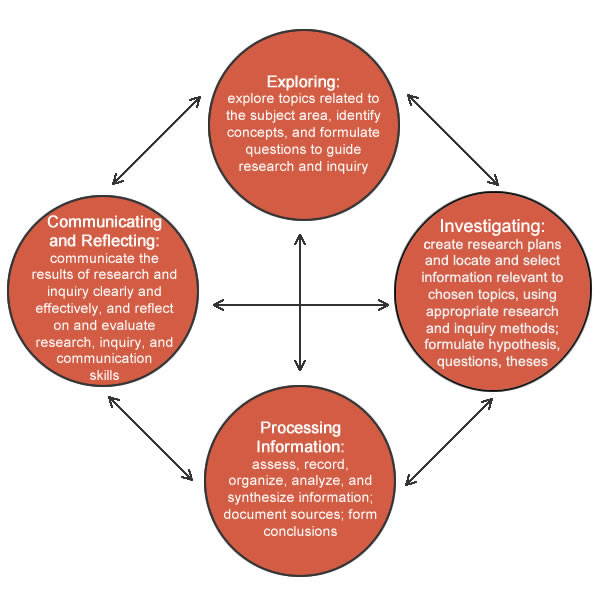
As you know, the Inquiry Process in the social sciences has four stages. You have been introduced to each of the four stages in this unit:
 Learning Goals and Success Criteria
 Learning Skills and Work Habits