
Thinking Like an Anthropologist
Anthropology and Socialization

MINDS ON
Before we begin, think about the ways in which your life is unique from others. Name something in your life that helps you or your family maintain your culture. Who and what are the agents of socialization (definition:) that have had an impact on creating who you are, what you believe, and how you act?

ACTION
As we have learned in the previous activity, culture both impacts and is shaped by beliefs and behaviours, and influences many facets of our society. We also learned that elements of culture act as agents of socialization to maintain the culture. As cultural anthropologists, when we study culture, we need to recognize that culture is not a stagnant ‘snapshot’ in time; rather, the values and beliefs of a culture are transmitted from one generation to the next as people raise, and are raised, to become adults. The concepts are embedded within one another.
We will investigate this further in an introduction to some key facets of understanding First Nations, Metis and Inuit culture in Canada. This includes an introduction to the Truth and Reconciliation Commission (TRC) report released in 2015 and the calls to action that both honour the legacy of the Indigenous community in Canada and recommend steps towards reconciliation. For more background information on the TRC report, you can review these sites as a starting point:
We will go into further depth later in the activity.
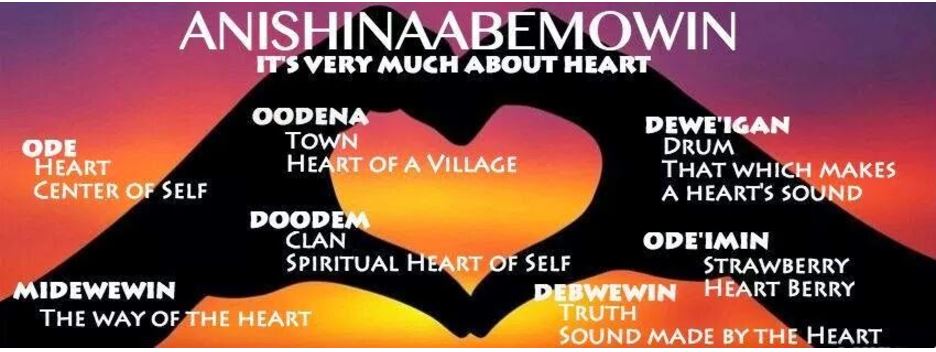
First, we want to recognize how culture is transmitted from one generation to the next. An example can be seen in the use of different languages. People who have this additional asset of carrying another language recognize that there are some terms that don’t easily translate into English. It is within these types of words, terms, or phrases that culture is embedded and give meaning and life to their cultural translation. For example, in examining the following picture, we can begin to have some insight into Anishinaabe culture through the translation of some of the words that are foundational to understanding their culture:
The following graphic from the resource Honouring our Strengths highlights the importance of language to Indigenous culture. Notice how integrated language is to multiple facets of the culture.
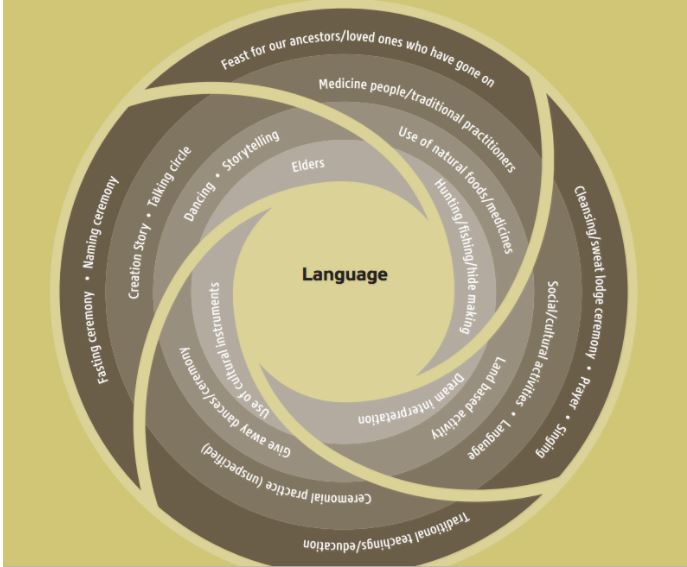
 Honouring Our Strengths
What are your thoughts about what the graphic shows about the importance of language to Indigenous culture?
You could consider some of the following questions to get you started:
- What one area in the graphic resonates with you most? Why?
- What one area in the graphic surprised you? Why?
- What could happen to Indigenous culture in Canada if native languages are lost?
- What actions could be taken to preserve Indigenous languages in Canadian culture?
 Full Circle Video
The following half-hour video gives six teenagers an opportunity to tell you about their Indigenous culture. As you view the video, make notes about the following:
- ways in which they talk about how their culture is maintained;
- what challenges they notice about trying to maintain their culture;
- why it is important to them to maintain their culture; and
- identify what agents of socialization play a part in their cultural identity.
In what ways are these teens different from you? In what ways are they similar?
We acknowledge these examples and the continued efforts of the First Nations, Metis, and Inuit peoples across North America to maintain their culture. Those who hold a first Indigenous language do have an advantage over those who do not have that same skill; but that is not to say the others have lost their culture. There is a recognition of needing to work harder at maintaining Indigenous culture through other cultural practices beyond language, such as through rites of passage, customs, beliefs and ways of establishing and maintaining relationships. Some of the ways in which culture can be maintained and passed down are through ceremonies of the various First Nations and First Peoples of North America and a recognition of their ways of living as called for by the environments in which they live, customs of their respective societies in terms of social/physical activities, and the values and beliefs of the peoples. Working to preserve these unique facets of culture and identity are all additional ways to exercise the distinctness of First Nations, Metis and Inuit cultures. While diversity exists amongst the various Nations, similarities in values and beliefs are found due to the original teachings given. People value their relationship to the land as it is recognized in many Creation stories that man was created from various aspects of the land and elements found around us. Everyone recognizes Earth being acknowledged as our Mother; this concept respects that teaching.
There still exists some controversy around the historical relationship between the Canadian government and the First Nations, Metis, and Inuit peoples of the country. The Truth and Reconciliation Commission acknowledges that movement needs to occur for the healing of that relationship to continue to grow in a positive direction. Many recommendations were suggested by the Truth and Reconciliation Commission. Specifically, 94 “Calls to Action” were written to further the process of Canadian Reconciliation. In order to redress the Legacy of residential schools and advance the process of Canadian reconciliation, the 'calls to action' include the following:
- child welfare;
- education;
- language;
- culture;
- health; and
- justice.
The 'calls to action' also address and identify areas for Reconciliation, including the following:
- Canadian government's and the United Nations' Declaration on the Rights of Indigenous People;
- Royal Proclamation;
- Settlement Agreement Parties and United Nations;
- Equity for Aboriginal People in the Legal System;
- National Council for Reconciliation;
- Professional Development and Training for Public Servants;
- Church Apologies for Reconciliation;
- Education for Reconciliation;
- Youth Programs;
- Museums and Archives;
- Missing Children and Burial Information;
- National Centre for Truth and Reconciliation;
- Commemoration;
- Media;
- Sports;
- Business; and
- Newcomers to Canada.
The list is all encompassing of the areas that have been affected in First Nations, Metis, and Inuit cultures of this country.
To gain a deeper understanding of the Truth and Reconciliation report, consult the following resource and review, in particular, the summary of the 'calls to action'.
If you want to view any links in this pdf, right click and select "Open Link in New Tab" to avoid leaving this page. (View the original article.)
 Truth and Reconciliation 'Calls to Action'
Choose one of the Legacy and one of the Reconciliation items in the 94 Calls to Action from the website.
For each, answer the following questions:
- What issue is identified? How is this different from the rest of Canadian society?
- What needs to happen for change to occur?
- What suggestions have or are being made?
- Who needs to be involved?
- In your mind, is it doable?
- What are the first steps to take?
- What will be the challenges?
- What will be the benefits?
- What impact do you think following these two items in the Calls to Action will have on Indigenous culture? On Canadian culture as a whole?
- What additional recommendation might you make as part of the truth and reconciliation within Canadian culture? What impact do you think this recommendation would make?

CONSOLIDATION
Culturally Connected
How does studying different cultures help us understand what makes us uniquely human, both as individuals and as a global community? How do we benefit from studying other cultures?
Create a graphic that demonstrates the way in which we are connected to each other through and by culture.
 Learning Goals and Success Criteria
 Learning Skills and Work Habits