
Towards Right Action: Exploring Ethics
Defining Ethics

MINDS ON
“
To be a good human being is to have a kind of openness to the world, an ability to trust uncertain things beyond your own control, that can lead you to be shattered in very extreme circumstances for which you were not to blame. That says something very important about the condition of the ethical life: that it is based on a trust in the uncertain and on a willingness to be exposed; it’s based on being more like a plant than like a jewel, something rather fragile, but whose very particular beauty is inseparable from that fragility.
~ Martha C. Nussbaum, American Philosopher
 To Do the Right Thing...
Consider the following scenarios:




- Its noise bothers you at night.
- It is killing your sheep.
- You enjoy the taste of its meat.
- You enjoy seeing it squirm.
- It is destroying your vegetable garden.
- You just don't like snakes.
- The condor (an endangered species) keeps killing your prized carrier pigeons.
- You enjoy hunting.
Pick any one of the scenarios presented above and take a position.
 Ethical Dilemmas - What Would You Do?
The above are examples of ethical dilemmas: situations in which difficult choices must be made in the service of right action. Select one of the above dilemmas and comment on it. Your comment should respond to the following questions:
- How did you come to your decision as the ‘best’ course of action? In other words, discuss what informed your decision, for example: religious beliefs, personal values, societal expectations, practicality, self-preservation, the fewest consequences, intuition, guilt ...?
- What choice did you make? Is this what you would ‘actually’ do, or is this what you think you ‘should’ do? Answer honestly.
- Other than the ones proposed, are there additional solutions to the dilemma?

ACTION
What are Ethics?
In a nutshell, ‘ethics’ is about ‘right action.’

Every day, we are faced with opportunities to do things that we would consider to be ‘right,’ ‘just,’ and ‘good’ - situations which allow us to affirm the values that we profess to hold dear.
We also have the same opportunities to do things that violate those values.
So how do we make decisions - how do we know which decisions are the ‘good’ ones - the ones that will allow us to look back on our decisions with a sense of satisfaction and know that we indeed, made the right choices? Indeed, how do we even define what ‘good’ and ‘right’ means? Is it an objective, inherent quality, or is it defined by context? Herein lies the central problem we have when defining ethics - who makes the rules that determine ‘right’ action from ‘wrong’ action?
The Rules By Which We Live
To best understand what Ethics is, it may help to examine how it is applied in everyday life. As demonstrated in the ethical dilemmas presented in the Minds On section, we often make decisions based on an understanding that there are certain ‘rules’ that govern the way we act - those rules are founded on ethics.
These can be formal rules, such as laws, which collectively reflect beliefs as to what actions should or should not be permitted. They can be informal rules, such as the social conventions that we use to smooth out the interactions between people - an example would be standing in line at the checkout counter and waiting your turn at the corner store. No one says you ‘have’ to line up, but we certainly look poorly upon anyone who is rude enough to break that societal convention!
These rules govern our day to day actions. Even if an outside force is not there to enforce the rules, we internally debate our options before acting. If we decide not to follow the rules, we tend to suffer guilt.
But where do these rules come from and why do they have so much power over us?
The Connection Between Ethics and Morals
Out of all of the branches of Philosophy that we will study in this course, Ethics is possibly the most applicable to everyday life. Ethical theories are theories in action!

Ethics are fundamental principles or beliefs by which a person distinguishes, consciously after some thought, or unconsciously and seemingly by instinct, between morally acceptable and morally unacceptable behavior.
Indeed, the terms 'ethics' and 'morals' are often used synonymously, and the study of ethics is often referred to as ‘Moral Philosophy.’ We often say that someone who is ‘ethical’ behaves morally, and someone with a strong sense of morality is ‘ethical.’
So they are connected, but there is a subtle difference between them.
Morals refers to systems of 'shalls' and 'shall nots,' otherwise called normative rules of conduct. They are regulations for proper behaviour.
For example, for those who follow the teachings in the Bible, the Ten Commandments provide a moral system to guide behaviour. They direct, in broad terms, how to act in a ‘good’ way. And, as we will see later on in this activity, many religions lay out a system of rules to which their followers adhere; these rules establish constraints or guidelines for their followers’ behaviour.
Ethics, on the other hand, strives to get at the basic principles of ‘right’ and ‘good,’ and what things determine the ‘rightness’ and ‘wrongness’ of an action. “How should I act?” and “How should I live my life?” are some of the fundamental questions of Ethics.
Which brings us back to this question: where do these rules come from?
To answer that, we need to look at the theories concerning ethics: metaethics, normative ethics, and applied ethics.
Moral Philosophy
| Metaethics |
Metaethics is the most abstract area of moral philosophy as ultimately, it is the study of where ethical principles come from. In particular, Metaethics asks: Did we just make up moral principles on our own, or did a Divine Being, or beings of some kind, give them to us? Metaethics examines questions such as:
|
| Normative Ethics |
Normative Ethics looks at how to assemble a set of rules, or moral principles, that determine what kinds of actions are good and bad, right and wrong. There are four normative theories:
In particular, Normative Ethics looks at questions such as these.
|
| Applied Ethics |
The most down-to-earth area of moral philosophy is Applied Ethics. Applied Ethics helps us resolve real-world, everyday dilemmas and issues. Applied Ethics seeks to apply normative ethical theories(definition:The principal purpose that normative ethical theories serve is to articulate and advocate an ethical code to determine what is moral and immoral behavior.) to specific cases to tell us what is right and what is wrong. Applied Ethics takes theories of morality and examines specific moral issues and dilemmas, from the more mundane, such as:
But it also examines very contentious issues such as reproductive rights/abortion, animal rights, and crime/punishment. |
Is There a Universal Ethical System?
Whenever we see words such as:
- right and wrong;
- good and bad;
- valued and unvalued;
- better and worse;
- important and unimportant;
- fair and unfair; or
- shameful and honourable;
We are already involved in what philosophers call ‘value-laden’ language. This is language that assumes a moral judgment.
For example, we cannot call something “wrong” without raising the question of what makes it wrong. Likewise, we cannot call something “important” without implying that anything less than that is not as worthy of our attention, time, or effort.
When trying to figure out the rules that are the foundation to our ethical reasoning, one may ask if there is a universal ethical system, one that can help us to make those judgments about what is right and wrong, or good and bad. Surely, one may ask, if something is determined to be ethically good, it is widely and universally accepted as so? Would that not make it easier for us to make the right choice, without a moment of doubt or trepidation?
Moral relativists would say "no" when answering that question. These ethicists believe that ethics are based on the individual, the situation, the place, and the time - that no moral judgments are true or false.
Cultural relativists would concur - that what is judged as ‘right’ or ‘wrong’ ethically, may be different in relation to the cultural context in which it occurs. For example, one should not judge the actions of another when that person makes decisions based on her/his own cultural beliefs and values. Ethics can be culturally subjective. For example, up until 2018, women in Saudi Arabia were not allowed to drive - a policy that, outside of the country, was considered oppressive toward women.
On the other hand, proponents of ethical non-realism, or moral realism, would disagree - there is no objective moral order that makes our moral beliefs true or false and our actions right or wrong. Moral facts and moral values exist independent of our perception of them, or our beliefs, or the norms prevailing in our community. For example, the Universal Declaration of Human Rights by the United Nations, has garnered criticism for promoting an ethical system that does not recognize that some countries and cultures have different values and beliefs.
As you are probably gathering at this point, establishing a universal ethical system that acts as a guideline for all possible groups of people is not a simple task. Whose criteria do we use to make judgments?
This, in part, may be why it is difficult when we find ourselves faced with a moral dilemma. Which direction - which decision - is the ‘good’ one, if ‘good’ is relative and subjective?
This is where we often defer to moral systems found in various religious texts or teachings. For example, look at the five following examples of guiding principles.
Moral Guidance to Ethical Decisions
Buddhism’s Eightfold Path
Also called the Middle Path or Middle Way, the Eightfold Path is part of the last of the four teachings of the Buddha - knowns as the Four Noble Truths. The Eightfold Path is a process to awaken your true nature and achieve spiritual enlightenment.
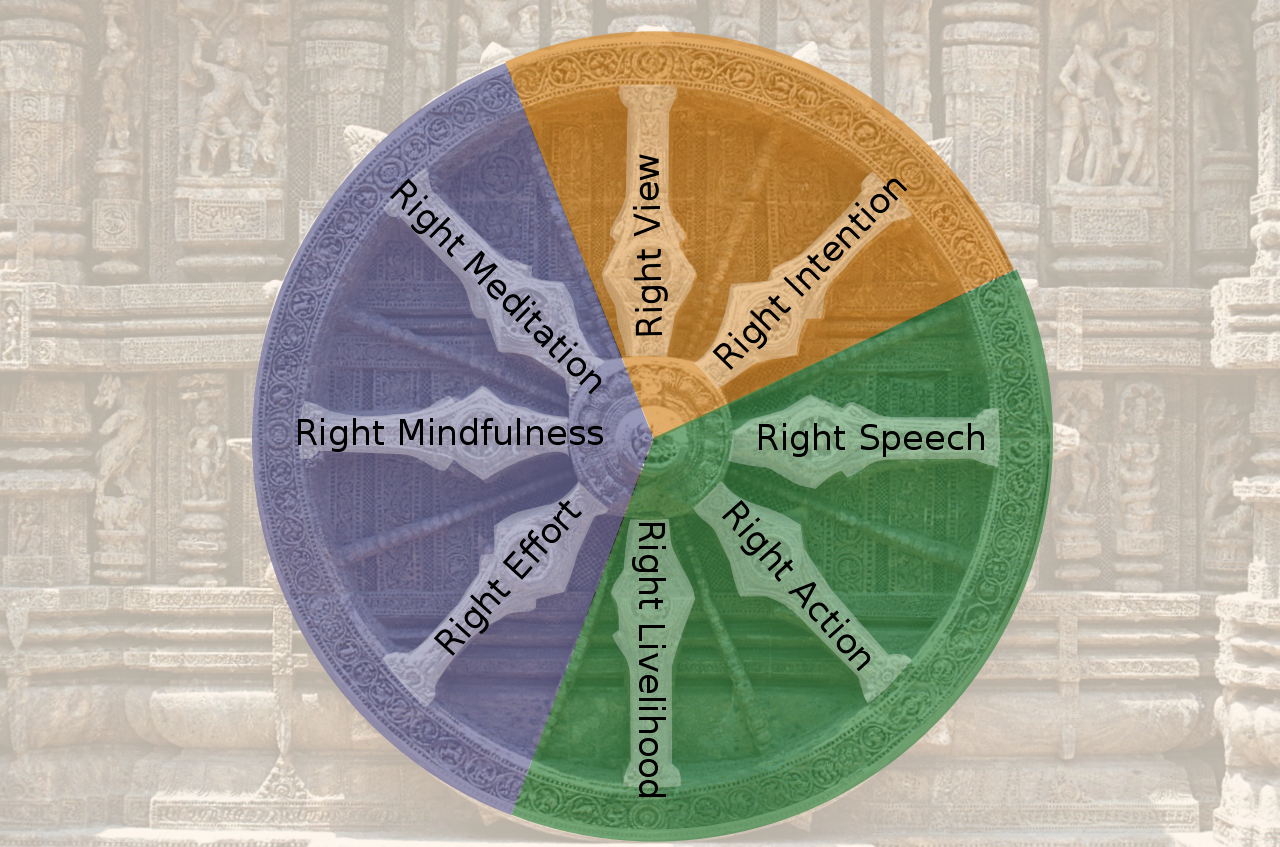
The Eightfold Path consists of eight practices:
- Samma(definition:Samma can be translated to ‘right’ or ‘proper.’)-Ditthi — Complete or Perfect Vision, also translated as right view or understanding the nature of reality.
- Samma-Sankappa — Perfected Emotion or Aspiration, also translated as right thought or attitude. Acting from a place of love and compassion.
- Samma-Vaca — Perfected or Whole Speech. Also called right speech. Clear, truthful, uplifting and non-harmful communication.
- Samma-Kammanta — Integral Action. Also called right action. An ethical foundation for life based on the principle of non-exploitation of oneself and others.
- Samma-Ajiva — Proper Livelihood. Also called right livelihood. This is a livelihood based on correct action - the ethical principle of non-exploitation. The basis of an ideal society.
- Samma-Vayama — Complete or Full Effort, Energy, or Vitality. Also called right effort or diligence. Consciously directing our life energy to the transformative path of creative and healing action that fosters wholeness.
- Samma-Sati — Complete or Thorough Awareness. Also called "right mindfulness." Developing awareness - awareness and mindfulness - of things, oneself, feelings, thought, people and reality.
- Samma-Samadhi — Full, Integral or Holistic Samadhi. This is often translated as concentration, meditation, absorption or one-pointedness of mind. Samadhi literally means to be fixed, absorbed in, or established at one point - very similar to what we now refer to as ‘mindfulness.”
Anishinaabe Seven Grandfather Teachings
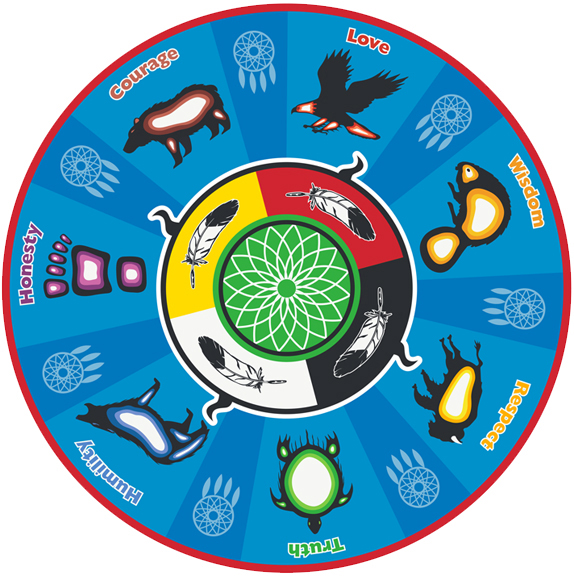
Each Grandfather Teaching is a tool for living a good life:
-
Minwaadendamowin – Respect: Place others before yourself in your life; don’t look down on anyone.
-
Zaagidiwin – Love: I have to love myself before I can love anyone different.
-
Debwewin – Truth: You have to look at yourself before you judge another’s way of walking.
-
Aakodewewin – Bravery: Hold firm in your thoughts and stand strong even when you don’t know what will happen right now.
-
Nibwaakawin – Wisdom: Wisdom allows me to eloquently and correctly interpret others’ ideas.
-
Miigwe’aadiziwin – Generosity: You have the ability to give things away and distribute what you have.
-
Dibaadendiziwin – Humility: Humble yourself to your fellow human in the way you walk with him or her.
Seven Laws of Noah (Hebrew)

According to the Talmud(definition:The Talmud is a central text of Rabbinic Judaism.), the Seven Laws of Noah (also known as the Noahide Laws) are a set of imperatives or binding laws from God - given to all of humanity (the children of Noah). The first six laws are derived from Genesis, the last law being the establishment of courts to uphold the first six:
- Do not deny God.
- Do not blaspheme God.
- Do not murder.
- Do not engage in illicit sexual relations.
- Do not steal.
- Do not eat from a live animal.
- Establish courts/legal system to ensure obedience to said laws.
The Ten Commandments: The Bible (Christian)
God gave the Ten Commandments or the Decalogue, to Moses after the Israelites left Egypt. The laws of life, which can be found in the book of Exodus in both the Torah and the Bible, outline rules that are important to both Judaism and Christianity, although there are variations to the translations and in their teaching and interpretations.
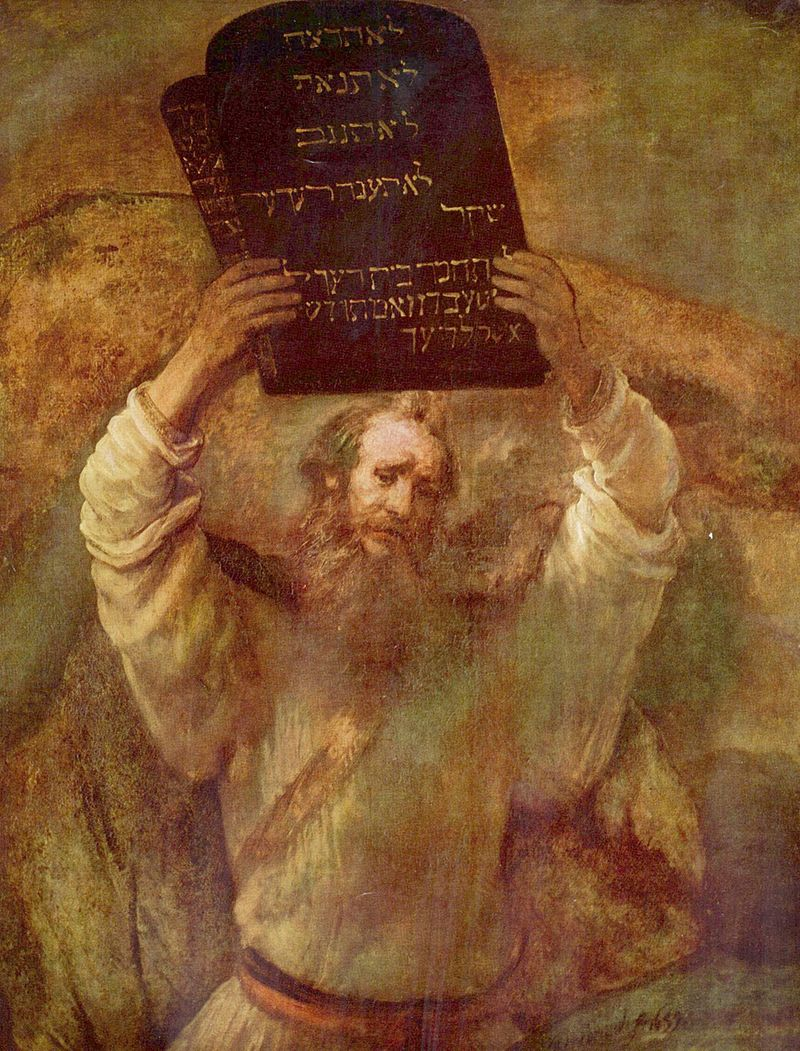
The following translation is from the King James version of the Bible.
- Thou shalt have no other gods before me.
- Thou shalt not make unto thee any graven image, or any likeness of any thing that is in heaven above, or that is in the earth beneath, or that is in the water under the earth. Thou shalt not bow down thyself to them, nor serve them: for I the Lord thy God am a jealous God, visiting the iniquity of the fathers upon the children unto the third and fourth generation of them that hate me; And shewing mercy unto thousands of them that love me, and keep my commandments.
- Thou shalt not take the name of the Lord thy God in vain; for the Lord will not hold him guiltless that taketh his name in vain.
- Remember the sabbath day, to keep it holy. Six days shalt thou labour, and do all thy work: But the seventh day is the sabbath of the Lord thy God: in it thou shalt not do any work, thou, nor thy son, nor thy daughter, thy manservant, nor thy maidservant, nor thy cattle, nor thy stranger that is within thy gates: For in six days the Lord made heaven and earth, the sea, and all that in them is, and rested the seventh day: wherefore the Lord blessed the sabbath day, and hallowed it.
- Honour thy father and thy mother: that thy days may be long upon the land which the Lord thy God giveth thee.
- Thou shalt not kill.
- Thou shalt not commit adultery.
- Thou shalt not steal.
- Thou shalt not bear false witness against thy neighbour.
- Thou shalt not covet thy neighbour's house, thou shalt not covet thy neighbour's wife, nor his manservant, nor his maidservant, nor his ox, nor his ass, nor any thing that is thy neighbor’s.
The Ten Commandments: The Qur’an (Islam)
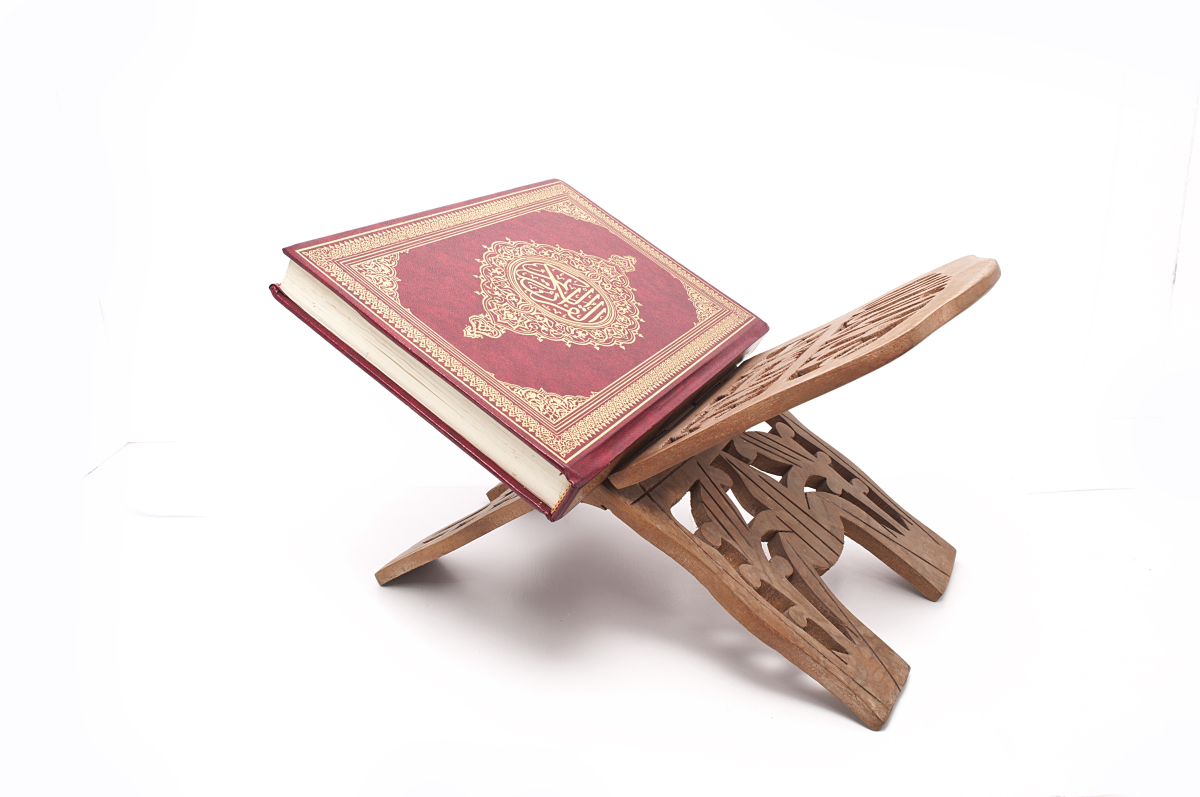
The Ten Commandments as outlined in the Qur’ran, are also known as ‘al-Din al-Jami.’ To acquire righteous and pious character - Taqwa - you need to remember your responsibilities and follow the Divine Path:
- Do not associate anything with Him: There is only One God. To believe that there is anyone else who shares the Divinity with Allah is Shirk, a blasphemy and a major sin. Belief in Tawhid or in the Oneness of Allah is the true, most logical, and reasonable principle. All other beliefs in duality or multiplicity of gods have no foundation in truth, reason, or reality.
- Be kind to your parents: Ihsan towards parents means doing everything nice to them. This includes respect, honor, kindness and love. Reason demands that parents must be honored and thanked for all the sacrifices that they make for their children. The children who neglect or ignore the rights of their parents are deprived of their own reason and decency.
- Do not kill your children because of the fear of poverty: Just as parents have rights so also children have rights. Even the babies and unborn have rights. They should not be killed for any reason even out of the fear of poverty. Allah provides for everyone.
- Do not indulge in shameful acts whether openly or secretly: It is not right to do shameful and indecent acts in public but it is also wrong to do them in private. The reasonable thing is that indecency should be avoided everywhere. Also, as there are open sins, so there are hidden sins. Open sins are theft, murder, fornication, bribery, forgery, mischief etc., but the secret sins are hypocrisy, faithlessness, hate, greed, suspicion, etc. All sins must be avoided.
- Do not kill any person whom God has forbidden except through due process of law: All killing is forbidden unless it is under due process of law and justice. When people lose their reason they start killing according to their own hate or anger. They exceed the boundaries of justice. Murderers go free while the innocent are punished or hundreds are made to suffer because of the murder of one or few. All these acts are against the dictates of reason and common sense.
- Protect the orphans' property: This means protect the rights of the weak. People remember the rights of the strong but of the weak they forget.
- Grant full measure and weight in all fairness: One should always be mindful of doing business in an honest way. People forget that honesty should be the policy in all business.
- Whenever you speak, be just even though it concerns a close relative. People tend to side with their close relatives; they forget that they have to be fair towards all people.
- Fulfill your promises: All promises should be fulfilled, but especially those that are made in the name of God. Do not forget your promises.
- Follow the straight path of God: Only God's path is straight. Other paths are not straight and they will not lead you to God.
While there are many variations to these words, you may be familiar with the following phrase:
“
Do unto others as you would have them do unto you.
~ Jesus, in the Sermon on the Mount
This is known as the ‘Golden Rule,’ otherwise known as the ‘ethic of reciprocity,’ which means we believe that people should aim to treat each other as they would like to be treated themselves – with tolerance, consideration, and compassion.
While a Universal Ethical System often seems improbable, looking at the rules found in the five examples of moral systems, you probably noted some similarities - some guiding principles that, despite theological or spiritual differences, collectively as humans, we deem to be ‘good.’
Philosopher's Notebook: The Golden Rule
Take a moment and find two examples of rules that seem to be ‘universal’ - that two or more moral systems seem to agree upon. Next, find one example on which two or more systems do not seem to concur.
Making notes first in your Philosopher’s Notebook, formulate a response to the following questions:
- Look at the two examples of rules that seem similar. Proponents of ethical non-realism would suggest that this validates their theory that there are some moral facts and moral values that transcend belief systems. Would you agree? Are there some rules that all of humanity accept as being in support of ‘goodness?’
- If more than one belief system agrees on a rule, would that make it easier for you, personally, to adhere to such a rule? What if it were a rule with which you personally did not agree? If the ‘majority rules,’ would you be able to accept a rule that you personally did not condone?
- Look at the example of a rule that is incongruent with the other belief systems. Is this an example of cultural relativism? Hypothesize as to why this rule might not exist in another belief system. Despite being anomalous in comparison, is it still an example of ‘goodness?’
- In your opinion, is it possible to have a Universal Ethical System? What conditions must be put in place to ensure that no one moral system takes precedence over another - especially considering that, historically, this is what has generally occurred?
When faced with difficult situations, we often have little opportunity to think carefully about the choices we make. More than likely, we aim to make the best, most right decision, one that is in synch with the values we profess to abide and uphold. We try to make choices based on reasoning that is consistent, from the root principle to action.
However, as we may already know, it is not always as easy when faced with difficult scenarios.
Studying ethics gives us opportunities to think carefully about the choices we have already made in our lives. Understanding ethics gives us the hindsight to assess our own process of reasoning, and to dig deep into the underlying beliefs, values, and rules that form the foundation from which we make our moral choices.
Summarize and Assess: Ethics in Everyday Life
Now that you have been introduced to ethics, defined it, and traced some of its roots, rules, and applications, it is time to summarize your learning.
Your Task
From bioethics to social activism, from legal matters to plagiarism, how many situations necessitate the use of ethical reasoning in our everyday lives?
To assist in such an assessment and to synthesize the information presented in this activity, you will create a visual representation - a mind-map, flowchart, or infographic - that demonstrates your understanding of the various aspects and characteristics that define and connect various theories concerning the Philosophy of Ethics.

Follow the steps below to complete the task:
Step 1: Learn
Familiarize yourself with the three theories related to Ethics.
- Metaethics
- Normative Ethics
- Applied Ethics
These will form the ‘backbone’ or nodules to your visual representation as you attempt to define them through examples that illustrate how ethics is manifested in our everyday lives.
Step 2: Research
For each of the three theories above, you will need to find at least two real life examples that illustrate the theory in practice. These can be examples that you source from a newspaper, a blog, social media, photojournalism, transcripts from interviews, anecdotal stories - you are seeking examples of acts of ethical judgement in action. Remember that you need to find examples that you can connect to a specific theory in Step 3.
Step 3: Assess
Once you have your examples, make connections by answering the following questions.
- What connections can be made between the real-life examples that you found, and the rules from any of the five moral systems we explored in this activity? Demonstrate the connection by attaching one or two specific rules that are illustrated by the example.
- If you have examples that illustrate ‘immoral behaviour’ or any other behaviour that society would deem unacceptable, hypothesize why someone chose an action that was detrimental to society and possibly to herself or himself. For example, is it because the difference between ‘right’ and ‘wrong’ was ambivalent? Were the punishments too lenient or the possibility of reward too high? Was the rule that was broken, only a rule specifically to one moral system or social context?
- In a brief paragraph, summarize your research by presenting your assessment of ethics - does understanding the theories and roots of ethics make it easier to choose the ‘good’ and the ‘right’ when faced with ethical dilemmas? If rules are universal, or if rules are not universal - does that make you feel more secure in making a decision?
- Remember to make direct reference to the material and examples you have presented in your diagram. In particular, assess how you, personally, would respond if you found yourself in the same situation - what would inform your decision-making process?
Remember to archive all of your resources as you are required to provide them in APA format with your finished diagram.
Step 4: Create
Remember to cite your sources in APA format.
Your diagram may include an image or visual for each term, but this not required. Do ensure that visually, you define the connections between the theories, real-world examples, and guiding rules, whether that is through colour, theme, or connecting lines between terms and examples.

CONSOLIDATION
Doing the Right Thing
In the Minds On section, you were given examples of ethical dilemmas and asked what you would do in any of the given situations. Now that you have had the chance to deepen your understanding of what ethical reasoning is, and what informs it, do you feel that you would make the same decisions?
Philosopher's Notebook: My Golden Rules
In your Philosopher’s Notebook, take a moment to reflect on the diagram you made for this activity.
Make an entry in your Notebook. Make sure you defend your choices by making direct reference to the diagrams and the content you explored in this activity.
Also, don’t forget to archive a copy of your diagram in your Notebook.
 Learning Goals and Success Criteria
 Learning Skills and Work Habits