
Probability involving Counting Principles, Permutations and Combinations
Introduction to Combinations

MINDS ON
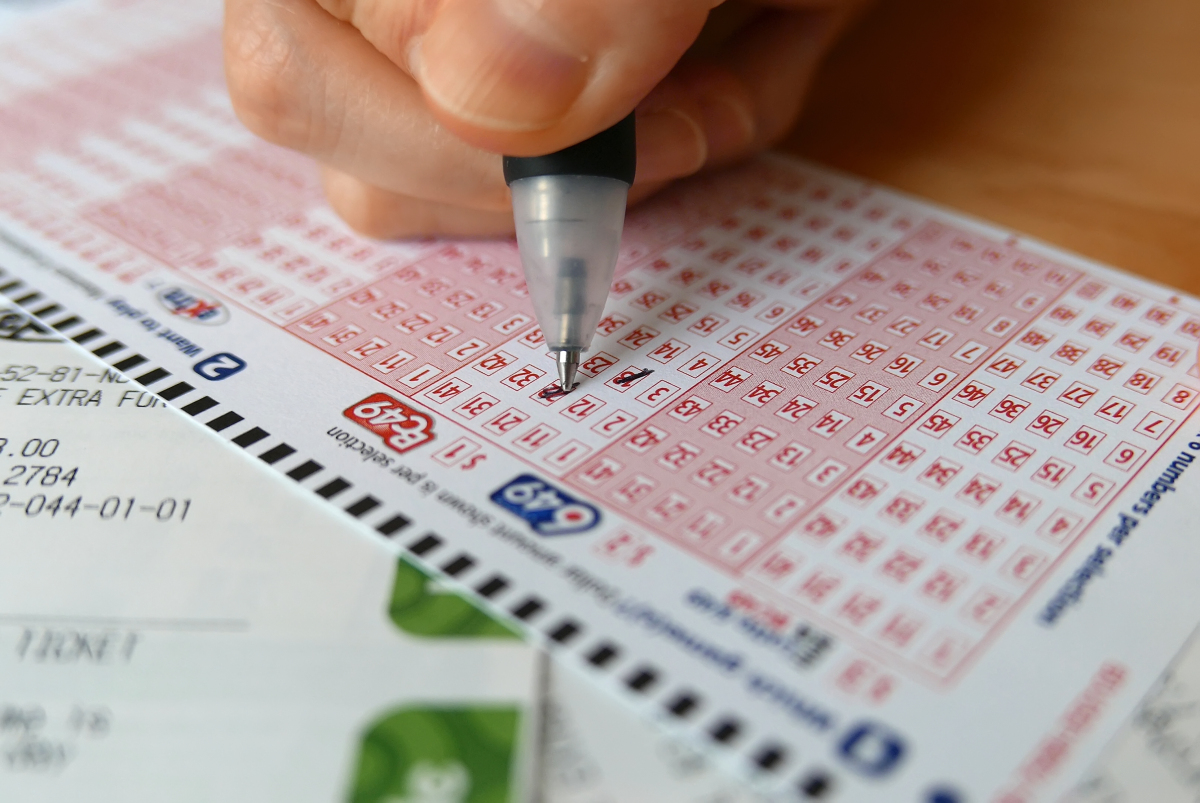
Lotto 649 is a Canadian lottery that has 49 numbers and is based on selecting 6 of those without replacing them each time.
A common question with the lottery is “Does order matter?” Calculate the number of ways to draw the numbers if order did matter. Reflect on whether or not this would create more or less ways if order didn’t matter. Consider the size of the number you calculated and the probability of getting the 1 order that would win.

ACTION
Permutations vs. Combinations
A permutation is a way of arranging a set of r objects from a larger set of n objects. Requiring you to decide how many ways can go in each slot, it assumes that order matters.
A combination is a way of choosing/grouping a set of r objects from a larger set of n objects. It is very similar to a permutation with one major difference; order does not matter in a combination.
 Example 1
Consider the following example. 6 people have 6!=720 ways of being arranged in a side by side picture.
There is only 1 way of putting all 6 people in a group when order does not matter.
The group of people (combination) can be arranged in 720 ways.
The permutation (definition:Ways to arrange for the picture.) is  where we have 6 people (n) and are arranging all 6 (r) .
The combination (definition:Ways to choose the people to make a group where order doesn't matter.) is written  and is read “6 choose 6” where we have 6 people and are putting all 6 in a group.
The one combination can be ordered 720 ways.
Example 2
Angela, Brian, Christian, Diana, and Edward are students at your school.
- In how many ways can they fill the student council positions for president, vice president, and treasurer?
- In how many ways can they form a committee of three? Write out all possibilities such as: ABC, ACD. Note: ABC is the same as BAC.
Solution
 = 5 x 4 x 3 = 60
- ABC, ABD, ABE, ACD, ACE, ADE, BCD, BCE, BDE, CDE and
 = 10
= 10
Notice that there are 6 times more permutations than combinations. There are 3! = 6 ways to arrange the combinations.
 Making Soup Practice
Consider another example. Say you had 13 ingredients for a soup.
- How many ways are there to place 3 of the ingredients in the soup in order?
- How many ways are there to choose 3 ingredients for the soup if order doesn't matter? Consider the previous 2 examples to try and make the calculation for the combination.
Compare your solution to the given solution below.
Solution
- This would give the permutation
 or 13 x 12 x 11 = 1716 possible orders.
- This would give the combination, the number of ways to arrange them in order divided by the number of ways to arrange each group of 3, 3!
 =
=  = 286
= 286
The following video will help you visualize combinations and will summarize it with a helpful formula:
Formula
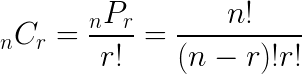
In general, the number of ways of choosing/grouping a set of r objects from a larger set of n objects where order doesn't matter is:
Permutation or Combination Practice
For each of the following scenarios, determine if it is a permutation or combination and answer the associated questions. You may use the interactive calculator to help.
- You have to decide how many ways to put 15 players into 5 different starting positions in a sport.
- Complete the calculation.
- Change the situation so it uses the other operation (Ex. if it was a combination make it a permutation).
- Out of 10 pairs of socks, you have to decide which 3 pairs you want to pack in your suitcase for the weekend.
- Complete the calculation.
- Change the situation so it uses the other operation (Ex. if it was a combination make it a permutation).
- Out of 30 different songs to listen to, you have to decide how many ways can you make a playlist of 10 songs, if it doesn't matter the order the songs are played.
- Complete the calculation.
- Change the situation so it uses the other operation (Ex. if it was a combination make it a permutation).
- You have to decide how many ways to select 3 different flavours for a 3 scoop cone of ice cream given 20 flavours of ice cream.
- Complete the calculation.
- Change the situation so it uses the other operation (Ex. if it was a combination make it a permutation).
PermCombCalculator
Back to the Lottery....
If you calculate the ways of drawing 6 numbers from 49 in order you would get  = 10,068,347,520 giving a probability of 1 in 10 billion, 68 million, 347 thousand and 520 chance. This means, if your numbers were 4, 8, 15, 16, 23, 42 and the numbers came up in the order 8, 23, 16, 4, 42, 15, you wouldn't win!
The other problem with that is, they don’t sell 10 billion tickets each week (it is a Canadian lottery). The probability of winning the lottery is very unlikely, but requiring order would make it nearly impossible.
If we divided  by 6! ways of ordering each group of 6 numbers (thus removing the order) you get
  = 13, 983,816. There is still a very small chance that you will get the one combination to win, but it is a much better chance than if order mattered! Order is not a requirement to win the lottery.
The Fundamental Counting Principle with Combinations
In previous activities you have seen that the slot method is used to create compound events by multiplying the number of ways of doing each individual event. Combinations are considered compound events and are calculated from permutations and/or factorials. Now, if you wanted to perform two compound events you can still use the fundamental counting principle. It is essential to calculating probabilities with combinations, which you will practice more in the next activity.
Example
When drawing 5 cards from a standard deck of 52 cards, what is the probability of drawing 3 fives?
If you wanted to find the number of ways to draw 3 fives from a deck of 52 cards you would use  because you are specifically drawing 3 from the 4 fives.
Since you are drawing 2 other cards as well, you would have to draw those 2 from the other 48:  .
.
Also, you are choosing 5 cards from 52 total. So, for probability n(S) = 
Putting these together, you get n(A) = 
 and
and 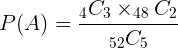
Lotto 649 Reflection
What is the probability of matching 4 of the 6 numbers in Lotto 649? Reflect in your Portfolio on how comfortable you are calculating combinations.
PermCombCalculator
Solution
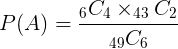 where there are 4 winning numbers and 2 losing numbers.
Number of Routes
As you have seen, combinations allow you to start looking at different types of scenarios and calculate probabilities that can be used to inform decisions. One of those situations is the number of ways to travel through a city.
Example
You are travelling through town and want to know how many ways there are to travel 4 blocks south and 3 blocks east. To save time, you will only travel south and east. At each intersection, you ask “How many ways to get to that intersection?” Watch the following video, paying close attention to the numbers created.
Below is a single slide containing multiple steps. Each time you click another step is revealed. To move through all the steps at your own pace, repeatedly click on the slide itself, the right and left arrow icons on the player or the arrow keys on your keyboard. Click the full screen button on the player if you prefer to see a larger version of the steps.
Does this pattern look familiar? Pascal’s triangle is created the same way.
Pascal's Triangle and Combinations
So where do combinations come in?
Let’s solve the problem in a different way. To get to the destination, you need to go south 4 times and east 3 times. That is a total of 7 roads to follow between intersections. We need to “choose” 4 of them (order not mattering) to be south OR “choose” 3 of them to be east.


There are 35 ways to go through the city and arrive at your destination.
 Consider the Connections
Analyze Pascal’s triangle to see if you can draw a link between the triangle and combinations.

Reflect on the Connections
Pascal’s triangle helps us understand the nature of combinations and allow us to calculate many combinations without having to go to a calculator. For example, it helps us understand that  and
and  are the same number. Record in Portfolio a reflection of the connection between Pascal’s triangle and combinations.

CONSOLIDATION
Reflections
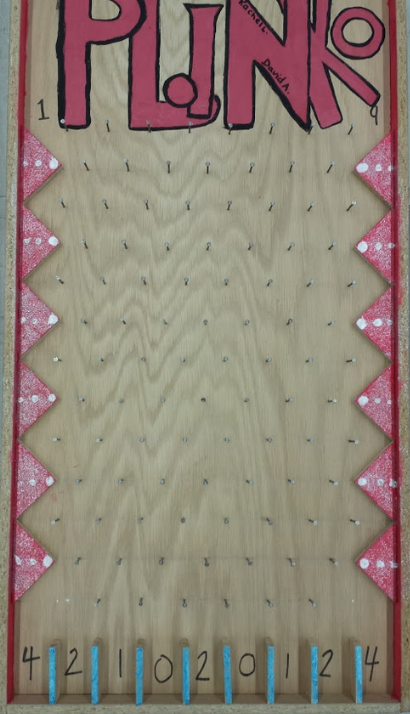
Use Pascal’s triangle to answer the following, then reflect on your answers and the link between combinations and Pascal’s triangle.


 Learning Goals and Success Criteria
 Learning Skills and Work Habits