
MEL4E
Unit 4: Families and Finances
Activity 1: From Single to Family


Priya has just recently married. Up until now, she has been single. She has a good job and a nice house.
She has always managed to save money because she lives a very simple lifestyle. Now, everything is different. Her new husband, Am, has a good job too, but his job does not pay nearly as much as hers.
Being a single parent, he has not managed to save any money. However, he has no debt either. Am’s 17-year-old son, Tosh, will be living with them. Tosh is planning to go to college after he graduates from high school. Priya and Am will pool their salaries and run their household with a single budget for the family.
 Consider: Budget Changes
Without seeing Priya’s current budget, what significant changes do you think Priya and Am will need to make to Priya’s budget?

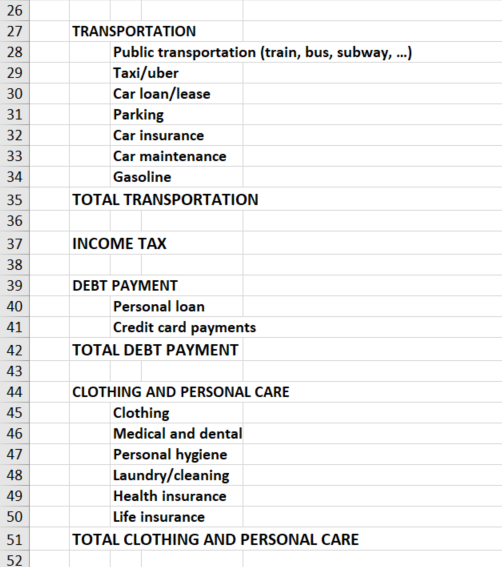
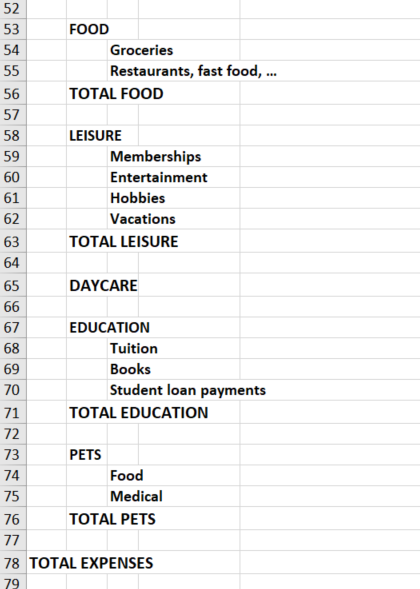
Here are some thinking prompts, consider these as you look at the various expenses that they might have:
- How will combining two incomes affect the budget?
- How will having two incomes affect the expenses?
- Which expenses are unlikely to change because there is more money available?
- Which expenses are likely to change because there are more people living in the house? How will they change and why?
- Which expenses are likely to change because there is more money available? How will they change and why?
- How would you classify the majority of the expenses that are going to change? Are they discretionary
or non-discretionary
Expenses that represent wants are known as discretionary expenses.
? FixedExpense that represent needs are called non-discretionary expenses.
or variableFixed expenses are expenses that stay the same or almost the same every month.
?Variable expenses are expenses that change from month to month.
- Note that you are not expected to suggest dollar amounts for any of the budget items. You are thinking about "what" will change, but not "by how much."
Record your thoughts in your notebook.

Changes
Priya finds herself having to cope with many changes in her personal life, including in her financial life. She knows that being married will change more than the household budget. She is sure that there are different income tax rules for married people, although she is not sure what they are. She also knows that families with children have different income tax rules and benefits.
Priya searches on the Canada Revenue Agency website to get more information about how being a newly married mother of a teenaged son will affect what she has to do to complete her T1 tax forms.
 Did You Know?
When you go from being single to being married, you are required to notify the Canada Revenue Agency by completing form RC65.
Under Canadian tax law, being married changes the way you file your annual income tax return. Having a spouse or common-law partner affects your tax rate. It may also make you to be eligible to receive additional tax benefits.
A spouse is a person to whom you are legally married.
A common-law partner is a person who is not your spouse, with whom you are living in a conjugal relationship, and to whom at least one of the following situations applies. He or she:
- has been living with you in a conjugal relationship, and this current relationship has lasted at least 12 continuous months. Note that "12 continuous months" includes any period during which you were separated for less than 90 days because of a breakdown in the relationship;
- is the parent of your child by birth or adoption; or
- has custody and control of your child (or had custody and control immediately before the child turned 19 years of age) and your child is wholly dependent on that person for support.
You can read more at the Canada Revenue Agency.
Priya also realizes that she now shares responsibility for a dependent child* and that she needs to find out if this will affect her income taxes. Your children are/is usually considered to be a dependent, whether they are biological children, stepchildren, or foster children. If the child is 19 or younger during the tax year, or if they are 24 or younger and also a full-time student, you may claim that child as a dependent.
Did You Know?
When you are newly married and your spouse’s children are now living with you, the CRA will move all the children to the female parent's CRA account. This means that any benefits that a male parent was receiving will transfer to the female spouse.
On the CRA site, Priya finds information for individuals and families that explains different aspects of income tax filing. From these resources, she finds out that she needs to provide information about her spouse on Page 1 of the T1 form.
Priya also learns that for "the CRA to calculate your benefits, both you and your spouse, or common-law partner, must generally file an income tax and benefit return every year, even if you have no income to report. If either you or your spouse or common-law partner has not filed a return, you have to file one so the CRA can send you certain benefits and credits."
Did You Know?
In Canada, everyone completes and files their own individual income taxes, regardless of their marital status. When two individuals are married or common-law partners, the two individual tax filings are linked together, to maximize credits and minimize the amount of income tax you have to pay.
Completing Page 1
Page 1 of your income tax return is where you would enter the following information about your spouse or common-law partner:
- your spouse or common-law partner's social insurance number;
- his or her first name;
- his or her net income for the year (line 236 of his or her tax return, or the amount it would be if he or she filed a return even if it is zero);
- whether he or she was self-employed in 2016. Tick the corresponding box in this area.
This example is from the 2016 tax year.
That part makes sense to Priya. She, Am, and Tosh are now a family, so it is reasonable that the CRA would link their personal information.
Complications - Benefits and Tax Credits for Families
Priya also learns about benefits and tax credits that may now be available to her because she has a spouse and a child.
Credits for Spouse or Common-Law Partner
She learns about Schedule 5 - Amounts for Spouse or Common-Law Partner and Dependants which has a "Spouse or common-law partner amount" tax credit. She cannot take advantage of it this year because Am makes too much money. If he decides to go back to school to improve his job prospects, as he has talked about doing, she may be able to use that tax credit.
An image of Line 303 of Schedule 5 (2016).
Did You Know?
The amounts that are calculated on Schedule 5 are reported on your T1 return on Schedule 1 - Federal Tax, in Step 1 - Federal non-refundable tax credits.
An image of Step 1 of Schedule 1 (2016)
A non-refundable tax credit is one type of tax credit. A tax credit is always used to reduce the amount of income tax you owe. Refundable tax credits act the same way as payments against your tax owing. With refundable tax credits, any amount that is not used to reduce your tax owing can be added to your tax refund (Line 484). However, any amount of a non-refundable tax credit that you are not able to use, to reduce your tax owing, cannot become a tax refund.
Child and Family Benefits
Priya and Am had wondered if their getting married would affect the Canada Child Benefit that he has been receiving. Priya looked into it.
In 2016, the federal government introduced the Canada Child Benefit (CCB):
- The Canada Child Benefit (CCB) is a tax-free monthly payment made to eligible families to help them with the cost of raising children under 18 years of age.
- A tax-free benefit is a payment that you receive as income, but that you do not have to include when you calculate your income. This way, you never have to pay income tax on this amount.
- Once you are receiving the CCB, you do not have to apply for the CCB every year. Parents simply need to file their taxes each year.
- The monthly CCB payment amount is based on the total family income from the previous year’s tax filings.
- To apply for CCB and other child benefits, you can complete this Form RC66.
Before getting married, Priya knew nothing about the Canada Child Benefit (CCB). She learned a lot about it by searching through the CRA site.
- The Canada Revenue Agency (CRA) administers the child and family benefit payments. The CCB is one of those benefits.
- Anyone who is a married or common-law spouse with children under 18 years old may be eligible to claim the Canada Child Benefit.
- Marital status affects how the CRA calculates benefits.
- The amount of the Canada Child Benefit depends on the number of children who live at home with the parents, the ages of those children, and the family’s net income.
Consider: Child Care Benefits
Do you think Priya and Am will still get the same CCB benefit that Am has been receiving? Why or why not?
Am knew that he used to receive a CCB of $4689.65, but he did not know how that was calculated. Priya had found a CCB calculation sheet on the CRA website, so she and Am filled it in to see if she would get that same amount.
This is their calculation sheet:
To complete the sheet, they needed to know Am’s adjusted family net income (AFNI). Priya had already looked up what that was. In Am’s case, his AFNI was the same as his net income, which they found on Line 236 of his income tax return.
 Assignment: CCB Calculation Sheet
Using Am’s CCB Calculation sheet as a guide, rework Priya and Am’s CCB calculation sheet, taking into account that the family now has two incomes to consider.
Their adjusted family net income (AFNI) is $81 515.70. You will need this information.
Use this blank calculation sheet to input and save your values.
Priya began to panic: "My taxes used to be so easy! There are too many things to remember now. I’m not sure I know what I should do. It would be easy to make a mistake that would cost us money. We need help." Priya set out to investigate income tax preparation products and services.
 Enrichment
If you are interested in learning more about how having a married status affects the filing of personal income taxes, visit the CRA site.
Here you will find links to more specific information.
For more information about the benefits available to families, go to the CRA Child and Family Benefits page.
For more information about benefits that you or someone in your family might qualify for, see the Government of Canada Benefits Finder.
 Introduction
 Learning Goals and Success Criteria
 Learning Skills and Work Habits
 Rubric 1