
MEL4E
Unit 6: Mathematics and Design
Activity 1: Seeing the World with Mathematical Eyes

Shapes are all around us. As we walk through the streets, as we do grocery shopping, as we sit in the park, we are surrounded by shapes.
In the slideshow below, you will see five different images: the Giant's Causeway in Ireland, a perfume bottle, London England's skyline, a popular toy and a staircase.
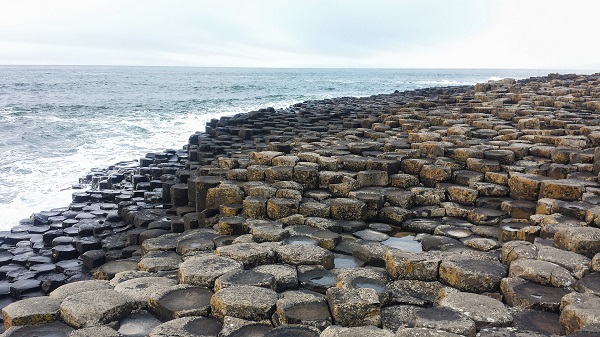
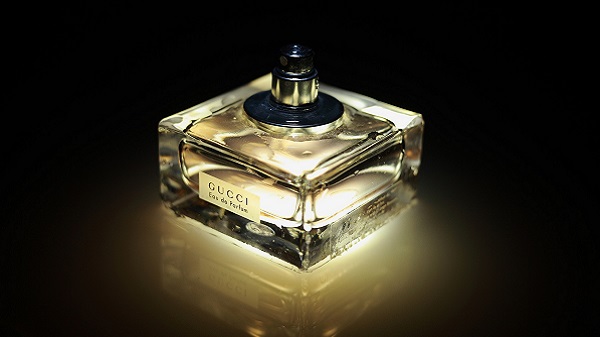
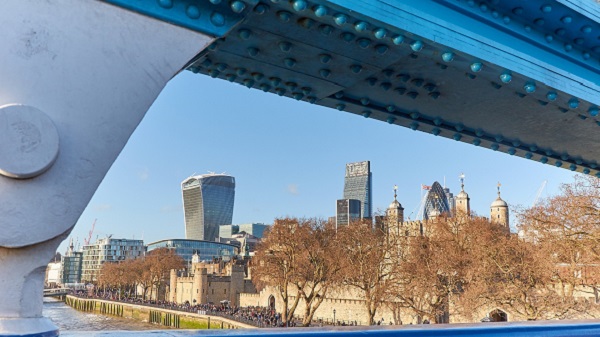
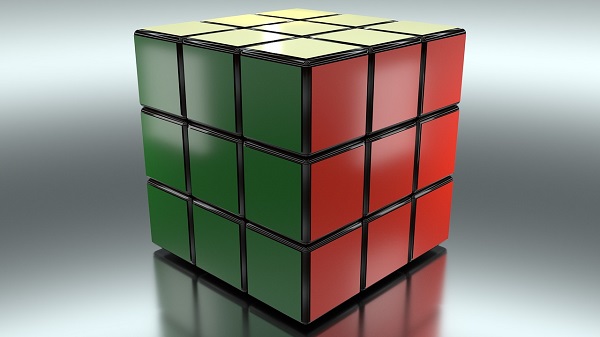
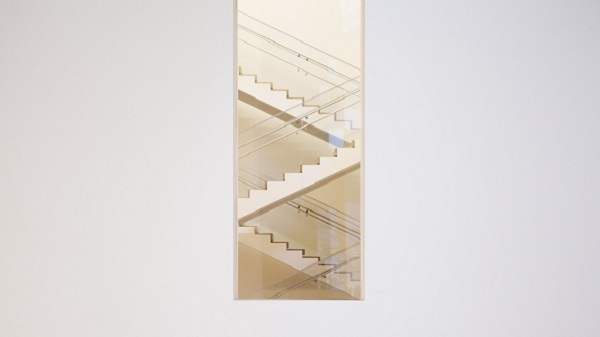
 Consider: Shapes All Around
Select two or three of the images that most interest you. Describe what shapes you see.
Before building an object, that object is designed and its construction is planned.
 Think About...
Think about one of the objects from the slideshow. What steps do you think were involved in designing and constructing that object? Record your thinking in your notebook.
Designing and constructing objects involves math. At every step, there is a real math problem to be solved:
- What shapes do I want to use?
- How can I put the shapes together?
- How can I represent an object as a drawing on paper or on a computer screen?
- How large should the object be?
- What will its dimensions be?
- How do I scale up from my paper design to the actual physical object?
- How much material will I need to make the object?
- How much will the materials cost? What is my budget?
- How will I ensure that my object is sturdy and safe? (The sculpture cannot topple over onto people. The building has to withstand wind and weather. The toy should not break soon after it is bought. The staircase cannot collapse if there are many people on it. The perfume bottle cannot shatter when someone pulls off the cap.)
Some objects must also find customers who want to buy it. The perfume bottle and the toy are designed to be attractive to customers. Businesses often do research before releasing a new product. They gather data about customer responses to various designs. They analyse that data. More math.
Think About...
Go back to your notebook and revisit the list of steps you thought of that were involved in designing and constructing the object. How many of the list above did you think of? Did you think of anything that were not on this list?
The Measurement of Objects
The objects that you saw in the slideshow involved several different shapes. Can you identify them?
Objects can be described by their size in two ways: Volume and Surface Area.
Volume
A can of soda has a volume. The volume is 12 fluid ounces, or 355 mL. The volume measures how much the can can hold. It tells you the capacity of the inside of the container -- how much soda you are getting. It also tells you how much space the can will use up if it is stacked on a shelf.Surface Area
Because the can is a container, it also has an outside -- the part you hold when you lift the can. The outside of the can is a surface. This surface has an area. We call this the surface area.Dimensions
The volume and the surface area are connected to each other by the dimensions of the can. The dimensions of the can are: 4.83 inches high x 2.6 inches in diameter for the body of the can, and a slightly narrower 2.13 inch diameter at the top of the can. The dimensions determine both the volume and the surface area of the can.The height of the can is 4.83 inches or 12.27 centimeters.
The diameter of the top of the can is 2.13 inches or 5.41 centimeters.
The diameter of the body of the can is 2.6 inches or 6.6 centimeters.
The Geometry of Objects
Think About...
Imagine that the cylinder in the image below is full of water.
From Mathematics Assessment Resource Service University of Nottingham and UC Berkeley
The water flows out through a pipe at the bottom of the cylinder.
Imagine looking down on the cylinder as the water flows out of it.
What shape will you see as the water is flowing out of the pipe?
Draw the shape of the surface of the water at five different levels in your notebook.
When you are done, use the interactive below to see how your drawings compare to what would really happen.
Think About...
Now imagine that there is a second cylinder that collects the water that was flowing from the top cylinder.
The bottom cylinder is oriented differently (see the image below).
Again, imagine looking down on the bottom cylinder.
- What shape will you see as the water is flowing into the pipe?
- Draw the shape of the surface of the water at five different levels in your notebook.
When you are done, use the interactive below to see how your drawings compare to what would really happen.
Connecting Perimeter, Area, Volume, and Surface Area
The 2D view of a 3D object allows us to design objects on paper. In doing this, we are connecting the volume and surface area of the 3D object to the area and perimeter of the 2D view. We may need to use information about the inside (volume, area) and the outside (surface area, perimeter) to solve problems.
A candy company had a competition for the design of a cardboard container that will hold 18 candies.Two employees, Sara and Jin, were in charge of judging the designs. There were a few specifications that had to be considered in the design:
- The candies should be packed closely together. The container should not be so large that the candies bounce around and get damaged.
- The candies are cylindrical.
- Each candy is 1 cm deep and 2 cm in diameter.
A designer, Shoaib, presented the following rectangular prism design for the box:
The first thing the judges did was to check: Will the 18 pieces of candy fit into Shoaib’s design?
Their Calculations:
Sara chose to compare the space needed by the 18 candies to the space inside the box. Sara was thinking about volume.
To determine the volume of the candy, this is what Sara did:
I typed "volume of cylinder" into Google. I had to put in the height and the radius of the candies.
I know that diameter, which is 2 cm, is two times the radius, so the radius is 1 cm.
The height is 1 cm.
The volume is about 3.14 cm3.
There are 18 candies, so the volume of the candies is 18 x 3.14 cm3.
Volume is about 56.52 cm3.
To determine the volume of the candy, this is what Sara did:
I know that a box is a rectangular prism.
I typed "volume of rectangular prism" into Google. I had to put in the height, length, and the width.
The height is 2 cm.
The length and width do not matter, so I put 5 for length and 4 for width. (If I multiply 4 x 5 or 5 x 4, I get the same answer.)
The volume is 40 cm3.
The box has a smaller capacity than the candy needs, so it will not fit.
Jin’s thinking:
The bottom of the box is a rectangle.
It is 5cm long by 4 cm.
The candies are 2 cm across, so you could put four candies along the bottom of the box.
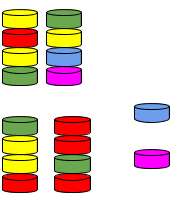
He reasoned that if you did that, you would need to have four in each stack, and two stacks would have five candies. He represented his reasoning by drawing a diagram.
Each candy is 1 cm high, so the stack of four candies would need a box that was 4 cm high. The box was only 2 cm high, so it could not hold a stack of four candies, let alone a stack of five!
Sara and Jin both concluded that this box was not designed to hold 18 candies, but they used different reasoning. Sara’s first thought was to think about volume. Jin started thinking about area, and then added height into his reasoning. In his solution, he was connecting to surface area -- could the box cover the candy?
Consider: Designing a Box
You are going to get a chance to design your own candy box!
You have a lot of choice in regards to how you would like to design the box. You can create scale drawings on grid paper, or you can actually build the box and submit photographs or a video of your box.
Designs must take into account the same specifications as were used by Shoaib:
- The candies should be packed closely together. The container should not be so large that the candies bounce around and get damaged.
- The candies are cylindrical.
- Each candy is 1 cm deep and 2 cm in diameter.
Additional Assignment Requirements:
- Your container design may use rectangular prism, triangular prism, or cylinder shapes.
- Your design must include all the dimensions that would be necessary to construct the containers.
- You must show that you have checked that your design will hold 18 candies.
 Resources
 Introduction
 Learning Goals and Success Criteria
 Learning Skills and Work Habits
 Rubric 1