
Algebraic Equations Can Be Expressed in Equivalent Ways
Solving Triangles - 1

MINDS ON
Solving equations is a regular occurrence in mathematics. The equation is a general representation of a pattern; you solve the equation when you want to know the details of a specific situation. Many of the patterns that we experience in daily life involve proportions which can be solved in various ways.
 Solving an Equation
Using the internet, search for “situations where solving an equation will help.” Choose one situation that interests you. Write a short description of the topic and save in to yoour Portfolio.
In Unit 2, you explored solving proportional relationships using a ratio table, an equation and a linear relation. In that activity, most of the values in the equations were greater than 1. Here, you will focus on solving proportional equations that include fractions or decimal values.
Example 1: Solve the following equations
Look at the two equations below. Predict if the answer is greater than 1 or between 0 and 1. Have a reason for your prediction.

When you have made a prediction, can you try to solve the equations. You can check your answer here.
Example 2: Solve the following equations
Look at the two equations below. Predict if the answer is greater than 1 or between 0 and 1. Have a reason for your prediction.

When you have made a prediction, can you try to solve the equations. You can check your answer here.
Explaining your Steps
The variable, x, was either in the

ACTION
 Mathematical Processes
In this activity, the Mathematical Process Selecting Tools And Computational Strategies is the focus.
Open your document U3 Mathematical Processes and read the description for the process.
As you complete the activity, notice when you are considering the information given before you choose a strategy and insert your record below the description of the process.
Save to your Portfolio.
In Unit 2, you learned:
- the names for the sides of a right triangle based on a reference angle;
- the definitions of the three primary trigonometric ratios (trig ratios);
- to use a calculator to determine a specific trig ratio for a given angle;
- to set up a solution to solve for an unknown value using a trig ratio.
In this activity, you will be using all this information along with your equation-solving skills to solve for the unknown values in applications that can be modelled using right triangles.
Values of Trigonometric Ratios
In Unit 2, Activity 3 you completed the Record of Ratios, recording the values of the trigonometric ratios for various angles from the Geometer’s Sketchpad Exploration. You also learned that the values are available on a scientific or graphing calculator or a math app on your computer, phone, or tablet.
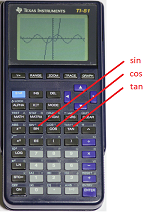
You will need your chosen device to complete the work today. Verify that it is working in degrees (not radians). Remember, not all calculators or software operate the same! Ask your teacher for help with checking the degree/radian setting and how to use the sin, cos and tan buttons.
You have some work saved from Unit 2, Activity 4. Open your partially completed copy of U2A4 Examples where you completed the solution set-up for the Unit 2 Activity examples and the additional questions on the page. You checked your work at the end of the activity.
The value for many trigonometric ratios are decimal values that go on and on, i.e. they are non-terminating decimals. It is impossible to write the value in your calculations. When completing work by hand using trigonometric ratios, correctly round the ratio to 4 decimal places. When the final answer in a problem is the side length of a triangle, round the answer to 1 decimal place. When the final answer in a problem is an angle, round to the nearest whole angle.
Examples:
Download and open this first example document. It takes you throught two examples of using trig ratios and one example of using pythagorean theorem.
In mathematics, you use inverse operations to ‘undo’ a calculation. Some inverse operations that you use are:
- subtraction and addition: 5 + 8 = 13 so 13 - 8 = 5
- multiplication and division: 4 x 7 = 28 so 28 ÷ 7 = 4
- squaring and taking the square root: 62 = 36 so
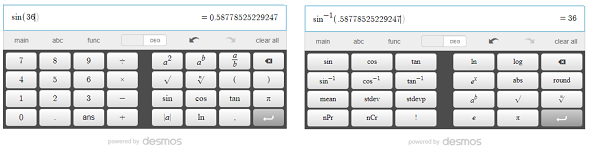
Trigonometric ratios are operations. In the same way squaring operates on a number to give you a number, the trig ratios operate on an angle to give you a number. The inverse of the squaring operation is the square root operation. The inverse of the sine operation is call the inverse sine operation. Similarly the cosine and tangent operations have inverse cosine and inverse tangent operations. As the square root operation undoes the squaring operation, the sine inverse operation undoes the sine operation.
If you know an angle, you can use the sine, cosine, or tangent operations to find the ratio, and if you know the ratio you can use the corresponding inverse operation to find the angle. In the image, notice the notation, sin-1. The ‘-1’ tells you that you are using the inverse operation and finding the angle for a given ratio. To access this feature on the desmos calculator, press the ‘func’ button along the top.
Look for the sin-1, cos-1, and tan-1 on your calculator.
Often they are written above the buttons sin, cos and tan. The inverse trig ratios are often reached by pressing the 2nd button, then the trig ratio that you are using.
Remember, not all calculators or software operate the same! Ask your teacher for help in using your calculator.
Download and open this second example document. It includes two examples of solutions using trig ratios.
Be sure to review both example documents so that you can understand how trig ratios are used to solve problems.
Further Practice
Watch the following video that shows how a student uses trigonometry to determine the height of the Statue of Liberty:
For further practice using the inverse trigonometric ratios to solve for an angle in a triangle, complete this Khan Academy activity.
Make sure that you round your answer as requested in the question.
In U3A7 U2A4 Examples, complete the questions in the right column and on the last page. Check your solutions when complete.
Working with Triangles
In Unit 2, Activity 4 you created a document, Working with Triangles.
Open your document and update previous entries or add new entries for using the primary trigonometric ratios and the Pythagorean Theorem to solve problems.
Consider the information that can be given and the value which you need to determine. How do you decide which ratio to use? Remember that you can list each relation more than once in the chart.
Save to your Portfolio.

CONSOLIDATION
Mathematical Processes
Complete your entry for the Mathematical Process Selecting Tools And Computational Strategies in the document U3 Mathematical Processes.
Save to Portfolio.
You have revisited the relationships between the side lengths and the angles of right triangles and how they can be used to determine unknown side lengths or unknown angles. You used the primary trigonometric ratios, sine, cosine and tangent, to create equations that can be solved to determine an unknown value.
You can use your calculator or another tool to determine the value of a ratio when given the angle and you can also determine an unknown angle when you have the value for one of the trigonometric ratios.
You will continue to gain more experience using the trigonometric ratios in the next activity.
Congratulations, you have completed Unit 3, Activity 7. You may move on to Unit 3, Activity 8.
 Learning Goals and Success Criteria
 Learning Skills and Work Habits