
MFM2P
Unit 4: Using Our Skills to Solve Problems
Activity 2: Problems - Different Ways to get the Answer


Earlier in the course, you investigated the properties of similar triangles and used a word journal to record everyday meanings of the word ‘similar’ along with the mathematical definition of similar. You identified similar triangles using the corresponding equal angles. Using proportional reasoning, you determined the lengths of sides in similar triangles and made connections with the applications in real life situations.
simTriangles

 The Mathematical Processes
In this activity, the Mathematical Processes Problem Solving and Communicating are the focus.
Open your document U4 Mathematical Processes and read the descriptions.
As you complete the activity, notice when you are thinking about the solution and how it is being presented.
Insert your record below the description of the process.
The Great Pyramid of Giza, also known as the Pyramid of Khufu, is the oldest and largest pyramid in the world.
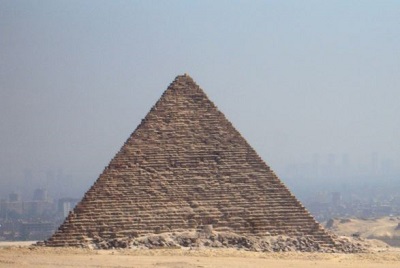
Every year, many people travel to Egypt to visit the massive structure and to learn more about the world when it was built. Other people learn about the Great Pyramid in the comfort of their home using different media sources to study the topic.
In this first task, you will use linear relations, approximate values for ordered pairs, a scale diagram, and conversion factors to determine the height of the Great Pyramid of Giza. Round your answer to the nearest integer.
The Important Book
You have been creating The Important Book to clarify the important concepts and skills in the different parts of the course. Open your document.
Do you have something written that gives you a suggestion about what you may do to solve the problem? Do you need to add something? What would you add?
Keep your document open as you follow the activity.
You may want to add to or change some of the information in your book.
Remember to save your document to your Portfolio.
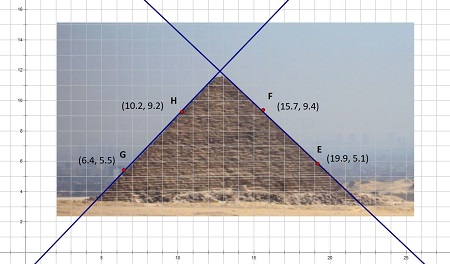
How can you determine the height of the pyramid on the grid? What information do you need? What information have you been given? Can you make a plan that lists the steps to follow? Do you have information in your document, The Important Book, that could help you start?
One plan could be:
- Use the two approximate points along the left side to determine the equation of the line.
- Use the two approximate points along the right side to determine the equation of the line.
- Use an algebraic method, substitution or elimination, to determine the point of intersection.
- Use the point of intersection to determine the height of the pyramid on the grid.
- Use a scale factor to determine the height of the actual pyramid.
Below is a solution that follows this plan.
Determining the Height of the Pyramid
- Determine the equation of the line along the left side using the points (10.2, 9.2) and (6.4, 5.5).
Determine slope:
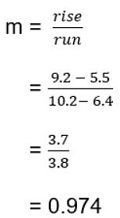
When working with decimal values and many calculations, it is always better to float additional decimal places as you complete the work. Do the final rounding for the last calculation. Rounding to the final form at each step introduces error with each calculation.
Determine the value of the y-intercept using the point (10.2, 9.2)
y = mx + b
9.2 = 0.974 (10.2) + b
9.2 = 9.935 + b
9.2 - 9.935 = 9.935 - 9.935 + b
-0.735 = b
Determine the equation of the line along the right side using the points (15.7, 9.4) and (19.9, 5.1).
y = -1.024x + 25.477
Determine the point of intersection algebraically.
The equations are in slope y-intercept form and it is difficult to determine a factor to create equivalent equations. The method of substitution will be used.
y = 0.974x - 0.735 and y = -1.024x + 25.477
|
Substitute the expression, 0.974x - 0.735, for y, in the second equation. |
0.974x - 0.735 = -1.024x + 25.477 |
|
Isolate x. |
0.974x + 1.024x - 0.735 = -1.024x + 25.477 + 1.024x |
|
Simplify. |
1.998x - 0.735 = 25.477 |
|
Continue to isolate x. |
1.998x - 0.735 + 0.735 = 25.477 + 0.735 |
|
Simplify. |
1.998x = 26.212 |
|
Solve for x. |
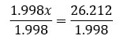
x = 13.119

Use the point of intersection to determine the height of the pyramid on the grid.
How can you use the point of intersection to determine the height of the pyramid on the grid? What does the ordered pair indicate? What other information do you need to use the value(s) in the ordered pair?
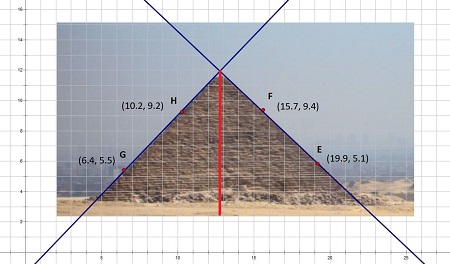
If the base of the pyramid was positioned on the x-axis, the y coordinate of the point of intersection would be the height of the pyramid. In this case it is not. If you know the equation for the horizontal line where the pyramid is positioned, then you will be able to determine the height on the grid.
With the horizontal line added to the diagram, you can write the equation for the line using an estimated value for the y-intercept, y = 4.
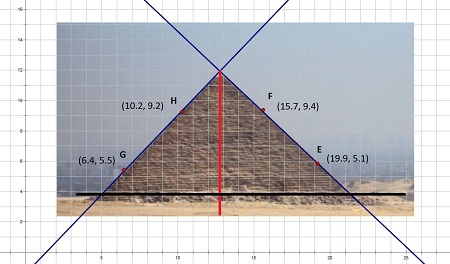
The vertical height of the pyramid is the difference in the y values, 12.043 - 4 = 8.043.
Determine the actual height of the pyramid. The scale is 16 m for every 1 unit on the grid.
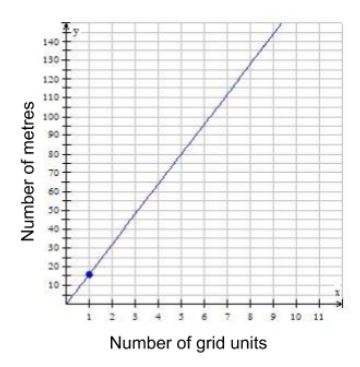
There are many strategies that you can use to determine the actual height. You can plot points to draw a line, write a linear equation, or write a proportional equation. What have you written in The Important Book?
Choose one of the methods and determine the height. Check your answer.
Actual height of the pyramid is: 128.688 m, which can be rounded to 129 m. This value was found using the equation, y = 16x where x represented the number of grid units and y represented metres.
How does your answer compare to the actual height of the Great Pyramid of Giza? Check your answer against Google.
How does the height of the Great Pyramid of Giza compare to structures in Ontario or in your home country if you were not born in Canada? Most of the tall structures that you found were probably built in the 20th or 21st century. The pyramid was constructed in 2560-2580 BC; which is approximately 4000 years ago. How was this possible? This is why it is a wonder!
Using mathematics that you have learned in the course, you were able to CALCULATE a value that you would not be able to MEASURE. How could one know how tall the pyramid is without using mathematics? Many distances that cannot be measured directly can still be determined using mathematical concepts and tools.
In the second task, you will use the scale model to determine the angle of elevation of the sides of the Great Pyramid of Giza. What information do you need to determine the angle? How will you determine the values? Round your answer to the closest angle.
Determining the Angle of Elevation of Sides
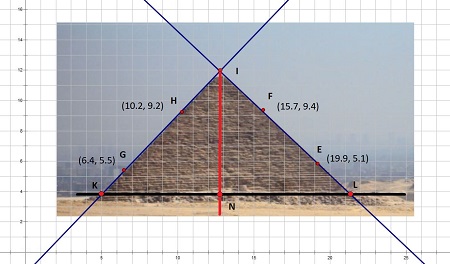
How can you use the image to determine the angle of elevation between the base and the sides of the pyramid? Do you have information in your document, The Important Book, that will help you start? Which topic of study was focused on angles? What values will you use to complete the work? What looks familiar? What looks different?
 Steps for Angle of Elevation
Write a plan of the steps that you will follow to determine the angle of elevation of the sides of the pyramid. Include how you will determine the values for your calculations. Explain why you can use actual values or the values on the grid.
Share your plan and explanation with your classmates in a discussion. Choose one classmate and read their plan.
When reading the work of other students, make comments or ask questions. Possible sentence starters are:
- You wrote that … I didn’t see that situation. How do you know?
- You used general words to … It would be clearer if you …
- You rewrote the … which I didn’t do. Why is that important?
- I noticed … I wonder if …?
Steps...
Use the feedback that you receive on your steps for angle elevation to make any changes to your explanation. Save to your Portfolio.
What lengths do you know?
- the vertical height of the pyramid
What other lengths can you determine from the grid?
- the length of the base or half of the base of the pyramid
With the vertical height and the base length, you can determine the angle of elevation on both sides.
The length of the base is the distance between the two points, K and L on the image. Find the x coordinates of the points of intersections between the horizontal line, y = 4, and the line for the side of the pyramid.
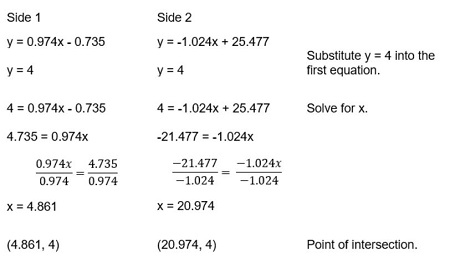
You could have estimated the ordered pairs from the image. Could you have determined that level of accuracy from the picture? By using mathematics to calculate the points, you continued using only the first set of estimated values and have not introduced more.
Look at the vertical line between the base of the pyramid and its apex. You can estimate a value for the equation of the line, e.g. x = 13.1. To determine the length of the base of the triangle on each side, you can determine the difference between 13.1 and the calculated x coordinate at the ends.
- Side 1: 13.1 - 4.861 = 8.239
- Side 2: 20.974 - 13.1 = 7.874
The two values are not the same.
You can also determine the value using the coordinates that you calculated; determine the difference between the two values and divide by 2.
- half the length of the base
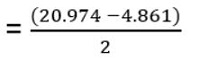
- half the length of the base = 8.057
A different value again. Which one should you use?
Maybe someone in your group estimated the ordered pairs, rather than calculated them, and had a different value for the length of half the base.
Three Methods
Three methods have been outlined to determine the length of half the base of the pyramid:
- calculating the ordered pairs using intersection of lines and determining half the value as the base of the triangle (8.057 above);
- calculating the ordered pairs using intersection of lines and estimate the equation for the vertical line and determining the distance between the two 8.239 and 7.874 above);
- estimating the ordered pairs from the image, subtract the value of the x coordinates and divide by 2.
Perhaps you have been tasked with the problem to determine the angle of elevation and, in your team, members get 3 different answers for the base length of the triangle. What do you think you should do, and why?
Share your reasoning with your classmates in a discussion. Choose one classmate and read their reasoning. When reading the work of other students, make comments or ask questions. Possible sentence starters are:
- You wrote that … What if …?
- You used general words to … It would be clearer if you …
- You suggested … Why is that important?
- I noticed … I wonder if …?
When you lay a grid on top of a picture, then estimate values for the ordered pairs to do calculations, it is possible for errors to become a part of the work. In this example, the two halves of the square base are not equal; in standard textbook questions, this would not happen. Greater accuracy could be achieved using different photographs and certain technology. Greatest accuracy occurs when a photograph is taken with a purpose in mind; the emphasis will be on accuracy, not a pleasing image.
Check your document, The Important Book. What information have you listed to support your next step? Which trigonometric ratio will you use?
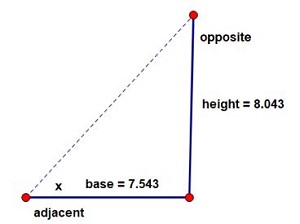
Draw and label a sketch. You have the opposite and adjacent sides for the angle. The tangent ratio uses the two side lengths. The opposite side is the height, which we found to be 8.043. The adjacent side we calculated to be 8.057. We will make the assumption that both sides are the same.
Left Angle of Elevation - Let x represent the unknown angle.
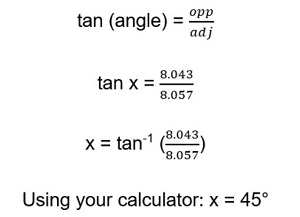
Check your answer against Google.
Using the Great Pyramid of Giza, the Pyramid of Khufu, you:
- wrote equations of linear relations using points on a graph
- determined the point of intersection
- used the point of intersection and scale to determine the vertical height
- determined base lengths
- determined the angle of elevation
- compared your calculated values to the actual values
More Pyramids
In the Valley of the Nile, there are 6 pyramids including the Pyramid of Khufu. When the pyramids were completed, their outside surface was covered with casing stones. The casing stones were highly polished white limestone. Over time, the casing was destroyed by earthquakes. Many of the stones lay at the base of the pyramids; they were often carried away to be used in other buildings. Today, only remnants of the casing stones are found at the bottom of these pyramids.
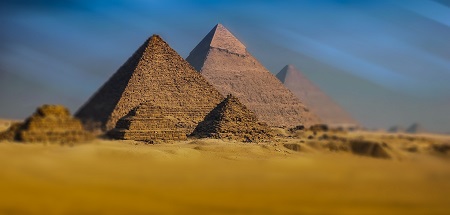
The Pyramid of Kharfe is another pyramid in the Valley of the Nile. It can be easily identified as it still has some of the limestone casings at the cap. It appears taller than the Pyramid of Khufu due to being built at a higher point.
How does the Pyramid of Kharfe compare to the Pyramid of Khufu? Are the two pyramids similar? How would you determine if they are similar?
 Pyramid of Kharfe
You will be working with a partner to determine the height of the Pyramid of Kharfe and to determine if it is similar to the Pyramid of Khufu.
Show your work that supports your answer. A picture of the Pyramid of Kharfe with the grid on top is available to use.
To complete this assignment:
- Individually, look at the information and think about what you will do.
- Write a series of steps that you plan to follow.
- Share your steps with your partner and your teacher.
- Read your partner’s plan. Consider how your partner's plan is similar to your plan and how it is different. Make comments about steps that you agree with and ask questions if something is not clear.
- Return the annotated plan to your partner.
- Review the comments that you receive from your partner and your teacher.
- Make your final plan in consultation with your partner.
- Solve the problem keeping a record of the work as you complete the solution with your partner. You may ask your teacher questions or ask for a Hint Card; both you and your partner must agree to ask.
- Submit your final plan and solution, including all your work, to your teacher.
Your teacher will provide feedback on problem solving and communication.

Your work in Unit 4 has involved a review of the course concepts and skills along with a focus on problem solving and communicating. You have followed one method of solving the problems. Sometimes there are other solutions that will produce the same answer. It is possible that one method is a better choice than another. In the real world, when mathematics is used to solve real problems - problems that don’t have answers at the back of a textbook - decisions must be made at every step along the problem-solving process, and each decision may change the answer that you get. The role of mathematics is to help people to get the best possible answer rather than the “correct” answer.
When you worked with your partner, you may have had different ideas about how to complete the task you were assigned. Through communication, you settled on a plan to follow. Sometimes, you may choose a method that other people have not anticipated. Having a plan and solution that is clearly communicated guides the other person to understand your work.
The Mathematical Processes
Complete your entry for the Mathematical Processes Problem Solving and Communicating in the document U4 Mathematical Processes.
Some questions to consider: Did you use diagrams to present the solution? Did you write your solution clearly so that others can follow your reasoning?
Save to your Portfolio.
The Important Book
You have revisited some of the concepts that you learned in the first three units of the course. Were some concepts easier to recall than others? You also used the concepts and skills differently. Did you use The Important Book to bring to mind a concept that you had forgotten or needed to verify? Was the information already included or did you need to change your entry?
Review the rubric and remember to update your document as you complete this unit.
Save your document to your Portfolio.
You will be submitting your final version at the end of the unit.
 Learning Skills and Work Habits Self-Assessment
Consider the learning skills and work habits you demonstrated as you completed this activity. You are to complete this self-assessment of your learning skills in order to move on to Activity 3. Your teacher will read your self-assessments and may use them to help you set next steps in your learning.
The Learning Skill you will focus on for this assessment is initiative.
To remind yourself how initiative can be demonstrated, click on the Learning Skills and Work Habits icon
As you complete the remainder of this unit, keep this learning goal in mind and consider how you might demonstrate that you have achieved it.
Congratulations, you have completed Unit 4, Activity 2. You may move on to Unit 4, Activity 3.
 Introduction
 Learning Goals and Success Criteria
 Learning Skills and Work Habits
 Rubric 1