
PPZ3C
Unit 1: Factors That Determine Good Health
Activity 1: Who are You... Who? Who? Who? Who?

The World Health Organization defines the social determinants of health as the following:
...the conditions in which people are born, grow, live, work, and age. These circumstances are shaped by the distribution of money, power and resources at global, national, and local levels. The social determinants of health are mostly responsible for health inequities - the unfair and avoidable differences in health status seen within and between countries.
Baz Luhrmann’s video, "Everybody's Free To Wear Sunscreen" was released in the ‘90s. It was based on the lyrics from a famous essay written in 1997 by Mary Schmich, a columnist with the Chicago Tribune. It gives some amazing advice for life.
Maybe you'll marry, maybe you won't.
Maybe you'll have children, maybe you won't.
Maybe you'll divorce at 40, maybe you'll dance the funky chicken on your 75th wedding anniversary.
Whatever you do, don't congratulate yourself too much, or berate yourself either.
Your choices are half chance.
So are everybody else's.
As you watch this music video think about what advice you would give to your six-year-old self.
Would you tell yourself to do something different?
Take different risks?
Enjoy different life experiences?
Try to make more friends?
Take a few minutes to find a quotation that conveys one thing you would be most likely to tell your six-year-old self.
Continue to think about these questions as you work through the course, begin to learn about the factors that affect your health and wellbeing, and explore what it means to live your own version of a healthy life.
A social support network is defined by the World Health Organization as "Many factors (that) combine together to affect the health of individuals and communities". If you are going to be a healthy person who has healthy relationships with others, you need to consider the following "Determinants of Health":
- the social and economic environment;
- the physical environment; and
- the person’s individual characteristics and behaviours.
A person’s health and wellness are not always a result of the decisions she or he does or does not make. A person’s health can also be affected by other factors. View the infographic or watch and listen to one of the two following videos to learn how the social determinants of health have an impact on your personal health:
Open this infographic as a pdf document
Test your understanding of the social determinants of health by completing the following interactive activity:
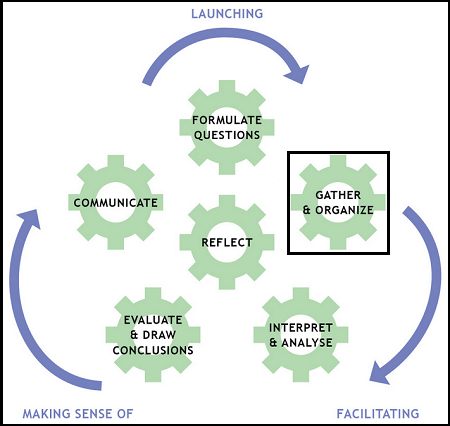
Inquiry Based Learning is a process that will be used throughout this course to help you explore the concepts in Health For Life and further develop your critical and creative thinking skills. This inquiry icon will appear throughout the course whenever the Inquiry Process is being reflected in the activities. The component(s) of the Inquiry Process that is the focus for our learning will be highlighted.
Have You Ever Wondered?
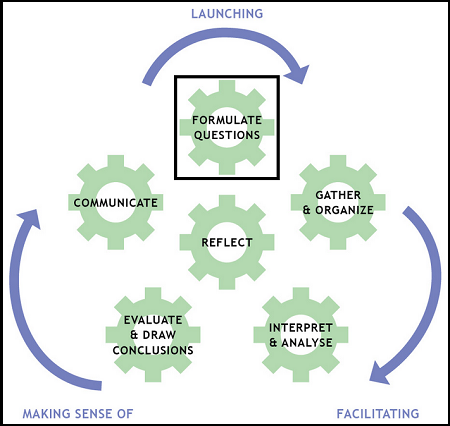
Have you ever wondered how something works? Have you ever asked yourself things like "why do bad things happen to good people?" When a question comes up and you don’t know the answer... do you Google it?
Inquiry is all about exploring and investigating questions, finding relevant and reliable information to explain a decision, solution, or stance, and then sharing that new knowledge with others.
Inquiry begins with a question or a wondering. Coming up with an inquiry question about a topic can be challenging. To get started, it can help to use an image to provoke your thinking by brainstorming what you actually see in the image, what you think about it, and what you wonder about it.
Here is an example to help demonstrate the task:
I see:
- a group of adults casually dressed, walking in groups of two or three;
- the group about 10 feet behind the first three people;
- one person carrying a walking pole and wearing a yellow vest.
I think:
- the person in the vest may be the leader;
- it may be spring or fall.
I wonder:
- how long they’ve been hiking?
- if the person in the vest works for Parks Canada?
Your turn! What do you wonder about when you look at the above picture?
 Assignment: What Questions Do You Have?
Let’s investigate social support networks using some visuals.
Choose one of the images below and use this See Think Wonder chart to record your answers.
Look back to the Minds On activity if you need to see some sample questions.
Assignment: My Social Support Network
Think about your social network. How does it support you on an emotional and social level?
Once you have finished your reading, answer the following questions.
- Who are the people who are a positive support for your mental health and wellness? Identify and describe two people in your social network who are the positive support for your mental health and wellness.
- What do they say or do that helps you? For example, do they give you emotional support or practical help, share their point of view, or give you helpful information?
- In what ways do you think you contribute to their positive mental health and wellness?
- Identify three ways you make your social network stronger.
- When might you want to change your social support network?
Assignment: A Letter To My Six-Year-Old Self
?
As You Watch...
Video 1 - Think about how this advice would really help a younger person make healthier life choices.
Video 2 - What do you notice about how the four-year-old speaks of her own young life?
Perhaps you have considered why you are taking this Health for Life course and you understand what you hope to get out of it. You now understand the importance of a strong social support network and know how to make it strong. So, what if you could go back and give advice to your six-year-old self? Would you tell yourself to do something different? Would you take different risks? Would you enjoy different life experiences? Would you try to make new friends when you could? What if you could go back and do the last ten years over again? How would they be different?
Write a letter of advice to your six-year-old self that includes this advice:
- why it is important to build healthy relationships;
- ideas for how to build these relationships;
- specific advice for improving your social support network, such as taking a risk by trying out for that basketball team in Grade 7 because you will grow five inches in Grade 8;
- how following this advice will pay off for your future self.
If you need some ideas to consider when writing your letter, watch the following videos:
Video 1 - This video is an example of adults giving advice to their former selves about actions they would have taken to avoid being diagnosed with cancer.
Video 2 - This video is advice from a four-year-old.
Finally, just to reiterate...
Social Determinants of Health are nine factors outlined by the World Health Organization (WHO).
They include:
- early life
- stress
- work
- income
- transportation
- availability of food
- social support
- social exclusion
- addiction
Being healthy means you have physical, mental, and social well-being.
 Introduction
 Learning Goals and Success Criteria
 Learning Skills and Work Habits
 Rubric 1