
Interactions and Change
Plant Growth

MINDS ON
Shifting Gears

Our focus in the Structures Unit was structure and function and how we classify life. Now the gears are going to shift as we put the focus on the connection between life, environmental factors, and human influences.
You will start here by looking at plants and how they grow and react to various factors. It is easy to think of plants as simple bits of organic matter that need to be mowed every week or so, but these life forms react to their environment just as many other organisms do.
Actually, many of the processes found in animals can be found in plants, as well. Where we have the circulatory system, more complex plants have a dedicated vascular system. Both plants and animals rely on gas exchange, only we breathe air in through the respiratory system as compared to using stoma. Humans are heterotrophic and need to digest food while plants are autotrophic and produce their own food through photosynthesis. However, both kingdoms rely on cellular respiration to produce energy. As you can see, we really aren’t that different!
Plants can produce many generations quickly, which gives us the chance to see changes that various interactions and factors can create in a relatively short amount of time. In fact, you will see that the regular ol’ pea plant is responsible for much of the inheritance theory that we have today! More about that in later activities.
Let's Get Growing!
Incredible, right? This is a time-lapse photographic sequence of bean seed germination, where both the root and shoot system can be seen developing. Let’s test some previous knowledge!
 Challenge Question!
Is a bean plant a monocot or dicot, and how can you tell based on the seed germination video alone?
Beans are dicots. The last part of the film focuses on the two cotyledons or ‘seed leaves,’ which is one of the identifying features of a dicot plant. In addition, fibrous roots are developed by dicots, whereas monocots produce tap roots.
Germinate Your Own Seeds Procedure
To germinate seeds at home, follow this simple procedure:
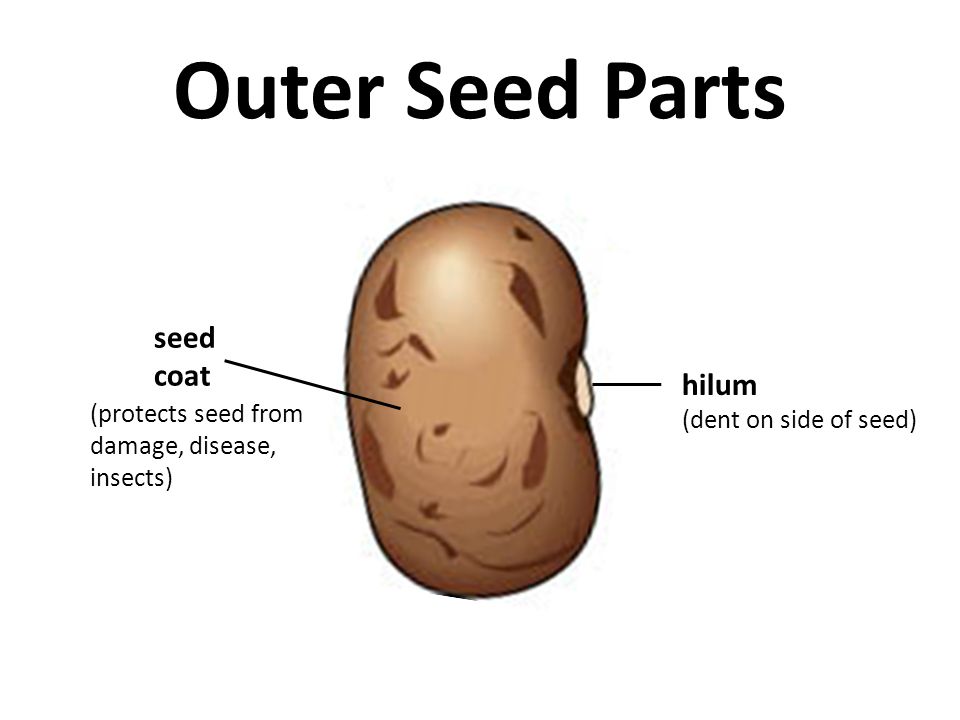
a) Seeds are in a dormant state. They need to absorb water in order to soften the outer seed coat, as well as hydrate and activate the cells within the seed. Soak the seeds in water overnight to get them ready for germination. This step is called imbibition.(definition:The absorption of water by a seed.) Gently scuffing the seed coat with sandpaper, which is called scarification,(definition:Altering the coat of a seed to encourage germination.) allows the water to enter the seeds with less soak time. It is best to use distilled water, or water with low chlorine levels, if available.
b) Wet some paper towel and wring it out. You just want the paper damp and not dripping wet. The amount you use will be dependent on the container you use, and a number of sheets may be necessary. You now want to position your seeds in the desired arrangement on the damp paper towel (you may want to add duplicates of each position in case not all the seeds germinate). You can either cover the seeds with the damp paper towel, or arrange them using an empty CD case or a glass as seen below if you want to watch the miracle of seed germination! You may need to add more paper towel to prevent the seeds from slipping.
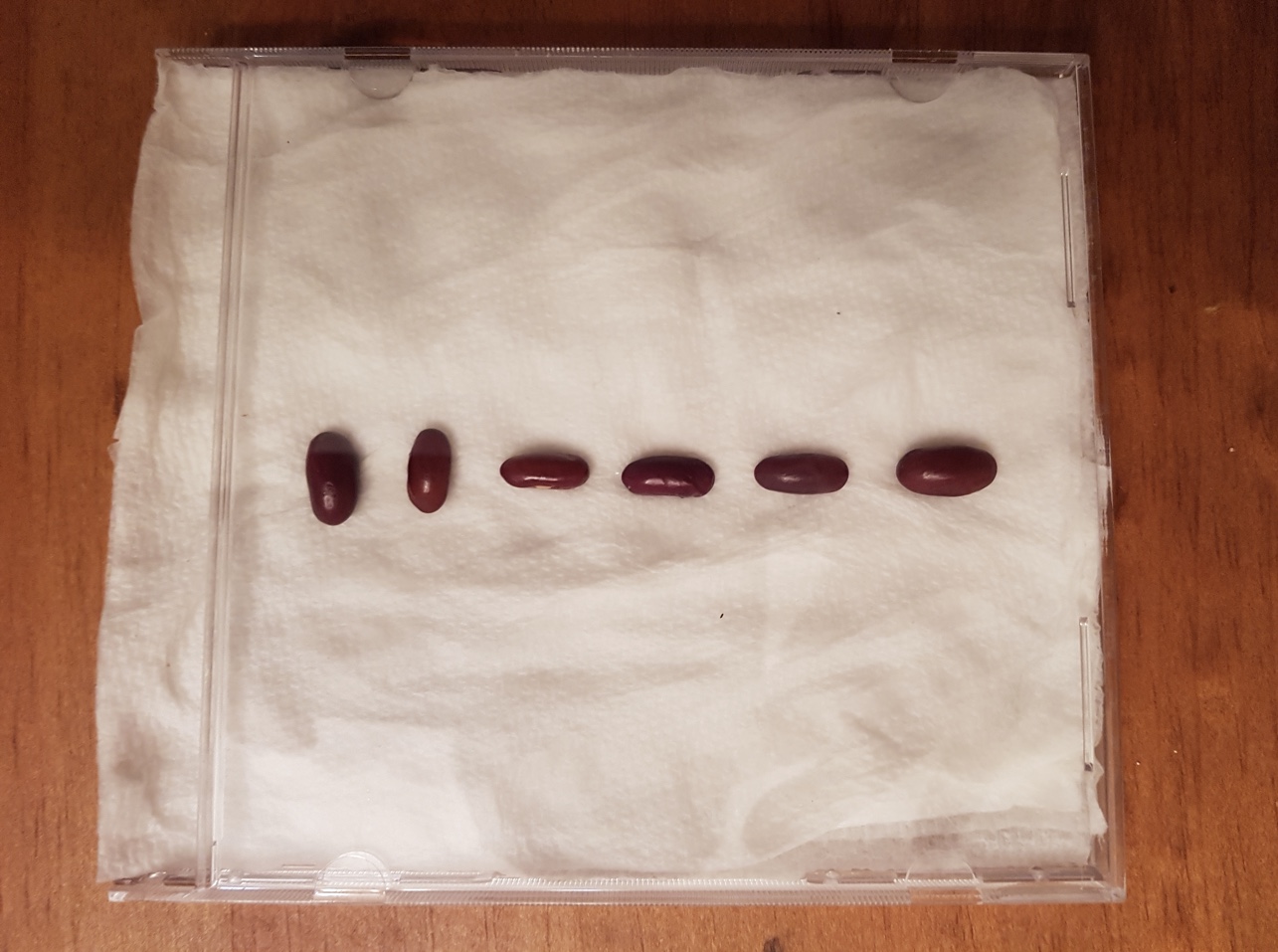
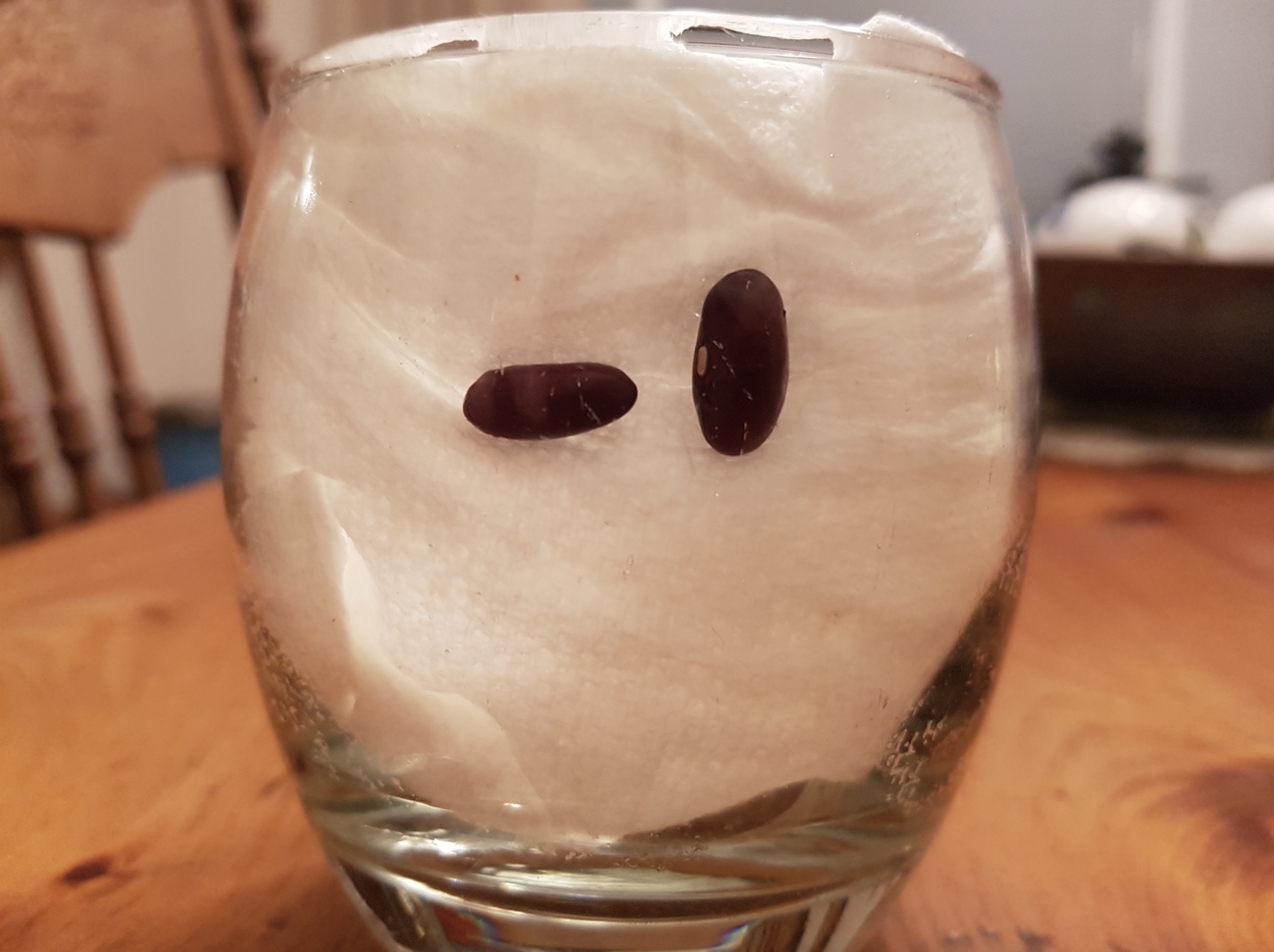
c) Keep the seeds in a warm area out of direct sunlight to prevent the paper towel from drying out. If using the CD case, you need to stand the case up by leaning it against something. Be sure to periodically check the paper towel for dampness and add water when needed.
d) Check the seeds periodically and hope that they germinate! Record your observations as they germinate. Include data such as the time passed and length of the root/shoot. A quick diagram showing the seed’s progress would be helpful. Keep your observations in your portfolio.
 Predict and Explain
If the seeds are positioned in the following arrangement, predict the direction that the root and shoot will take once they break out from the seed.
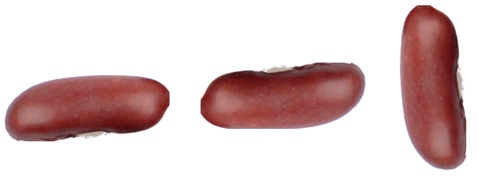
You will find that factors that impact the germination of seeds will also influence the plant growth. The Action section of this activity will detail the main growth regulators.
From Seed to Plant
Although you have already watched the germination of the seed at the beginning of this section, this next video shows a 25 day time-lapse of the development of the full plant. In essence, this video touches upon all the main aspects of this activity. As you watch the growth, think about all the various factors that are needed in order to develop from seed to plant. Also, pay attention to the location of elongation and growth. Enjoy!

ACTION
Types of Growth
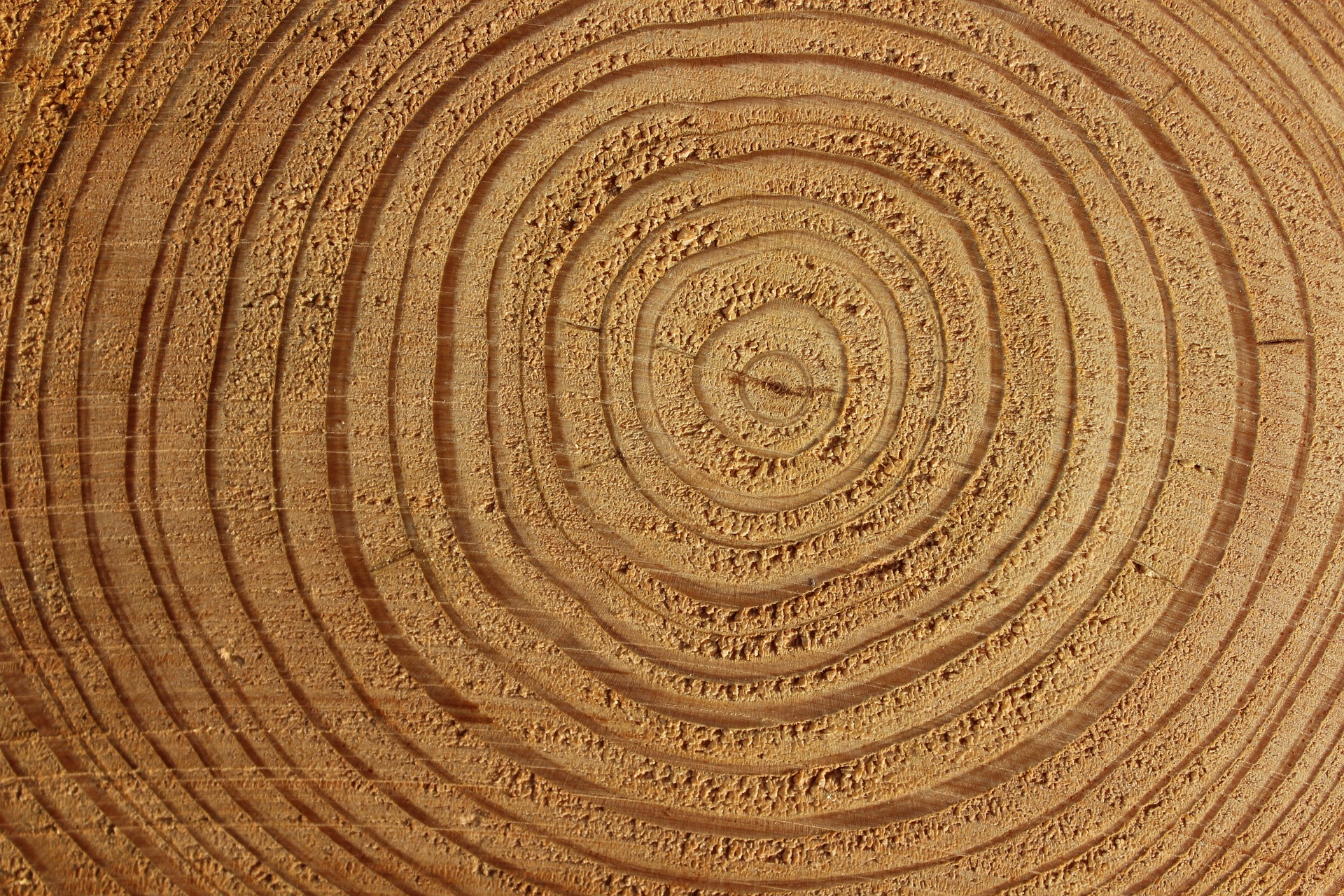
While watching the bean plant time-lapse in the Minds On section, you will notice that the elongation of the plant occurs from the tips and sides of the roots and shoots. This elongation and initial development of a plant is known as primary growth,(definition:Growth resulting mainly in an increase in length and the addition of appendages.) and also includes any lateral(definition:Toward, or from the side or sides.) growth, or thickening, of the plant that occurs during the first year. Secondary growth(definition:Lateral growth that causes stems and roots to thicken.) is when a plant shows lateral growth after the first year and thickens and increases its width. Some plants don’t undergo secondary growth. More on this later.
Challenge Question!
Is the image of the annual rings shown above representative of primary or secondary growth?
AnswerSince the rings show a lateral growth, which increases the width or girth of the tree, they represent secondary growth.
Close Encounters of the Fourth Kind

In the bean growth videos, you witnessed primary growth from the tips of the shoots and the roots. Why is it that the primary growth only originates from those two locations? The answer is the fourth kind of main tissue found in plants called meristem.(definition:A region of plant tissue consisting of actively dividing cells forming new tissues.) This is tissue made up of actively dividing cells.
The meristematic tissue found at the tips of roots and shoots is called apical(definition:The apex or tip of a structure.) meristem. The meristem that is responsible for secondary growth is called lateral meristem. It is found parallel to the edges of stems and roots.

Apical Meristem
All the cells produced by the meristem are identical at first, but then differentiate(definition:The process of cell specialization.) to take on particular functions. For example, when you watch the video showing the bean growing you can see lateral roots growing from the middle of longer roots. These lateral roots are made from differentiated meristematic tissue.The following interactive will show you the different regions found on a root tip. The zones are similar at the tips of the buds and shoots, as well.
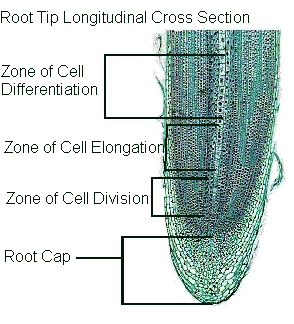
As you explore the following interactive, try to make connections to the germinating seeds from the PEOE task. You will be able to see this apical meristem in action as you make your observations.
Meristem
Lateral Meristem
Responsible for secondary growth, lateral meristematic tissue is not found in all plants. This increase of diameter is important for what are known as woody(definition:Plants that have hard stems due to the wood produced by secondary growth.) plants, as they need the extra support that a wider stem provides. Trees, shrubs, and some vines are all considered woody. Normally woody plants are perennials,(definition:Plants that live for longer than two years.) and therefore survive multiple seasons. Some non-woody plants also show secondary growth, but not in the stems. Potato tubers and carrots are examples. Most dicots have some form of secondary growth, but it is usually absent in monocots.
Woody Plants
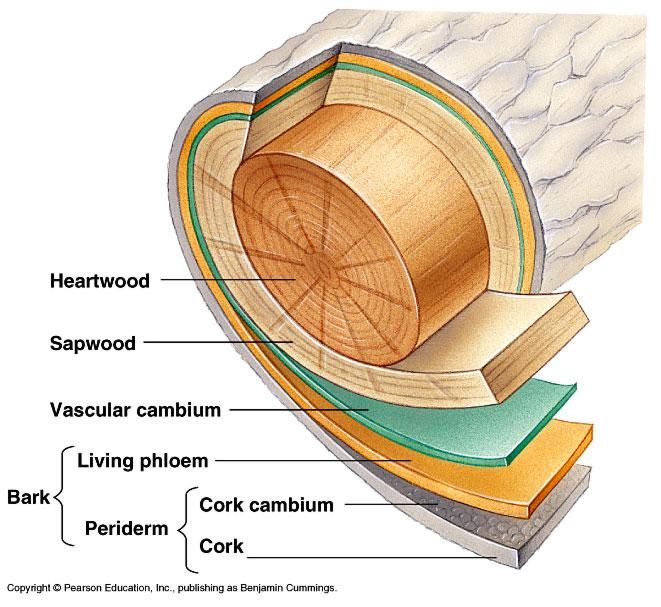
The lateral meristem is found in two forms within a woody plant. The vascular cambium(definition:Meristematic tissue located between the xylem and phloem in stems and roots of woody plants.) produces new vascular tissue every year during the growing season. This new growth eventually crushes the vascular tissue from the years before. This crushed vascular tissue loses its ability to transport water and nutrients and makes up the dense heartwood.(definition:The dense inner part of a tree trunk.) The sapwood(definition:The soft outer layers of recently formed wood between the heartwood and the bark, containing the functioning vascular tissue.) is the youngest vascular tissue and still functions as such.
The cork cambium(definition:Lateral meristem and is responsible for secondary growth that replaces the epidermis in roots and stems.) is responsible for creating new epidermis on the outside surface of the stem and roots, which helps to protect the living vascular tissue from water loss, mechanical injury, and infection from microorganisms.
The amount of secondary growth that occurs during a growing season depends on the environmental conditions. If there was lots of moisture that year and fair temperatures, the associated annual ring will be thicker as compared to a ring formed during a drought year. For this reason, tree ring studies are useful for climatologists to study the relative humidity and temperatures in which the trees grew.
Extension: Tree Rings
This video will tell you more about tree rings than you most likely thought possible! Take a few minutes to scan through this video to get an idea of how much information can be determined from the cross section of a tree. Think about ways in which human influence may have some impact on the size of growth rings. Do you expect rings to get wider or more narrow in the future?
Growth Factors and Regulation
Now that you have a good understanding of the mechanics of plant growth, you can investigate how these processes are regulated. You will explore how environmental factors and natural plant hormones impact plant growth. You will also have a chance to consider how humans can influence plant growth through manipulation and how the plants respond to these changes in growth conditions.
The following interactive will detail the main environmental factors that will affect plant growth.
FactorsAffectingPlantGrowth
Extension: Why Do Leaves Change Colour?
During the spring and summer, trees are food factories. Water and nutrients are brought up from the soil through the vascular system and up to the leaves. Chlorophyll is produced which captures the Sun’s energy to produce glucose to feed the tree. As the daylight hours grow shorter and temperatures start to cool in late summer and autumn, the vascular tissue that supplies the leaves starts to close up. Production of chlorophyll is reduced due to the decreased flow of water and nutrients and the remaining chlorophyll starts to break down. As the amount of chlorophyll decreases, the other pigments in the leaf get their chance to shine through!
The following video provides a nice chemistry-based explanation of this process:
Macronutrients
The following video investigates the roles that a number of important macronutrients play in the healthy growth of plants.
Please note that nitrates are nitrogen-containing salts.
When we think about plant nutrients, our thoughts will often go straight to the bags of fertilizer available at the local garden centre. As mentioned in the previous video, many farmers simply add commercially available fertilizer to their crops when needed.
Just remember that plants have been successful for many thousands of years without the help of humans! If you understand the life cycle and needs of different plant species, it is possible to let the plants take care of themselves. Take a look at the following article to see how this has been done for generations.
Human Influence on Growth
There are a great number of factors that can influence the growth of plants. From environmental conditions to nutrients in the soil, plants have specific needs in order to remain healthy.
The theme interwoven throughout this unit is interactions and changes that occur due to these interactions. Well, nothing is more interactive than humans when it comes to influencing the natural world! In the following activities, you will explore how humans influence a population by choosing to breed plants and animals based on characteristics that people desire, even if those characteristics do not match well with the environment in which the organism lives.
All the way back in the Structures Unit, you looked at how humans domesticated animals and plants to fit their needs. These interactions have changed many species in ways that may not be natural. For better or for worse, humanity's manipulation of its surroundings will likely never cease.
 Human Input
You now know the main factors that have an effect on plant growth and health. Light, soil, temperature, and nutrients all play a vital role.
Take some time to think about all the human influences on plant growth that occur in your immediate region. People who live in a rural setting may have different examples than people who live in the city, but human influence on plants and plant growth is all around us - no matter where the location.
Think of at least one example of human input on each factor: light, soil, temperature, and nutrients. These interactions may be intended or accidental, but they are interactions all the same.
For each example, indicate whether the impact on the plants is positive or negative.
Tropisms
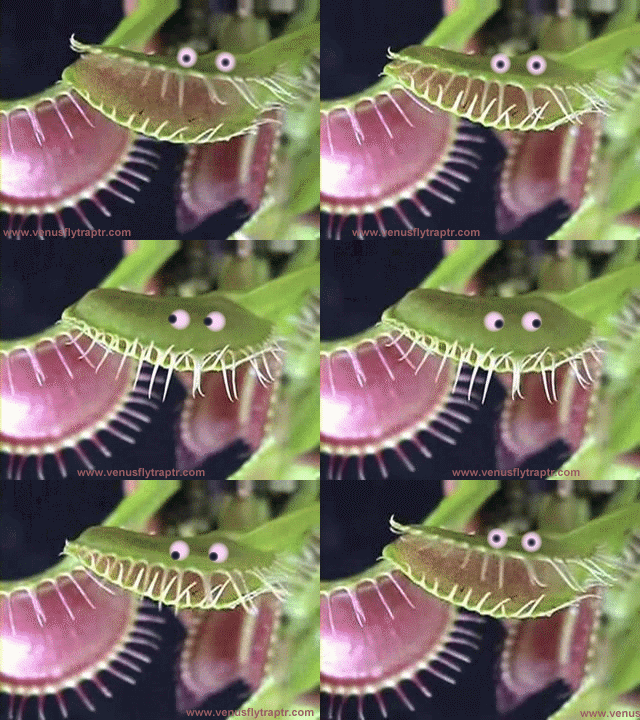
Tropism(definition:The motion of a plant in response to a stimulus.) is a term used to describe movement of a plant in response to some sort of stimulus. Wait...plants don’t have muscles or skeletons to which muscles can attach. How is it possible for them to move in specific ways? You will learn more about the ‘how’ in a bit, but let’s look at the different types of tropisms first.
There are negative tropisms, when the plant moves away from the stimulus, and positive tropisms, when the plant moves toward the stimulus. Take a minute to look over this overview of tropisms.
The main tropisms are detailed below:
Phototropism(definition:Movement of a plant in response to light.) - A response to light.
Thigmotropism(definition:Movement of a plant in response to touch.) - A response to touch.
Geo or Gravitropism(definition:Movement of a plant in response to gravity.) - A response to gravity.
Thermotropism(definition:Movement of a plant in response to temperature.) - A response to temperature.
Hydrotropism(definition:Movement of a plant in response to water.) - A response to water.
Pretty simple, eh? Take a shot at classifying examples of tropisms in the following interactive.
Tropisms
Plant Regulators
Although there are many different chemicals involved in plant processes, you will focus on the main five:
- auxins,(definition:A plant hormone that promotes stem elongation and inhibits growth of lateral buds.)
- gibberellins,(definition:A plant hormone that promotes stem elongation, germination, flowering, and fruit ripening.)
- cytokinins,(definition:A plant hormone that promotes cell division, or cytokinesis, in plant roots and shoots)
- abscisic acid,(definition:An inhibitory hormone in plants that helps a plant adapt to stress. It also plays a key role in the closure of the plant's stomata, bud development, and seed dormancy.) and
- ethylene.(definition:A plant growth substance involved in growth, fruit ripening, and breaking of dormancy.)
What Does it All Mean?
Plants, just like animals, are affected by a variety of environmental and chemical factors. You have looked at how various conditions influence plant growth and health and thought about how humans are involved with these processes for better or for worse.
 Learning Goals and Success Criteria
 Learning Skills and Work Habits