
DESCRIPTION OF INTERACTIVE
This interactive will be based on a diagram of the digestive system. There will be dots on the image that correspond to areas that are impacted by a disorder. Clicking on the each dot will bring up information about that disorder (description, causes, etc.). This interactive is similar to http://techprojects.ca/PS/CGG3O/ArcticOcean%20-%20Storyline%20output/story_html5.html
The first image shows the image to be used without the dots. The second image has letters that show where the dots will appear. Below the images will be the descriptions that will come up in the information box when a dot is clicked. I have added numbers before the title of each box that correspond to the numbers on the image of the system.
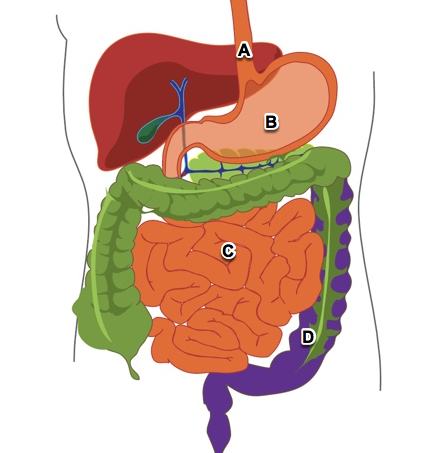
A: Gastroesophageal Reflux Disease (GERD)

Also known as acid reflux, this disease occurs when stomach acid comes up through the cardiac sphincter and irritates the lining of the esophagus.
Acid reflux impacts many people from time to time, but some people experience this reflux frequently. If left untreated, this irritation can cause permanent damage to the esophageal lining.
Symptoms of GERD(definition:Occurs when the sphincter muscle at the lower end of your esophagus relaxes at the wrong time, allowing stomach acid to back up into your esophagus.) include heartburn (a burning sensation in the chest), difficulty swallowing, regurgitation producing a sour taste, and difficulty sleeping. Often these symptoms are worse after eating.
GERD can be attributed to a number of causes, including obesity, hiatal hernia,(definition:The protrusion of an organ, typically the stomach, through the esophageal opening in the diaphragm.) certain medications, smoking, and pregnancy. Medications can help to reduce the amount of acid that the stomach produces. Changing your lifestyle and diet can also ease some of the symptoms. In more severe cases, surgery may be needed to strengthening the sphincter muscles located at the top of the stomach.
If left untreated, scar tissue can form in the esophagus, narrowing the pathway and leading to problems with swallowing.
Visit the Canadian Digestive Health Foundation website for more information about GERD.
B: Peptic Ulcers

Peptic ulcers(definition:A lesion or sore in the lining of the digestive tract, typically in the stomach or duodenum, caused by the digestive action of pepsin and stomach acid.) are sores that develop in the stomach or small intestine. The acid from the digestive system eats away at the lining of these structures and causes a burning sensation.
Although many ulcers go undetected, more severe cases can result in nausea, vomiting, and bleeding. A doctor’s visit is in order if any of these severe symptoms appear. An endoscope(definition:An instrument that can be introduced into the body to give a view of its internal parts.) can be used to look at the linings.
It was once believed that certain foods caused this condition, but it is known known that many ulcers are due to a bacterial infection. The bacterium Helicobacter pylori secretes enzymes that neutralize stomach acid, allowing it to survive in this harsh environment. These bacteria can then irritate the lining of the stomach or intestine causing the ulcer. Certain medications are also known to cause these sores in the lining.
A change in diet doesn’t have much impact on ulcers, but certain substances such as caffeine and alcohol should be avoided. Smoking can also lead to ulcers.
Medications that can suppress the acid created in the stomach can allow the ulcers to heal, but only if the H. pylori has been eliminated. Antibiotics can kill the bacteria, but the best bet is prevention. Vaccines are being developed to prevent the bacterial infection from occurring in the first place.
Visit the Canadian Digestive Health Foundation website for more information about ulcers.
C: Crohn’s Disease

Crohn's disease(definition:A chronic inflammatory disease of the intestines.) involves inflammation of the digestive tract. This makes absorption of nutrients through the jejunum less efficient which can lead to pain, fatigue, severe diarrhea, and weight loss. The inflammation can occur in different regions of the digestive tract in different people.
Crohn’s can be debilitating for some, while others only have periodic flare ups of the symptoms. The cause for Crohn’s disease is not known, but research is indicating a link to heredity and to the immune system. Most people develop this condition when they are young, and you are at higher risk if you have a close relative with the disease. Smoking and other environmental factors can also play a role. Doctors can diagnose this disease based on symptoms, stool samples, and endoscopy.
Although these is no cure for this disease, treatments can reduce the symptoms considerably and even bring about long-term remission. Not everyone reacts to treatments in the same way, but anti-inflammatory drugs have had the greatest success.
Visit the Crohn’s and Colitis Canada website for additional information.
D: Colitis

Colitis(definition:Inflammation of the lining of the large intestine.) is similar to Crohn’s disease, only it is more localized to the large intestine and causes inflammation of the inner lining of the bowel tissue. As a result, less water is absorbed by the colon.
Symptoms include severe and bloody diarrhea, cramping, decreased appetite, and false urges to have a bowel movement. This sense of urgency to empty the bowels is due to inflammation in the rectum.
As with Crohn’s disease, endoscopy can be used to diagnose colitis. Blood tests and other imagery procedures can also help with diagnosis. Anti-inflammatory medications are the main form of treatment, but some severe cases require surgical removal of sections of the large intestine.
Visit the Crohn’s and Colitis Canada website for additional information.