
Unit 3: My Community
Unit 3, Activity 3: Down on the Farm

MINDS ON
Cows Produce a LOT of Methane!
Depending on where you live in Ontario, your community may look drastically different from those of other students your age around the province.
If you have ever taken a drive through the countryside, you will have undoubtedly seen examples of agriculture and farming industry at work in our province. Perhaps you even live on a farm yourself. Horticultural crops (e.g., fruits and vegetables, honey or maple syrup), field crops (e.g., corn, soybeans, wheat, etc.) and livestock farming (e.g., cattle, pigs, sheep, etc.) are a few examples you may have noticed in your travels. All are important to the health and wellbeing of our residents.
In this activity, we are going to focus specifically on livestock farming. We will investigate the issue of greenhouse gases caused by raising cattle, the primary producers of methane and unwitting culprits in the important issue of global warming.

If you want to view any links in this pdf, right click and select "Open Link in New Tab" to avoid leaving this page. (View the original article.)
Cow Farts and Climate Change
Watch this video to understand how cattle produce methane.
 What Do You Think?
- Do you think methane counts as a carbon emission? Why or why not?
- Besides the burping and farting of livestock, what other sources of greenhouse gases are there in beef or dairy farming?
- Unlike the creation of greenhouse gases from burning fossil fuels, this source of greenhouse gas is a natural one. However, how could this “natural source” still be considered the product of human action?
- If you consume beef or dairy foods, how might this information change your eating habits?
- The article identifies a scientific solution to the problem of livestock creating methane gas. What is it? Do you think this is a sustainable option? Explain why or why not.

ACTION
How Do Greenhouse Gases Work?
Watch this video to better understand greenhouse gases and the greenhouse effect.
One thing shown here is the way in which the greenhouse effect is essential to life on Earth.
This is because greenhouse gases absorb, keep and re-emit radiation (heat). The greenhouse effect is actually a natural process that allows us to survive on Earth. Without these gases in the atmosphere, the Earth would be extremely hot during the day and extremely cold at night, making it impossible to sustain life.
The energy from the sun gets absorbed by the Earth or reflected and emitted back into space. Some radiation is also absorbed and re-emitted back toward Earth's surface, which in turn heats up our atmosphere.

Anthropogenic Greenhouse Effect
While the natural greenhouse effect makes life possible on Earth, human activity can cause increased amounts of greenhouses gases to be produced in our atmosphere, resulting in a greenhouse effect. We refer to this as the anthropogenic (anthro means human, so this word means human-caused) greenhouse effect, which can be seen in the diagram above.
The rate at which we are releasing greenhouse gases into the atmosphere is steadily increasing, with the effect of warming the atmosphere faster than ever and causing an overall increase in global temperatures.
Sometimes, the greenhouse effect is used effectively to benefit humans, such as with growing food in a greenhouse. For example, in some parts of Canada, there is only a very short season in which farmers are able to grow crops outdoors. In communities like Inuvik in the Northwest Territories, they are able to produce fresh food only in greenhouses.

by /www.inuvikgreenhouse.com
 Cause and Effect
Now that you have learned about the sources of greenhouse gases and how they work, explore how releasing these can affect one particular region of Canada.
This interactive will allow you to evaluate some of the effects of livestock farming in Alberta on glaciers in the Rocky Mountain Range. Please keep in mind that livestock farming is only one of many factors at play here.
You may also wish to complete an internet search to help enhance your ideas on these connections. When you have completed your analysis, save it to your Portfolio.
CauseandEffect

CONSOLIDATION
 Hamburger Impacts
Have a look at this infographic showing what it takes to make a typical quarter-pound hamburger.
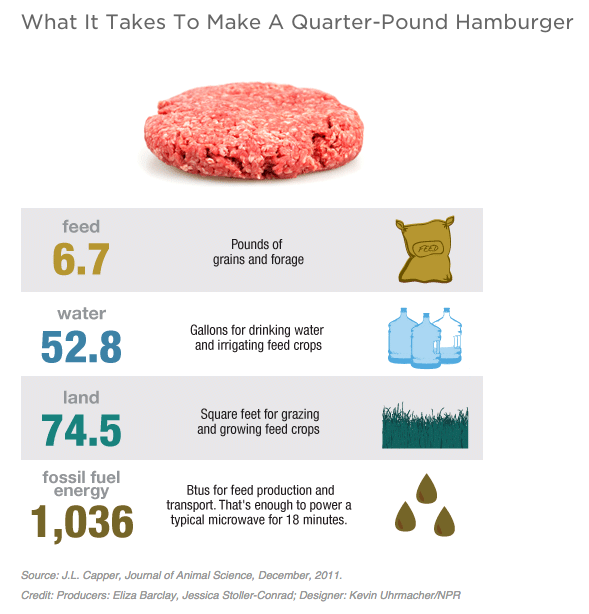
by Capper, J.L. (December, 2011). What It Takes To Make A Quarter Pound Hamburger. Journal of Animal Science.
After exploring the impact of a single hamburger, it is important to note that beef and dairy products do provide some necessary nutrients in many people’s diets. But some people choose not to consume these products at all and instead get their nutrition through other foods or supplements.
Analyze your own eating habits to identify ways that you could help reduce greenhouse gas emissions.
Start by answering the following questions:
- If you regularly eat beef or dairy products, how might the information presented in this activity change your thinking and your eating habits? Would it be healthy for you to completely eliminate beef or dairy from your diet? Why or why not?
- If you already avoid beef or dairy products, can you identify the alternatives in your diet which would still provide the nutrients necessary for a healthy body? Do your alternatives decrease greenhouse gas emissions and the greenhouse gas effect as a result?
 Learning Goals and Success Criteria
 Learning Skills and Work Habits