
Unit 3: My Community
Unit 3, Activity 4: The Amusement Park

MINDS ON
Reflection Mini Golf
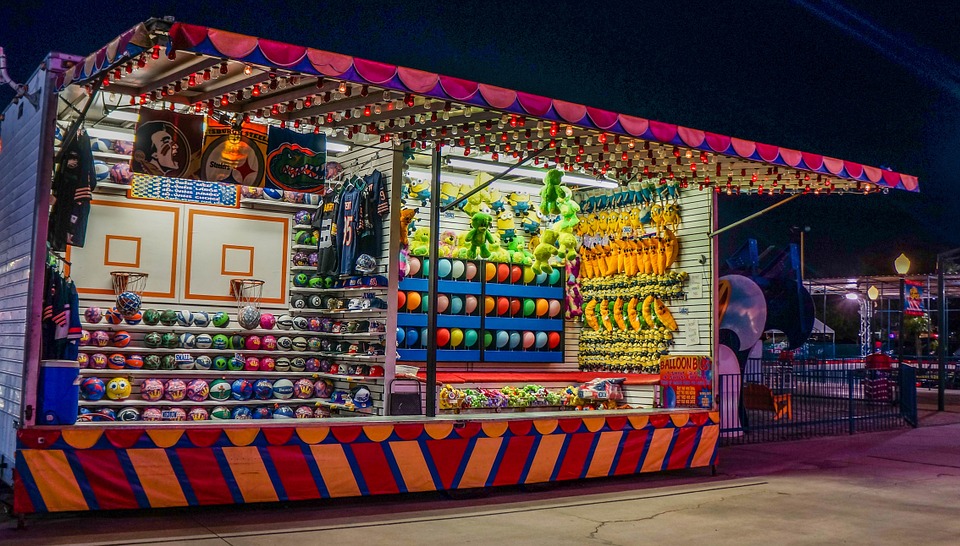
At the carnival midway, there are numerous games of chance or skill that people play for prizes or just for fun. Because many of these involve science concepts, knowing them can give you the advantage and even better your chances at winning!
Some of these games involve reflections, so let's look more closely at them now.
Review The Law of Reflection

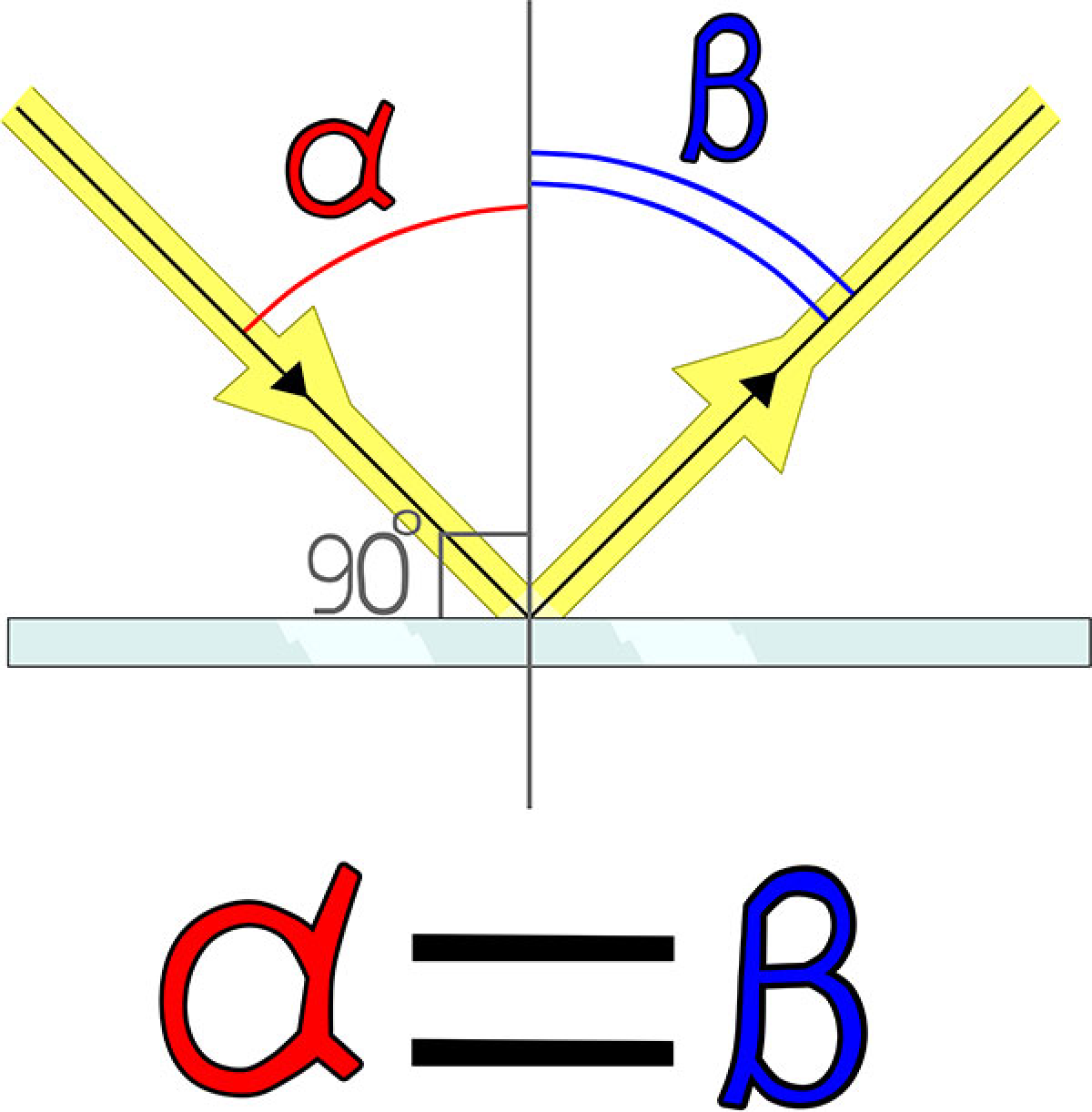
This means that at whatever angle light strikes a mirror, it will reflect off at the same angle.
The concept involved in the Law of Reflection can be observed in other areas of life, such as when an air hockey puck bounces off the edge of the table or a billiard ball banks off the rails.
Now, use this concept of reflection to play a game of mini golf. Your goal is to get the golf ball around the obstacles and into the hole, using reflection.
Can you score a hole-in-one?
MiniGolf

ACTION
The Art of Illusion
Mirrors are used not only in carnival games or at amusement parks, but also to create optical illusions(definition:something that deceives the eye by appearing other than it is).
Different mirror types can be used to produce different types of illusions. For example, a never-ending illusion can be formed by using a series of plane mirrors.
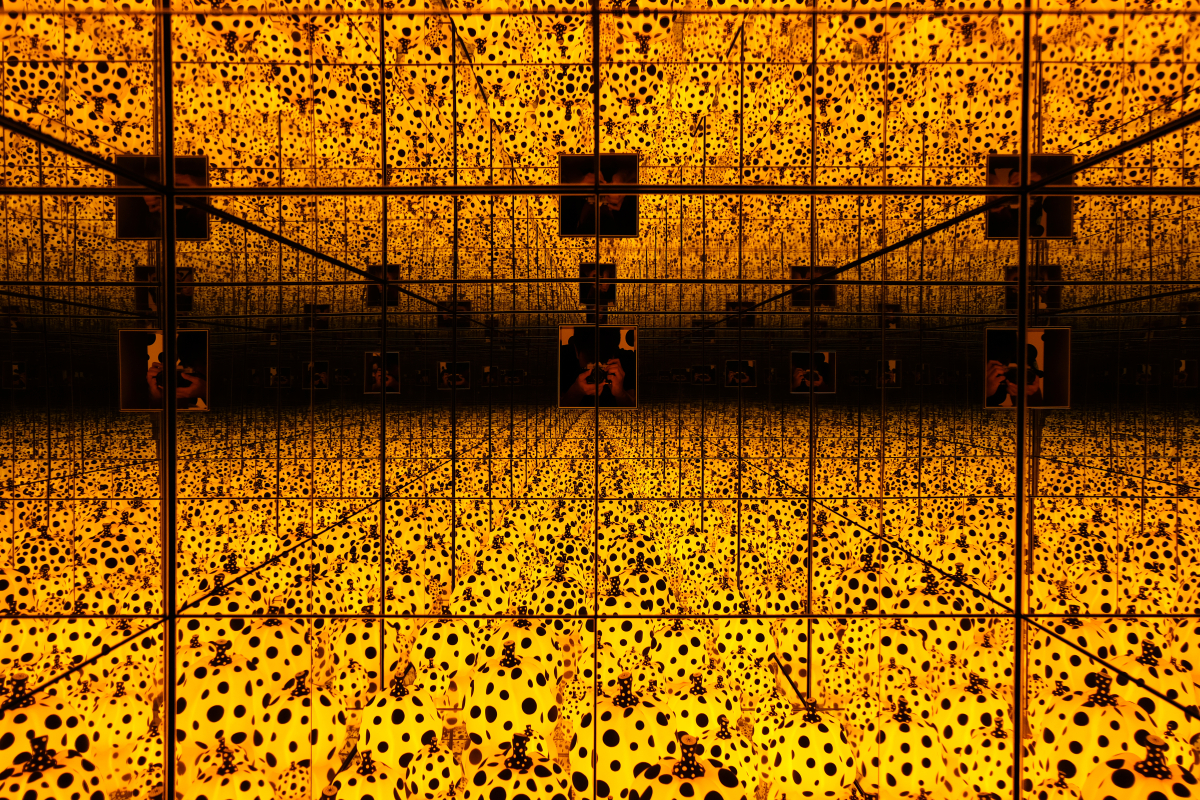
Artist Yayoi Kusama effectively used this technique to create her popular Infinity Mirrors art exhibit (featured at the Art Gallery of Ontario in 2018). In this exhibit, it appears that the room goes on forever into the distance, the floor and ceiling filled with illuminated objects. Although the actual room is rather small, the plane mirrors continue to reflect back and forth, obeying the Law of Reflection, so we can never really tell where it ends.
This optical illusion occurs because the object in front of the first mirror creates an image behind that mirror, which then becomes the object for the second mirror, generating a new image. With each reflection, these objects and images continue to seem farther away from the two mirrors.
To learn more about how images in a plane mirror form by reflection, watch the following video.
Plane Mirrors and Infinity Selfies
You can actually create your own infinity mirror selfie! Here's how.
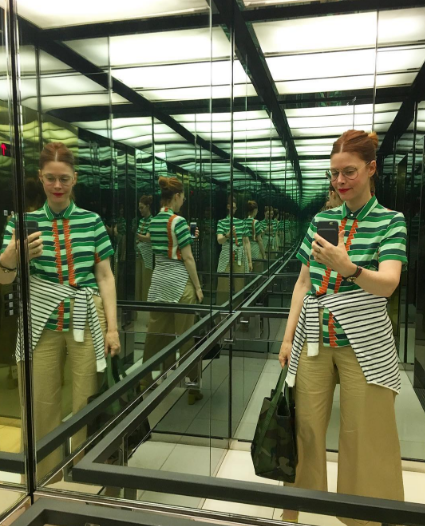
When you place two plane mirrors parallel to each other and a certain distance apart, your reflection will be repeatedly reflected back and forth between both mirrors. You may have noticed this effect yourself in mirrored elevators or bathrooms.
Plane mirrors always have the same image characteristics. The image size will always be the same as the original object size.
This means that if you are looking at yourself in a plane mirror, your reflected face will appear to be the same size as your actual face.
 Create Your Own Infinity Mirror Selfie
Now, here's your chance to show off your artistic side!
Using your knowledge of plane mirrors and how they can be used to give the impression of infinite reflections, create your own optical illusion with this infinity mirror selfie.
To document your process and final product, you should:
- Use two mirrors to create your infinity mirror. Recall that the effect is created when a mirror is reflected back into another mirror.
- Include a picture of how you set up your mirrors to produce the infinity effect.
- Include a picture of yourself posing in front of the infinity mirror. If you are uncomfortable sharing a picture, inform your teacher and use a class-appropriate object to show the effect instead.
Now, admire the beautiful artwork you have created! Share your photograph with your classmates and explain why your image looks the way it does. Outline the challenges you faced when setting up the picture in order to achieve the desired effect.
You should also explain the process you followed in setting up your infinity mirror selfie. For example, where did you get your mirrors? How far apart did you have to place them for the best effect?
Light Refraction
Mirrors aren't the only things that produce distortion in what we see. You may have noticed the phenomenon of refraction(definition:the phenomenon of light changing direction when it passes from one medium to another of different density) while swimming or fishing, as it is frequently experienced in or around water.
Watch the video entitled Making a Penny Disappear to see the power of refraction at work.
To understand this phenomenon, we need to know that light rays travel in straight lines, which is why we draw them as arrows.
Recall that sometimes light will not just reflect off substances, but will also pass through them fully (if transparent) or partially (if translucent). Any substance through which light travels is called a medium(definition:a substance that light passes through. The plural of medium is media. For example, glass, water and air are all types of media.), and each has its own resistance to light passing through it.
When light is travelling through space or air, it encounters very little resistance, so travels at its top speed(definition:about 300 000 000 metres per second. That's about 7.5 times around the earth in one second.).
When light moves through a more dense medium, such as water or glass, there is more resistance, which causes the light rays to slow down and “bend” or change direction. This change in speed and direction of light is called refraction(definition:the phenomenon of light changing direction when it passes from one medium to another of different density). The opposite is also true.
Watch the short video below demonstrating how light interacts as it passes from air into different media.
Rewatch the video as many times as you need so that you are able to answer the following questions. The phenomenon of light demonstrated in the video is important to understand and will be used in the rest of this activity.
 What Do You Think?
- The angle made by the refracted light ray with the normal is called the angle of refraction. How did this angle change when the light was refracted through different media?
- Glass is more optically dense than water and water is more optically dense than air. How can you use this information to explain or predict what the direction of the refracted light ray could be?
- How would you summarize what you saw in this video?
- The penny in the last video seemed to disappear because of the changing direction of light rays no longer pointing towards our eye. Think of some other times in your life when you have noticed a similar phenomenon.
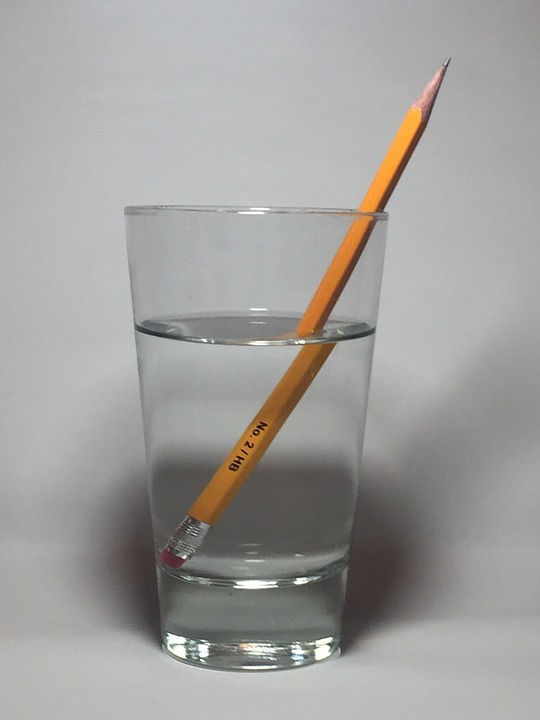
In the image above, do you notice how the sections of the pencil appear different from one another?
This has to do with the speed and direction at which the light reflecting off the pencil is travelling. The light refracts when it reaches the glass and changes both, resulting in the pencil looking slightly larger through the glass alone.
For a more detailed explanation, look at the answers to the questions below.
 Questions
For these questions, refer to the image of the pencil in a glass of water.
- Why does the tip of the pencil appear the way it does?
AnswerLight reflecting off the pencil travels from the pencil through air and towards our eyes at its regular speed. This results in no distortion of the pencil's appearance, so it appears normal.
- Why does the middle of the pencil appear the way it does?
AnswerLight reflecting off the middle of the pencil travels first through air at its regular speed, then through the glass at a lower speed (changing its direction) and then back into the air and towards our eyes again at its regular speed.
Because the glass is thin, it results in a minor distortion of the pencil's appearance.
- Why does the bottom of the pencil appear the way it does?
AnswerLight reflecting off the bottom of the pencil travels first through water at a much slower speed, then through the glass at a bit faster speed (changing direction) but still lower than normal, then finally back into the air (changing its direction again) and towards our eyes at its regular speed.
This results in a major distortion of the pencil's appearance.
Refraction and Reflection
Look at the following diagrams which demonstrate how the change in direction is observed.
Reflection
Reflection deals with the change in direction of light as it bounces off a surface back into the same medium. The angle of reflection is equal to the angle of incidence.
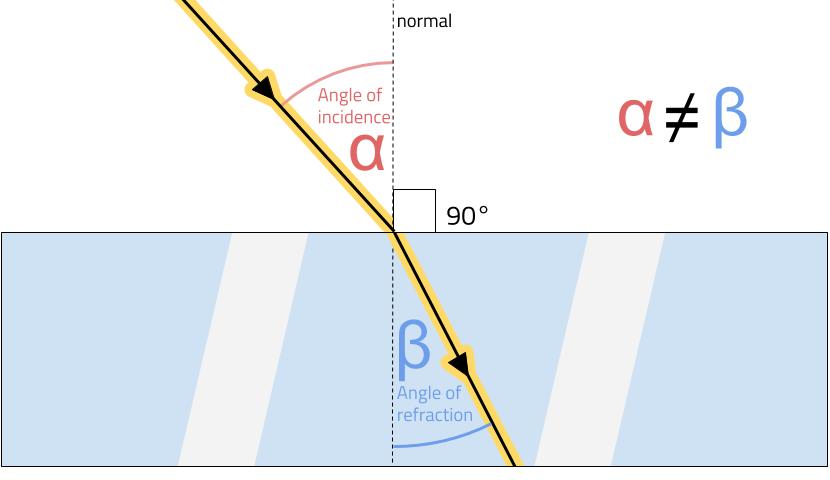
Refraction
Refraction deals with the change in direction of light as it passes through a surface from one medium to another. The angle of refraction is not equal to the angle of incidence.
 Try This At Home!
Did you know that you can use your knowledge of refraction to magnify things? For example, a water droplet placed on a newspaper is able to magnify the letters beneath it.
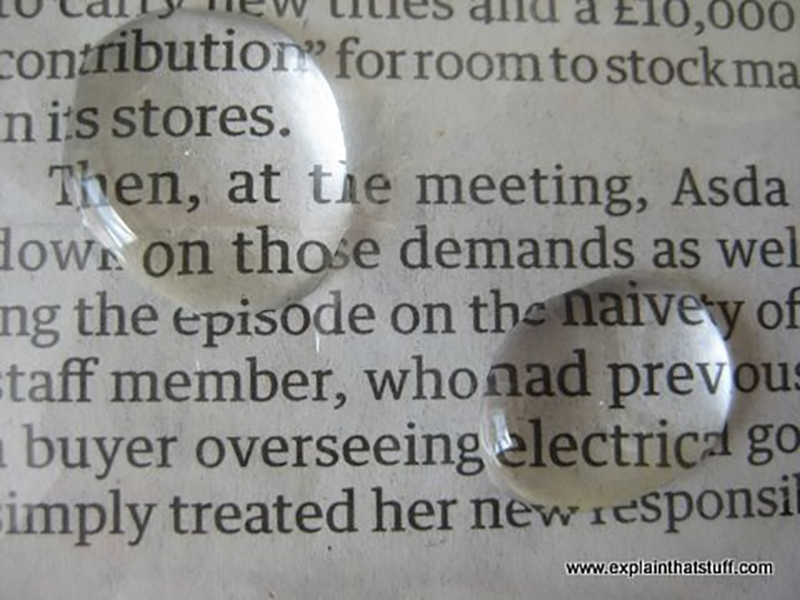
Take a newspaper or magazine (something you don't mind getting wet) and cover it with some plastic wrap or a clear plastic bag. Use your pinky finger to place a drop of water gently on the letters.
Due to refraction, the letters beneath the water should appear larger than the text surrounding it.
What Do You Think?
- What would happen if you were to make the drop of water larger?
- What would happen if you were to make the drop of water smaller?
- What would happen if you were to lift up the plastic to see how the distance from the letters changed the magnification?
- Check these out for yourself. Were your hypotheses correct?
Source: Explain That Stuff - Lenses

CONSOLIDATION
 Laser Tag Arena
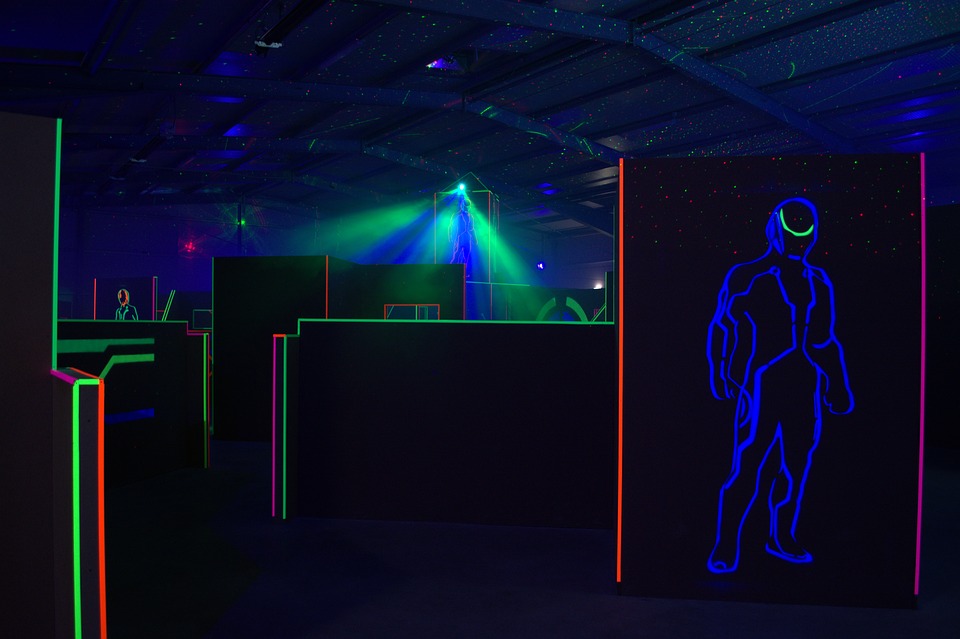
Now, just for you, here's another opportunity for creative design and competitive fun using science.
Your new challenge is to help with the design of a laser tag arena at your local amusement park.
If you are unfamiliar with laser tag, watch this short video so you will better understand what you are being asked to design.
Before You Begin
The Arena
You will notice that the laser tag arena is usually very dim. It also uses different kinds of fluorescent materials and shades of lights to give the room a futuristic feel. Many obstacles create a maze-like feel of walls, half walls, mirrors, windows and ramps. There are locations for use as hiding spots and frequent targets in hard-to-find areas.
Scoring
Points can be scored by tagging other players in different areas on their chest, back, shoulders or blaster. But to get the big (!!) scores in a laser tag game, you will need to tag different targets, some of which require stealth and skill to reach. Sometimes these require a precise shot in order to bounce off a mirror or travel through transparent materials like plexiglass windows or water walls.
Design Your Own Arena
Using different types of mirrors and your knowledge of reflection and refraction, you can create your own interesting and challenging laser tag arena.
Note: Your arena will be shared with your classmates and will need to be drawn by hand or designed digitally, so keep this in mind before you begin your design process.
Imagine the empty rectangular room with which you will be working. In this arena, you need to design only the main floor, as there will be no second floor. Every area that is available to players must be accessible to all players.
Your arena must include all four elements outlined below.
Walls
These will make the maze-like structure of the arena and provide cover, as well as paths to secret areas on the map. Consider creating different challenges for different paths, such as dead ends, windows and half walls.
Mirrors
Place a minimum of four plane mirrors in locations around the arena. Consider locating some of them in strategic areas other than walls, so that trick shots can be performed on scoring targets or other unsuspecting players or targets.
Water Panels
These panels are just as thick as walls but filled with water. They are transparent (see through). Place a minimum of two water panels in strategic areas.
Scoring Targets
Locate at least four scoring targets strategically around your arena. Two targets must use science concepts learned in this activity in order to be hit. One must use reflection in a plane mirror. Another must use refraction through a medium other than air.
Special Considerations
Consider the Law of Reflection for the use of mirrors. Use your understanding to visualize how you want your obstacle course to work and how to make it most challenging for players.
For example, because mirrors can reflect lasers, you could tag another player around a corner with a strategically and correctly placed mirror. This could also be used to hit a target that cannot be reached directly by foot.
Consider refraction for the use of the water walls. Aiming directly at someone as they appear through the panel may not actually result in a hit. Similarly, looking at it from an angle, you may not be able to see an opposing person behind it. This could also be used along with a scoring target to create a difficult shot worth a lot of points.
 Self Check
| Self Check - My Laser Tag Arena | |
|---|---|
| I have incorporated plane mirrors in my arena. | |
| I have used mirrors to create a challenge in my arena. | |
| I have used the Law of Reflection accurately (e.g., the placement of the mirrors will correctly project an image as I intend). | |
| I have created multiple paths in my arena using a variety of walls and water panels that involve the use of mirrors. | |
| I have used refraction accurately (e.g., the placement of the water panels will correctly direct light rays as I intend). | |
| I have incorporated at least four plane mirrors, two water panels and four scoring targets in my arena. | |
| I have incorporated different challenges to hit two of the scoring targets, one involving reflection and one involving refraction. |
 Learning Goals and Success Criteria
 Learning Skills and Work Habits