
Forces and Newton's Laws of Motion
Forces, Free Body Diagrams, and Newton's First Law of Motion

MINDS ON
You have likely seen this trick before, and perhaps even tried it. What does this have to do with physics?
 Reflection
Take a few minutes to think about the video, and re-watch it as many times as you like. Create a reflection to record the answers to the following questions:
- Explain what happens in the video. What does the person do, and what does the place setting do?
- Why do you think the place setting does what it does?
- What tips does the person have for doing this sort of trick? What do you think might happen if these tips were ignored and why?

ACTION
What happens when you hit the brakes in a car that makes you come to a stop, or what happens to the parachutist as she jumps out of the plane that makes her fall faster and faster -- this is the study of dynamics. Dynamics is the study of the causes of the different motions: uniform and non-uniform.
In order for an object to change its speed, something needs to act on it: an object either needs to get pushed or pulled in a certain direction. Our parachutist is being pulled toward the Earth by the Earth’s force of gravity, causing her to go faster. When she deploys her parachute, the parachute pulls her upward, causing her to go slower. And when she collides with the Earth (hopefully, lightly!) the Earth is, in effect, pushing on her, causing her forward motion to slow down quite quickly and stop.
These pushing and pulling interactions between objects are called forces. Any two objects, provided they are interacting with each other, will exert a force on each other. Don’t forget, that objects don’t necessarily need to be touching in order to interact, for instance the Earth can still exert gravity on an airplane in mid-air.
Force is a vector measurement, so there is always a direction associated with it. The symbol for force is 
 , and forces are measured in newtons -- the reason for this will become apparent later in this activity!
Throughout this activity, we will look at six types of forces that impact us every day. To simplify, each force is defined separately, however there is almost always a combination of forces acting on any given object.
Gravitational Force: 

- Exists between a planet (usually the Earth) or other large body and the object in question; dependant on the object’s mass.
- Always acts on the object in the [down] direction.
- Known as an action-at-a-distance force: two objects do not need to be in contact with each other in order to experience a gravitational force.
Normal Force: 

- Exists when an object is in contact with a surface (like a book sitting on a table, or a skater gliding on the ice, or a box on a ramp), usually to counteract the force of gravity.
- Always acts in the direction perpendicular to the surface upon which the object is resting.
Applied Force: 
- Exists when two objects interact with each other.
- The direction of the force will depend on the situation.
Each applied force will have a different notation depending on the source of the force. For example, a person pushing on a car would have an applied force of .
.
Friction Force: 

- Exists when two objects are in contact with each other.
- Typically acts in the opposite direction of an object’s motion (it is what slows down a skateboarder gliding down the street), or opposite an applied force on a stationary object (it is what keeps a heavy filing cabinet in place even when you are pushing on it).
Air Resistance: 

- Exists when a moving object comes into contact with air (think friction, but due to the air instead of a surface).
- Always acts in the opposite direction of an object’s motion.
Tension Force: 

- Exists when an object is being pulled by a string, rope, chain, etc.
- Always acts in the direction parallel to the rope.
 Questions
Can you identify the forces acting on each of the following objects?
- A bird, standing motionless on a branch.
Answer- Gravitational force (pulled downward by the Earth)
- Normal force (pushed upward by the branch)
- A curling stone, gliding forward along an ice surface.
Answer- Gravitational force (pulled downward by the Earth)
- Normal force (pushed upward by the ice)
- Friction force (pushed backward by the roughness of the ice)
- A toy, being dragged along the ground by a child pulling on a string.
Answer- Gravitational force (pulled downward by the Earth)
- Normal force (pushed upward by the ground)
- Tension force (pulled by the child)
- Friction force (pulled opposite the direction of motion by the roughness of the ground)
- A person, pushing a car that has run out of gas.
Answer- Gravitational force (pulled downward by the Earth)
- Normal force (pushed upward by the ground)
- Applied force (pushed by the person)
- Friction force (pulled opposite the direction of motion by the roughness of the ground)
Reflection
Give some thought to the following questions, and create a reflection to jot down your answers.
- All of these examples include the gravitational force. Can you think of a situation where an object would NOT have a gravitational force exerted on it?
- All of these examples also include a normal force. Can you think of a situation where an object would NOT have a normal force exerted on it?
- Which force was NOT exerted in any of the above examples? Can you come up with a situation where an object WOULD have that force exerted on it?
Now that we are keeping track of what is happening to objects to cause them to move in different ways, it helps to describe a situation with two kinds of diagrams: system diagrams, and free-body diagrams. A system diagram is a quick sketch of the object in question, along with any other interacting objects in the same environment, and an indication of the forces acting on them.
A free-body diagram is a sketch of only the object in question and the forces acting upon it. While this could still be a sketch, the emphasis is on the forces, so they must be drawn accurately. While system diagrams are useful in helping us understand the problem at hand, free-body diagrams contain the quantitative information needed to solve the problem.
Let’s go back to our earlier examples and draw their system diagrams and free-body diagrams.
a) A bird, standing motionless on a branch.
The system diagram might look like this:

The free-body diagram, however, would look like this:

Each of the forces acting on the bird are represented and labelled by arrows starting at the object and moving outward. It would be incorrect to have drawn the following:
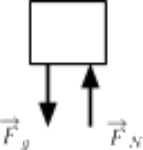
Also, notice the sizes of the arrows. In the case of the bird, the normal force of the branch on the bird is exactly the same magnitude of the force of gravity on the bird, causing the bird to remain motionless on the branch. We represent this by drawing the arrows the same length. The longer the arrow (relative to the other arrows), the stronger the force.
How did we know the normal force and the gravitational force would be the same magnitude? Think back to the bird on the branch -- is it moving? If the gravitational force was stronger than the normal force, the bird would accelerate downward, breaking the branch. If the normal force was stronger than the gravitational force, the bird would accelerate upward. Since the bird is at rest, there is no acceleration, so those two forces must be equal. We will learn more about this later in the activity.
b) A curling stone, gliding forward along an ice surface.
Let’s assume the stone is moving to the right. The system diagram might look like this:

The free-body diagram would look like:

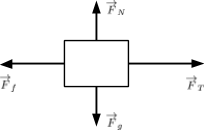
c) A toy being dragged along the ground by a child pulling on a string.
Again, let us assume the toy is being dragged to the right.
System diagram:

Free-body diagram:
d) A person, pushing a car that has run out of gas.
Once again, assume the car is moving to the right.
System diagram:

Free-body diagram:
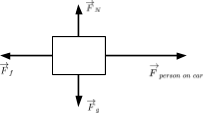
Note that though we’re giving the directions of each of the forces, we are not distinguishing between a force that pushes, and a force that pulls. Though the system diagrams for the child’s toy and the stalled car look very different, the free-body diagram for the toy and the car look very similar. Even though one object is being pulled (tension force) and one is being pushed (applied force), how the forces act on the objects is almost identical.
Questions
Try drawing some system diagrams and free-body diagrams of your own. Check your answers when finished.
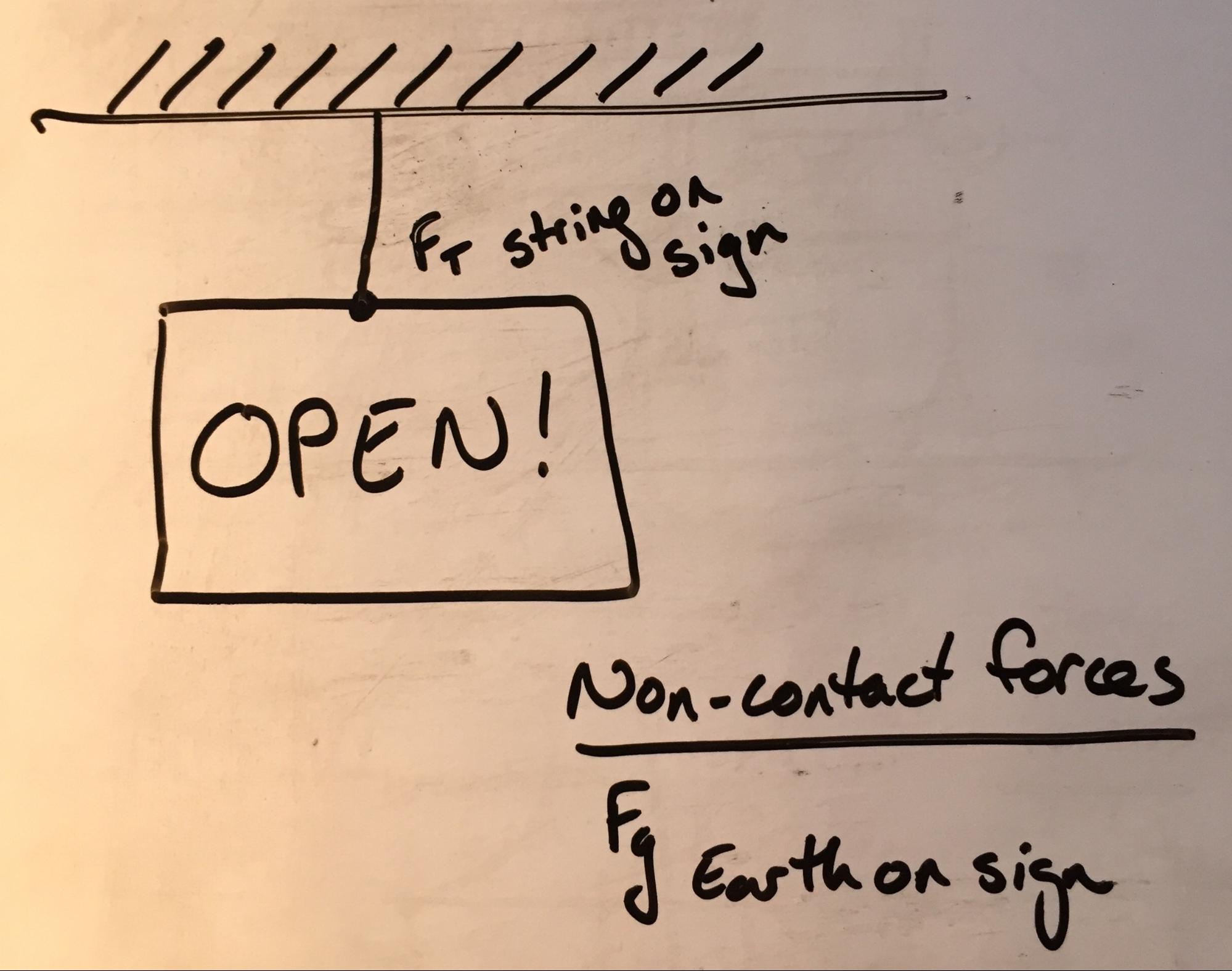
- A sign, hanging by a string.
AnswerSystem Diagram
Free-Body Diagram
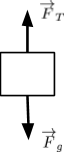
- A car, travelling at constant speed down a straight stretch of highway.
AnswerSystem Diagram

Free-Body Diagram

- A baseball, flying through the air.
AnswerSystem Diagram

Free-Body Diagram
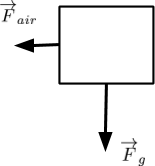
Did you have an applied force on your free-body diagram for the baseball? That’s a common mistake. Once the ball leaves the thrower’s hand, or leaves the bat (if it is being hit), there is no longer an applied force acting on it. In other words, there is nothing continually pushing it (or pulling it) forward as it flies through the air. The only forces acting on it are the gravitational force (pulling it down) and air resistance (acting opposite to the ball’s direction of motion, slowing it down).
Imagine a box at rest in the middle of a room. If you were asked to make that box accelerate, what would you do to it?

You might think to push it (applied force), or attach a string to it and pull it (tension force). But before the box began to move, it would have to overcome the force of friction.
If you pushed on it a little, the box’s free-body diagram might look like this:

Even though you are pushing on the box, your applied force is not enough to overcome the friction force the box feels in contact with the ground. In fact, when you just push a little, the friction force and the applied force are equal, and perfectly balanced. In this case, so are the normal force and the gravitational force.
You will need to push harder -- apply a larger force -- in order to overcome the friction force and get the box to accelerate:

By pushing harder, you have made forces unbalanced: the applied force is no longer equal to the friction force. The box feels a greater push to the right, and accelerates in that direction. In general, if you want to make an object accelerate (change its speed), you have to apply an unbalanced force.
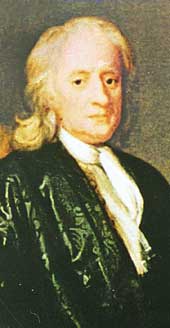
An object in motion (or at rest) will remain in motion (or at rest) until acted upon by an unbalanced force.
A car moving at a constant speed (uniform motion) has all forces acting on it balanced. In this case, the two backward forces (air resistance and friction) perfectly balance the applied force of the wheels on the road in the opposite direction.
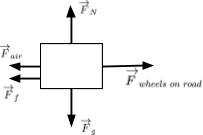
The moment you take your foot off the gas pedal, though, there is no longer an applied force, and the forces become unbalanced:

Now unbalanced, those forces acting backward on the car slow it down, which we also know as negative acceleration.
Sitting on a chair, you might find that the forces acting on you are perfectly balanced (you are not accelerating).
But if someone gave you a pile of heavy textbooks to hold on to, your free-body diagram might come to look like this:

That unbalanced force would cause you to accelerate downward, likely hurting your tailbone as you crashed through the chair to the floor, because there was not enough upward force (i.e. normal force from the chair) to balance the additional mass.
What happens to passengers in a car when the car brakes suddenly? We often perceive being “thrown” forward, feeling the strain of the seat belt keeping us in place. In reality, we are experiencing inertia: our body (already in motion, moving forward with the car) will remain in motion until acted upon by an unbalanced force. So we are not actually being thrown forward -- we are moving forward as we always have.
When the seat belt pushes on us, we are feeling an unbalanced force, causing our forward motion to cease. Check out this video of a crash test dummy to see how the dummy’s inertia keeps it moving forward even after the car comes to a stop.
Inertia
Think about other times in a car when your body seems to move in a different direction than the car is moving. Typically, these motions happen when the car moves suddenly in a certain direction.
Create a reflection and record two or three other examples of inertia you have experienced in a car. What is your body trying to do that the car (or parts of the car, like the seatbelt) is preventing?
Can you imagine a situation where there are many forces acting on an object, all along the same direction? For example, five people pushing on a stalled car to move it, or nine birds and a squirrel sitting on a telephone wire. What about eight children pulling one way on a tug-of-war rope, and another eight children pulling the opposite way on the same rope? Is there a way we can combine forces?
Instead of referring to every force present in a problem, we often refer to the overall force acting on an object, and we call that the net force. The net force is not a force unto itself -- it should never show up in a free-body diagram -- but rather a sum of all the forces in a certain direction.
Recall that forces are vector quantities, measured in newtons (it was Sir Isaac Newton’s observations and work with forces that inspired scientists to use his name as the unit of force).
We can imagine two children fighting over a toy: one child pulls on the toy with a force of five newtons in the westward direction (written: 5 N [W]), while the other pulls on it with a force of 8 N [E]. In which direction would the toy accelerate?
We can tell from the free-body diagram: the arrow to the right (eastward) is larger, so we know that the toy will accelerate to the east. But what is the net force?
![This is a free-body diagram for a toy being pulled by two children. There is a gravitational force and normal force exerted on the toy, as well as two applied forces (5 N [W] and 8 N [E])](_images/image44_1.png)
If the net force is the sum of the forces in a given direction, then we can write:
![\vec{F}_{net}= 8N[W]+5N[E]](_images/image_DnAfL.gif)
...but remember: we can only add vectors when they are in the same direction. We have to change the positive 5 N [E] to negative 5 N [W].
![\vec{F}_{net}= 8N[W]-5N[W]](_images/image_k776A.gif)
![\vec{F}_{net}=3N[W]](_images/image_iAX8b.gif)
So the net force on the object is 3 N [W], and it will accelerate in the westward direction.
Note that the gravitational force and the normal force are NOT in the same direction as the applied forces in this question. In fact, they are perpendicular to the applied forces. Because of this, we do not take them into consideration -- we are only concerned with the direction of motion.
 Practice
-
A car is stuck in the mud! In an effort to free it, a person pushes on the back of the car with a force of 27 N [forward], while a tow truck pulls on the car with a force of 259 N [forward]. The frictional force on the car, though, is 281N [backward]. Does the car come free? Try this for yourself and then click on the solution below to see if you’ve got it.
Solution
Given:

![\large \vec{F}_{person on car}=27 N [forward]](_images/image_wzes5.gif)
![\large \vec{F}_{towtruck on car}=259 N [forward]](_images/image_MYdxe.gif)
![\large \vec{F}_{f}=281 N [backward]](_images/image_bhLZ5.gif)
Required:
The car will need to accelerate in order to come free of the mud. In order to accelerate, we need a positive net force in the forward direction.

Analysis:
![This is a free-body diagram for car being pulled by a towtruck and pushed by a person. There is a gravitational force, a normal force, a friction force (381 N [bkwd]), and two applied forces (259 N [fwd] and 27 N [fwd]) acting on the car.](_images/image7_1.png)
We know that the net force is equal to the sum of the forces in a given direction, in this case, horizontally.
Solution:

![\large \vec{F}_{net}=27N[fwd]+259[fwd]+281N[bkwd]](_images/image_I4kwW.gif)
![\large \vec{F}_{net}=27N[fwd]+259N[fwd]-281N[fwd]](_images/image_Opsu3.gif)
![\large \vec{F}_{net}=5N[fwd]](_images/image_7hFIg.gif)
Paraphrase:
The net force on the car is 5 newtons forward. Because of this, the car will accelerate in a forward direction, and will likely become free of the mud.
But what if we calculated the net vertical force here? What would it be?
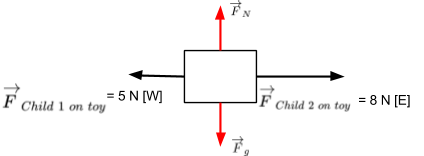
Recall that the gravitational force and the normal force were exactly balanced. This is represented in our free-body diagram as arrows of the same length, pointing opposite to each other.
If we were to calculate the sum of these forces, the result would be a net force of zero (they would sum to zero). A net force of zero indicates no acceleration in that direction, and that makes sense for the toy -- in fact in the vertical direction, the toy is not moving at all.
The example of the car moving at a uniform speed earlier in the activity shows the same:
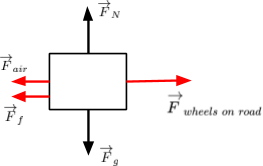
Since the car is not accelerating, the force of air resistance and the friction force must add to give the exact opposite of the applied force. The net force here would be zero, as well.
Note that a net force of zero does NOT mean that the object is standing still. A net force of zero indicates that the object is not accelerating. The car in this example is still moving, but its speed remains unchanged.
 Careers
Civil Engineering is a branch of engineering that deals with the design, construction and maintenance of structures. This can include everything from roads, bridges, and railways, to canals, seaports, and dams, to energy systems and drinking water systems.
Chris, after a successful career in retail, has just finished a three-year Civil Engineering Technology program as a mature student at Algonquin College in Ottawa, Ontario, where part of his studies centred on the effects of forces on structures. One of his courses, Structural Analysis, emphasized the importance of having to consider the magnitudes and directions of forces:
“
“A key aspect of forces on the design of any structure is that they must be static. Every building, bridge, or even shed, has to be in equilibrium. In order to verify this, you need to use a free body diagram to calculate all the forces affecting a body. If the calculate is imbalanced, then the body isn't stable. In a structure this could cause collapse. By calculating the weight of the structure, adding in the snow and rain load, and then factoring in the wind load, you can determine the load that the foundation must support. If it is able, then you have a stable structure.”
For more information on careers in Civil Engineering, visit ontariocolleges.ca.

CONSOLIDATION
Summary
Dynamics is the study of the causes of motion, namely forces.
A force is a push or a pull experienced between two objects. Forces are given the symbol  and are measured in newtons. As force is a vector, always remember to include a direction.
The six types of forces we have learned about in this activity are:
- Gravitational (
 )
) - Normal (
 )
) - Applied (
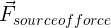 )
) - Friction (
 )
) - Air Resistance (
 )
) - Tension (
 )
)
A free-body diagram is a sketch of only the object in question and the forces acting upon it, to scale.
Newton’s First Law of Motion: An object in motion (or at rest) will remain in motion (or at rest) until acted upon by an unbalanced force.
Net force: The overall force acting on an object, or, the sum of all forces in a given direction. A net force of zero indicates no acceleration.
Questions
- Which of the following statements on forces is most correct?
- The gravitational force always acts opposite the direction of motion.
- Air resistance only acts on objects that are moving.
- The force of friction does not exist when an object is stationary.
- All objects experience a normal force.
b. Air resistance only acts on objects that are moving.
The gravitational force can act in the direction of motion (ie. an object falling), friction can exist when an object is stationary (it could be what prevents the object from moving), and objects only experience a normal force when resting on a surface.
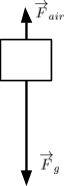
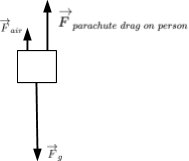
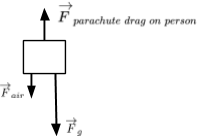
- Which of the following is the free-body diagram of a parachutist accelerating downward, with his parachute open?
c. The gravitational force is down, the applied force (the parachute) is up, and the air resistance is opposite the direction of motion.

- Three friends are helping to move a piano, though they’re not communicating well. One friend pushes the piano with a force of 46 N [fwd]. Another friend pulls the piano 53 N [bkwd]. The third friend pushes with a force of only 5 N [fwd]. Ignoring friction, what is the net force? Answer
d. 2 N[bkwd]

![\vec{F}_{net}= 46N[fwd]+53N[bkwd]+5N[fwd]](_images/image_MY1Ie.gif)
![\vec{F}_{net}= 46N[fwd]-53N[fwd]+5N[fwd]](_images/image_GGtNq.gif)
![\vec{F}_{net}= -2N[fwd]](_images/image_sIIzZ.gif)
![\vec{F}_{net}= 2N[bkwd]](_images/image_XFDJD.gif)
Therefore, the object will experience a net force of 2 N [backwards].
- 104 N[fwd]
- 51 N[fwd]
- 12 N[bkwd]
- 2 N[bkwd]
- In what direction is the acceleration of an object experiencing an applied force of 79 [N], a friction force of 53 [S], and an air resistance force of 26 [S]?
- North
- South
- No acceleration
- It depends on the direction of the gravitational force.
c. No acceleration
To determine the direction of acceleration, we need to determine the net force:

![\vec{F}_{net}=79N[N]+53N[S]+26N[S]](_images/image_qbqg5.gif)
![\vec{F}_{net}=79N[N]-53N[N]-26N[N]](_images/image_i5wKF.gif)

Because there is no net force, there is no acceleration.
 Learning Goals and Success Criteria
 Learning Skills and Work Habits