
Forces and Newton's Laws of Motion
Newton's Second and Third Laws of Motion

MINDS ON
It has long been an endeavour of humans to explore previously unexplored regions, and that includes outer space. Think about the connection between forces, net force, and acceleration. How much net force would we need to escape Earth’s gravity and launch something into space? What kind of acceleration would such a large net force cause? Watch the following video to witness the launch of a space shuttle.
 Reflection
Take a few minutes to think about the video, and re-watch it as many times as you like. Create a reflection to record the answers to the following questions:
- We’ve mentioned a connection between net force and acceleration -- do you think there are any other factors that affect how much an object can be accelerated? What are they?
- Do you think the amount of force demonstrated in this video would be enough to launch a car into space? Do you think this would be enough force to launch a vehicle twice as large as the space shuttle into space?
- What other types of exploratory vehicles must take forces into account either for propulsion or for occupant safety?

ACTION
 Investigating Net Force and Acceleration
In this investigation, we will collect data to see how much net force is needed to accelerate an object by a certain amount. In the process, we will see if we can determine a correlation between acceleration and net force, as well as acceleration and mass.
NetForceAcceleration
Data Collection:
- Start by choosing a value of net force between 1-30 N. Enter this where prompted. This will be the net force applied to the cart. Record this net force for future reference.
- The cart starts empty. On its own, the cart has a mass of 5 kg. You can immediately see the acceleration the empty cart would have when your net force is applied.
- We are going to add more mass to the cart, and each time, see if the acceleration changes. Drag the 5 kg masses, one at a time, onto the cart, and track any changes in the acceleration. You may want to use a table like this one:
Mass (m) in kg
Acceleration
 in m/s/s
- Continue adding mass, and recording the mass and acceleration until there are no masses left.
- Reset the simulation, and choose a new force. Repeat the procedure two more times until you have three mass-acceleration data tables.
Analysis:
- Look at your tables of mass and acceleration for the three forces. In general, what do you notice about the acceleration as the mass changes? This is known as an inverse proportionality. Read more about direct and inverse proportionality at MathisFun.
- Because of this, it might be more useful to compare the inverse of mass to acceleration. Create three new tables -- one for each net force you chose -- of inverse mass and acceleration. It might look like this:
Inverse Mass (1/m) in 1/kg Acceleration
 in m/s/s
- Create a graph of inverse mass (on the x-axis) and acceleration (on the y-axis) for your three sets of data. They should be linear. If not, check with your teacher.
- Determine the slope of each of the three graphs. How do these values connect with the simulation? What symbol can we give this? What are the units of the slope?
- Use this information to create a linear equation of the form y = mx + b, where:
- y is the variable on the y-axis;
- m is the slope;
- x is the variable on the x-axis;
- b, in this case, is zero.
- Create a new table of values that is acceleration and net force, and fill it with the measurements obtained for all the empty carts. Your table should look like this, and only have three data points in it.
- Based on what you saw at MathisFun on proportionality, is the relation here directly proportional, or inversely proportional?
Conclusion:
- Write a statement describing the proportionality between acceleration and mass, and between acceleration and net force.
- What new equation did you come up with for linking net force, mass, and acceleration?
What you noticed in the previous investigation is exactly what Sir Isaac Newton and his predecessors noticed when they performed similar experiments. That led him to formalize what is now known as Newton’s second law of motion:
Newton’s second law of motion states that the acceleration of an object is directly proportional to the net force exerted on the object, and inversely proportional to the mass of the object. In other words, the larger the net force on an object, the greater the acceleration, and the less mass an object has, the greater the acceleration.
As you saw from the investigation, this can be written as:

 A more common way of writing it, however, is:

 Provided you know any two of these three pieces of information (the net force on the object, the mass of the object, or the acceleration of the object), you can determine the third. Keep in mind that mass should always be measured in kilograms, acceleration in m/
 , and net force in newtons.

What is a Newton?
We have been stating individual forces and net forces using units of newtons, in honour of Sir Isaac Newton, who formalized a lot of the physics around the study of dynamics. But exactly how large is a force of one newton, anyway?
If we look at Newton’s second law in equation form, we can get a sense of the units that make up a newton. Recall that:

...where mass is measured in kilograms, and acceleration is measured in metres per second per second (or, metres per second squared). Using the equation, we can perform a unit analysis:

So one newton, is the same as one kilogram-metre per second squared: 1 newton is enough force to accelerate a 1 kg object at a rate of 1 m/s per second. In other words, one newton is approximately the same amount of force required for you to pick a 1 kg object up off the floor and raise it to your waist height. Not very much!
 Practice
Let’s take some time to practice using Newton’s second law. The first example is done for you. On the subsequent examples, try the question yourself before clicking to see the answer.
-
A player kicks a 0.43 kg soccer ball such that it accelerates at 104 m/
 [fwd]. With what net force did the player kick the ball?
Solution
Given:
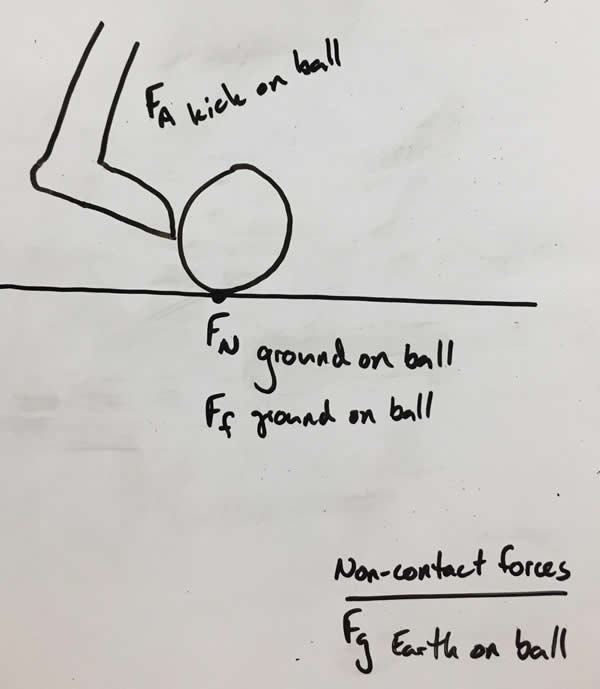
m = 0.43 kg
![\vec{a}= 104m/s^{2}[fwd]](_images/image_xcdlX.gif)
 Required:
We are asked to determine the net force the player applies to the ball.


Analysis:
We can use Newton’s second law of motion, which states that the net force is equal to the mass of the object multiplied by the acceleration of the object.
Solution:

![\vec{F}_{net}= (0.43kg)(104m/s^{2}[fwd])](_images/image_29ZbN.gif)
![\vec{F}_{net}= 45kg \cdot m/s^{2}[fwd]](_images/image_XvFeG.gif)
![\vec{F}_{net}= 45N[fwd]](_images/image_bKkic.gif)
Paraphrase:
The soccer ball was kicked with a net force of 45 N [fwd].
-
A condor with a mass of 15kg takes off with an acceleration of 2.2 m/
 [upward]. With what net force must the condor’s wings lift in order to accelerate at that rate?
Solution
Given:
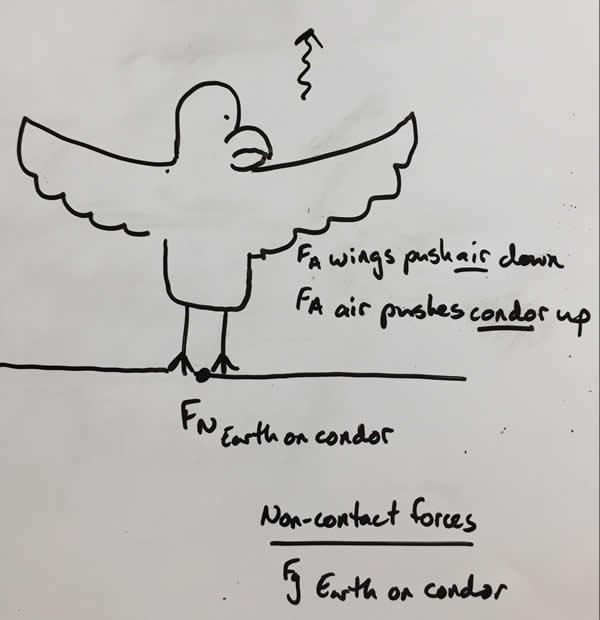

![\vec{a}= 2.2m/s^{2}[up]](_images/image_RPi0m.gif)
Required:
We are asked to determine the net force the condor’s wings exert.

Analysis:
We can use Newton’s second law of motion, which states that the net force is equal to the mass of the object multiplied by the acceleration of the object.
Solution:

![\vec{F}_{net}= (15 kg)(2.2m/s^{2}[up])](_images/image_FLwAu.gif)
![\vec{F}_{net}= 33 kg\cdot m/s^{2}[up]](_images/image_WVJNO.gif)
![\vec{F}_{net}= 33 N[up]](_images/image_7h6Mw.gif)
Paraphrase:
The condor must lift with a net force of 33 N [up]
 Example
Consider three friends moving a piano. One friend pushes the piano with a force of 218 N [fwd]. Another friend pulls the piano 195 N [bkwd]. The third friend pushes with a force of only 27 N [bkwd]. If the mass of the piano is 204.5 kg, and ignoring friction, what is the acceleration of the piano?
Solution
Given:
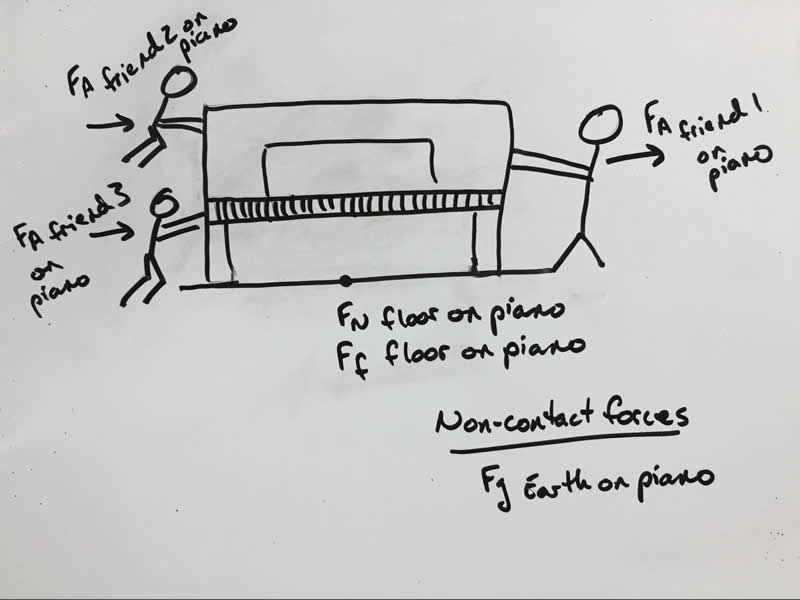

![\vec{F}_{friend 1 on piano}= 218N[fwd]](_images/image_FGcyc.gif)
![\vec{F}_{friend 2 on piano}= 195N[bkwd]](_images/image_tJT67.gif)
![\vec{F}_{friend 3 on piano}= 27N[bkwd]](_images/image_DqSvQ.gif)
Required:
We are asked to determine the acceleration of the piano.

Analysis:
The free-body diagram for the piano looks like this:
![This is a free-body diagram of the forces acting on the piano. There are three applied forces (218 N [fwd], 195 N [bkwd], and 27 N [bkwd]), a gravitational force, and a normal force.](_images/image25_2.png)
We can use Newton’s second law of motion to determine acceleration, which states that the net force is equal to the object’s mass multiplied by the object’s acceleration. To determine net force, we can add the individual forces in the horizontal direction.
Solution:

Dividing both sides by mass allows us to solve directly for the acceleration:

However, before we solve for acceleration, we need to determine the net force. We can do that with:

![\vec{F}_{net}= 218N[fwd]-195N[fwd]-27N[fwd]](_images/image_zQHBt.gif)
![\vec{F}_{net}= -4N[fwd]](_images/image_V2tbf.gif)
With the net force, we can now determine the acceleration:

![\vec{a}= \frac{-4N[fwd]}{204.5kg}](_images/image_oYAXG.gif)
![\vec{a}= \frac{-4kg\cdot m/s^{2}[fwd]}{204.5kg}](_images/image_wqK44.gif)
![\vec{a}= -0.02m/s^{2}[fwd]](_images/image_9sces.gif)
![\vec{a}= 0.02m/s^{2}[bkwd]](_images/image_PV2Vo.gif)
Paraphrase:
The piano is accelerating 0.02 m/ backwards.
A force is interaction between two objects, like two billiard balls. Does that mean that if one object feels a force, another object must also feel a force? Sir Isaac Newton asked that same question.
Newton’s third law of motion states that for every action force, there is an equal, but oppositely-directed reaction force. In other words, whenever there is an interaction between two objects, there is always a pair of forces acting on the objects. Those forces have the same magnitude (strength), but act in opposite directions on each object.
While simple in theory, it is sometimes a bit tricky to identify those action-reaction force pairs.
Imagine you are on a pair of ice skates, leaning against the boards in a skating rink. At the moment, you are at rest. What happens when you exert a force by pushing on the boards? As you might imagine, you slide away from the boards, in the opposite direction that you pushed.
But wait a minute… you exerted a force forward by pushing on the boards, so why are you now gliding backward?
There are two forces at work here: you pushing on the boards is an action force. We could draw the board’s free-body diagram to show this, with your applied force on it in red.
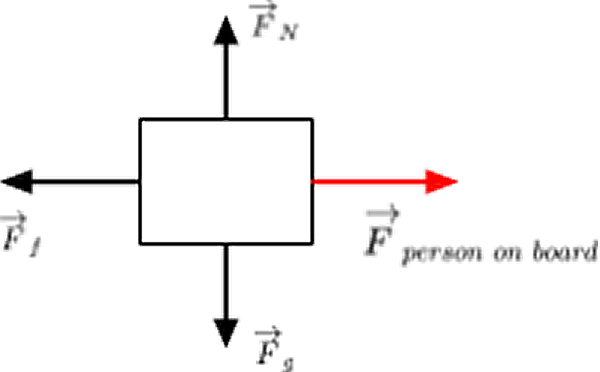
While you are quite strong, you are not strong enough to overcome the board’s force of friction and move it. All forces are balanced.
According to Newton’s third law, the boards are exerting an equal, but oppositely-directed force back on you! Your free-body diagram would look like this:

The applied force acting on you by the wall is the reaction force. It is the same magnitude as the force you exerted on the boards, but this time that force is more than enough to overcome friction, and as a result, you accelerate, moving you away from the boards.
We could write this as follows:
- Action force: Person on the boards, forward
- Reaction force: Boards on the person, backward
Here’s another example. Consider a pop can resting on a table. We can draw a free-body diagram of the can to examine the forces acting on it. For now, let’s just look at the normal force upward.
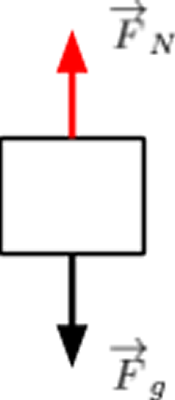
This normal force is being exerted on the pop can by the table -- the table is what is preventing the pop can from accelerating downward due to the force of gravity. But just as the table is pushing up on the can, the pop can is also pushing down on the table! If we were to draw a free-body diagram of the table, it would look like this:
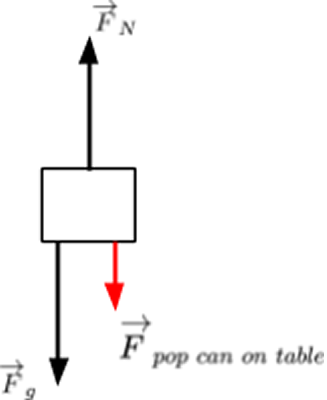
The gravitational force is the force of the Earth pulling on the table, and the normal force is the force exerted by the floor the table is standing on. The applied force in red -- the force the can is applying on the table -- is the of the same magnitude as the normal force on the can, but in the opposite direction. We can write:
- Action force: Table on pop can, upward
- Reaction force: Pop can on table, downward
Be careful! Even though in our original free-body diagram the gravitational force and the normal force are equal AND in opposite directions, they are NOT an action-reaction force pair. In fact, action-reaction force pairs are never drawn on the same free-body diagram together, because by definition, only one of the forces is acting on each object.
What Causes Gravity?
What is the gravitational force? The magnitude of the gravitational force an object experiences depends on three things: the mass of the object doing the pulling (in our case, the Earth), the mass of the object being pulled (such as a baseball), and the distance between them.
While we often think of gravity as only coming from a planet or moon, any two objects that have mass actually exert a gravitational force on each other. That’s right -- you are currently exerting a gravitational force on the device on which you are reading this content, and it is exerting a gravitational force on you! But because your mass (and the mass of your device) is so much smaller than the mass of the Earth -- from which we feel the most gravitational attraction -- we don’t notice the gravitational forces exerted by everyday objects.
We are so used to the force of gravity we feel due to the Earth that we often take it for granted. However, it’s interesting to consider what these forces might be like on other planets!
Jupiter, a more massive planet, would exert a greater gravitational force (so much so that we would be hard pressed to overcome that force to even lift a foot, let alone take a step, if we were to find ourselves there). The Moon, a less massive body, exerts a weaker gravitational force. Our muscular strength -- after a lifetime of conditioning overcoming the Earth’s stronger gravitational force -- is way more than needed to overcome the Moon’s gravitational force in order to take a step. In footage seen from the Moon landings, humans appear to have superpowers, taking giant leaps effortlessly.
We could imagine a species of aliens from Jupiter jumping the same way if they came to the Earth, as they would be stronger from a life on a massive planet!
Consider one more example. Let’s take an object with only one force acting on it: a baseball at the very top of its trajectory when thrown upward. At the very top of its path through the air, the ball stops momentarily before coming back down. The only force acting on it is the gravitational force.
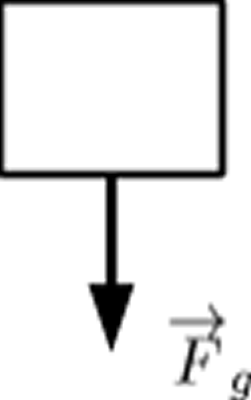
The Earth is pulling on the ball. As an unbalanced force, this will cause the ball to accelerate downward. This is the action force.
However, as we learned earlier, the ball is also exerting an equal gravitational force on the Earth. We could write:
- Action force: Earth on baseball, downward
- Reaction force: Baseball on Earth, upward
So, why does the ball fall downward toward the Earth, but the Earth doesn’t “fall” upward toward the ball? Not only does the Earth have many more forces acting on it (think of all the falling objects all around the world, to start), but the Earth is MUCH more massive than the ball. While a small force would get the ball accelerating, we would need a HUGE unbalanced force to get the Earth accelerating toward the ball. Nevertheless, the ball does exert a force on the planet upward toward it.
 Questions
Try these examples to see if you’ve got the hang of identifying action-reaction force pairs.
State the reaction force to each of the following action forces:
- A car crashes into a wall.
- Action force: Car on the wall, forward
- Reaction force:
Reaction force: Wall on the car, backward
- A large textbook is sitting on a shelf.
- Action force: Textbook on the shelf, downward
- Reaction force:
Reaction force: Shelf on the textbook, upward
- A large textbook is sitting on a shelf.
- Action force: Earth on the textbook, downward
- Reaction force:
Reaction force: Textbook on the Earth, upward
- A pin is pushed into a pin cushion.
- Action force: Pin on the cushion, inwards.
- Reaction force:
Reaction force: Cushion on the pin, outward
- A propellor pushes a boat through the water
- Action force: Propellor on the water, backward
- Reaction force:
Reaction force: Water on the propellor, forward
- A person pushes with a force of 27 N on a tree.
- Action force: Person on tree with 27 N [east]
- Reaction:
Reaction force: Tree on person with 27 N [west]
Reflection
Are you starting to see a pattern? Create a reflection, and answer the following questions.
- When given the direction of the action force, how can you find the direction of the reaction force?
- What general rules can you come up with to help you identify these pairs of forces?
- Create two more examples of action-reaction force pairs.

CONSOLIDATION
Summary:
Newton’s second law of motion states that the acceleration of an object is directly proportional to the net force exerted on the object, and inversely proportional to the mass of the object. Mathematically, this law is often written as

Newton’s third law of motion states that for every action force, there is an equal, but oppositely-directed reaction force. In other words, whenever there is an interaction between two objects, there is always a pair of forces acting on the objects.
Questions
- A car accelerates at a rate of 6.512 m/s2 [north]. If the net force the car must exert to accelerate at that rate is 9 183 N [north], what is the mass of the car?
- 1 410 kg
- 59 800 kg
- 709 kg
- 5 979 kg
a. 1 410 kg


![m= \frac{9183N[north]}{6.512m/s^{s}[north]}](_images/image_aIy6R.gif)
![m= \frac{9183kg\cdot m/s^{2}[north]}{6.512m/s^{s}[north]}](_images/image_bpHwR.gif)
- Newton’s second law of motion states that acceleration is inversely proportional to mass. This means that:
- as mass increases, acceleration increases.
- as mass increases, acceleration decreases.
- as mass increases, acceleration stays the same.
- as mass increases, acceleration becomes negative.
b. as mass increases, acceleration decreases
Inversely proportional means that there is a linear correlation between acceleration and 1/m. As mass increases, acceleration will decrease, making the correct answer b).
- A car is moving along a highway at a constant pace. If the action force is the air resistance of the air on the car, backward, then the reaction force must be:
- The force of the tires on the road, forward.
- The force of the car on the air, forward.
- The force of the road on the car, up.
- The force of the tires on the road, backward.
b. the force of the car on the air, forward
If the action force is the force of the air on the car, backward, then we know that the two objects experiencing the action-reaction force pair are the air and the car. We also know that the reaction force is in the opposite direction of the reaction force, so in this case, it must go forward. The correct answer is therefore b) Reaction force: car on the air, forward.
- Just before a thrown object leaves your hand, it experiences an applied force of 12 N [west], and a force of air resistance of 8.3 N [east]. If the object is 0.145 kg, what is the acceleration of the object?
- 83 m/
 [west]
 - 57 m/
 [east]
 - 26 m/
 [west]
 - 140 m/
 [west]
c. 26 m/


![\vec{F}_{net}= 12N[west] + 8.3N[east]](_images/image_PmAEB.gif)
![\vec{F}_{net}= 12N[west] - 8.3N[west]](_images/image_DfhhB.gif)
![\vec{F}_{net}= 3.7N[west]](_images/image_94Z8p.gif)


![\vec{a}= \frac{3.7N[west]}{0.145kg}](_images/image_4Ne8I.gif)
![\vec{a}= \frac{3.7kg\cdot m/s^{2}[west]}{0.145kg}](_images/image_TuxdF.gif)
![\vec{a}= 25.5 m/s^{2}[west]](_images/image_yWS9k.gif)
![\vec{a}= 26 m/s^{2}[west]](_images/image_udrf8.gif)
- 83 m/
 Learning Goals and Success Criteria
 Learning Skills and Work Habits