
Forces and Newton's Laws of Motion
Gravity and Friction

MINDS ON
When a tablecloth is yanked straight out from under a place setting, it is inertia that keeps the dishes and glasses stationary. The place setting at rest remained at rest, because there were no unbalanced forces acting on it. Had the cloth been pulled more slowly, or at an angle, additional forces would have caused the place setting to accelerate.
What else makes a difference when performing this trick? What other forces come into play? Watch the following video.
 Reflection
Take a few minutes to think about the video, and re-watch it as many times as you like. Create a reflection to record the answers to the following questions:
- Why did the initial motorcycle pull of the tablecloth not work? Which force was there too much of, and why wasn’t this an issue with the (much) smaller place setting?
- What effect does increasing the speed of the tablecloth pull have on performing the trick? Which Newton’s Law explains this?
- What were some of the tactics used to overcome the force you identified in question 1? In what other (real-life) situations would we want to reduce that force?

ACTION
With Newton’s second law, we saw that net force depends on mass and acceleration:

We also know that gravity depends on the mass of the object doing the pulling (in our case, the Earth), the mass of the object being pulled (such as a person), and the distance between the two.
That’s a lot to keep track of. But if we only drop objects on (or close to) the surface of the Earth, we fix two of our three variables mentioned above (the mass of the Earth is a constant, and the distance to the object is considered a constant, since our height above the Earth’s surface is often much, much less than the radius of the Earth), and the calculation of the force of gravity becomes more manageable. And, we can even use Newton’s second law to do it!
If an object is released above the surface of the Earth, just as it begins to fall, the only force acting on it is gravity. Its free-body diagram would look like this:

In our example,  is only based on one force -- the gravitational force. So, we can write:

In this special case, the acceleration of the object is caused entirely by gravity. It turns out, that when an object is close to the surface of the Earth, that value of acceleration has a very specific value, which is given a special symbol:  . Our equation then becomes:

In other words, the force of gravity on an object is the mass of the object (in kilograms) multiplied by the gravitational acceleration of the planet (in metres per second per second [down]).
But what is the value of  on Earth?
Different objects have different values of acceleration, and you may have come up with some good reasons for this. It is commonly (but mistakenly) thought that the mass of an object changes its rate of acceleration toward the Earth -- many people think that heavier objects fall faster.
Watch this video of a famous experiment performed on the Moon:
Reflection
Take a few minutes to think about the video, and re-watch it as many times as you like. Create a reflection to record the answers to the following questions:
- This experiment is not impossible to do on Earth, but it is nearly impossible to achieve the same result. Why is this?
- Based on this video, does the mass of any object affect how quickly it accelerates when it falls? How do you know?
- How would the free-body diagram of a feather dropped on Earth differ from that of a feather dropped on Mars? Sketch each diagram.
 Mass and Weight
In Physics, we make an important distinction between two terms that are used pretty much interchangeably by most people: mass, and weight.
We have used mass, measured in kilograms, in calculations so far (such as  ) with an understanding that it represents “how heavy something is.” The truth is a little more nuanced than that.
Mass is the amount of matter (“the stuff”) in a given object. It is an unchanging amount -- if you had a 25 kg dumbbell, that dumbbell would have a mass of 25 kg here on Earth, a mass of 25 kg on the Moon, and even a mass of 25 kg floating out in space. It is a fundamental property of matter.
Weight, on the other hand, is the force of gravity on an object. Like any force, it is measured in newtons. The stronger the gravitational force, the greater an object’s weight. So unlike mass, it is a quantity that changes depending on the gravitational force it experiences -- that 25 kg dumbbell on the Moon would have less weight than it would here on Earth.
So why the confusion? Weight only changes when the source of gravitational force changes -- there are changes in weight here on Earth, depending on how far you are from the surface of the Earth (standing on the top of a tall mountain, you would weigh slightly less compared with standing at sea level, for example), but those changes are extremely small. Because most of us don’t ever experience the gravitational force of another planet, we tend to use weight and mass interchangeably here on Earth.
As both private companies and government organizations such as the Canadian Space Agency or NASA start looking at sending humans to the Moon, Mars, or beyond, we as a species will have to start differentiating between the weight we feel on a particular planet, and our actual mass.
So, the next time someone asks you how much you weigh, feel free to answer them in newtons! Interested in knowing how much you actually weigh? Read on to find out!
Sometimes, to remind us that gravitational force ( ) is the same as weight, we write

as:

… where weight is measured in newtons. Sometimes, weight is given the symbol  , but in this course we will just use “weight.”
In our first learning task in this unit, we determined the acceleration of an object due to gravity here on Earth. In advanced laboratories, it has been determined that this acceleration is equal to 9.80665 m/ [down]. Often rounded to just one decimal place, we can write:
![\vec{g}=9.8m/s^{2}[down]](_images/image_j5Jzl.gif)
Remember that this value is only valid on Earth -- other planets (or celestial bodies, like the Moon) will have different values of gravitational acceleration, because of their different mass.
What is the weight of a 25 kg dumbbell, on Earth?
Given:
m = 25 kg
Required:
We are asked to determine the weight.

Analysis:
Because the question specifies that the dumbbell is on Earth, we also know the gravitational acceleration.
![\vec{g}=9.8m/s^{2}[down]](_images/image_6mLIG.gif)
We know that the weight of an object (in other words, the gravitational force acting upon it), is equal to the object’s mass multiplied by the gravitational acceleration experienced on that planet.
Solution:

![weight=(25kg)(9.8m/s^{2}[down])](_images/image_eoKF3.gif)
![weight=245kg\cdot m/s^{2}[down]](_images/image_D9OCU.gif)
Remembering that a Newton is equivalent to  , and that we need to keep the same number of significant digits as our least precise measurement (in this case, two significant digits), we end up with:
![weight=250N[down]](_images/image_CDDqi.gif)
Paraphrase:
The 25 kg dumbbell has a weight of 250 N [down].
On Earth, we can always assume that ![\vec{g}=9.8m/s^{2}[down]](_images/image_KOC8Q.gif) -- when problem solving, it will always be a given.
-- when problem solving, it will always be a given.
Friction
Friction is another force we encounter everyday, often giving very little thought to its presence. Friction is a force that resists the relative motion of objects sliding against each other. It depends on the nature of the surfaces of the two objects interacting with each other, as well as how much they are pressed together. Both of these traits can be quantified.
In fact, we have already seen a force that represents how much two objects are pressed together: the normal force! If an object is resting on a surface, the amount of force needed to hold the object up (opposing gravity) is an indicator of how close the contact is between the object and the surface.
Quantifying the interaction between two surfaces (e.g. rubber and asphalt, or stainless steel and ice) is trickier. For that, physicists have created a new value, the coefficient of friction, which is represented by the Greek letter mu (pronounced mee-yoo), which has the symbol “ ”. The coefficient of friction is a purely empirical value, meaning it can only be determined through experimentation. The higher the value of
  , the rougher the surface, and the greater the force of friction will be.
 is a ratio of the magnitudes of the force of friction (
 ) to the normal force (
 ) - as a result of this, it is one of the few values in Physics that is unitless. We can write:

Or, multiplying both sides by  ,
,

This equation represents the maximum amount of friction that can be between two objects. Tables of values for coefficients of friction between various substances (for instance, between rubber and concrete, or between wood and steel) can be found online, and are considered fixed values.
It is worth noting that there are several different types of friction:
- Static friction occurs when the objects are in contact, but not moving against each other. This is the force that must be overcome in order to accelerate an object (imagine pushing on a filing cabinet -- you need to overcome the initial force of friction before it will move). The maximum value of the force of static friction occurs just before the object starts to move.
- Kinetic friction occurs when the objects are in contact and moving against each other (once you get the filing cabinet moving, there is still friction between it and the floor).
- Rolling friction occurs when an object is not sliding, but rather is rolling along a surface.
Our equation to calculate the force of friction is only valid for static friction and kinetic friction. Remember that the force of friction between two objects that are not moving against each other is greater than the force of friction between the same two objects when the objects are moving against each other. We can denote this difference with subscripts on the coefficients:  for the coefficient of static friction, and
  for the coefficient of kinetic friction.

and

We now have an equation for the magnitude of the force of gravity,

...and an equation for the magnitude of the force of friction,

But, in order to calculate the force of friction, we need to know the normal force. How can we calculate that?
Think back to our work with free-body diagrams. In all of our examples so far, the gravitational force and the normal force have always been balanced. Take our example of a curling rock sliding along the ice to the right:
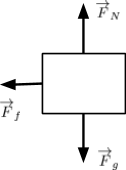
In the vertical direction, there is no acceleration, indicating that  is balanced with
  . In other words, the magnitudes of the two forces are the same. The directions are different, though -- they are directly opposite each other.
We can write:

(Notice that the vector arrows have been removed -- we are now just looking at the magnitudes of the forces.)
So, if we know the force of gravity, we also know the normal force! While this is not always the case in real life, provided there is no acceleration and no additional forces acting in the vertical direction, we can always make this substitution in this course.
Here is an example of a question that makes use of the gravitational force and the force of friction.
 Example
A car, with a mass of 1730 kg, slams on its brakes, locking its wheels while it skids. If the coefficient of kinetic friction between rubber and concrete is 0.80, what is the force of friction acting on the car?
Given:
We know that the car is moving forward, but slowing down.
m = 1730 kg

Required:
For this question, we are asked to determine the force of friction.

Analysis:
The free-body diagram of the car would look like this:
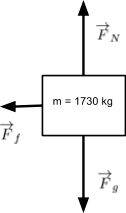
We know that the force of friction depends on two things: the coefficient of friction, and the normal force. Because the car is not accelerating in the vertical direction, we know that all forces in the vertical direction are balanced, with a net force of zero. Looking at our free-body diagram, we know that the magnitude of the normal force is the same as the magnitude of the gravitational force.
Solution:


We know that  , we can write:




Now, we can solve for the force of friction.



Paraphrase:
The force of friction acting on the car is 14 000 N, in the direction opposite to the motion of the car.
 Questions
Try the following mini-quiz to see if you’ve got it!
- What is the force of kinetic friction between a 30 kg pile of bricks and a gravel driveway? The coefficient of kinetic friction for brick and gravel is 0.6.
- 180 N
- 18 N
- 490 N
- 50 N
a. 180 N





- A 7.3 kg box slides across the floor, experiencing a force of friction of 17.885 N [backward]. Determine the coefficient of kinetic friction between the box and the floor. Using this chart, what are the materials of the box and the floor?
- Copper and steel
- Waxed wood on wet snow
- Wood on wood
- Rubber on wet concrete
d. Rubber on wet concrete.


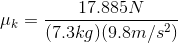

By looking at the table of coefficients of friction, we can see that this coefficient of kinetic friction is between rubber and wet concrete.
- A wooden skid is loaded with 550 kg of cargo, and pushed with a forklift. If the coefficients of friction between the skid and the floor are μs = 0.35 and μk = 0.20, what force does the forklift need to exert in order to start moving the skid?
- 110 N
- 193 N
- 1100 N
- 1900 N
d. 1900 N
In order to get the skid moving, we have to overcome static friction, so we will be using the coefficient of static friction,




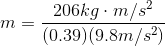
- What is the mass of an object that requires a force of 206 N to push it across a floor with a coefficient of kinetic friction of 0.39 at constant velocity?
- 54 kg
- 80 kg
- 530 kg
- 790 kg
a. 54 kg
If the object is moving at constant velocity, then the net force must be zero. In other words, the applied force must be equal in magnitude to the friction force. Therefore, the friction force is also 206 N.




What does Physics look like?
We’ve been doing a lot of math in this course so far, and you might have a belief that physics must involve a lot of calculations. It is important to remember that knowing physics, and “being good” at physics, doesn’t always require being able to do complex calculations.
Think about the last time you went on a walk along a nature trail -- maybe you had to walk on uneven ground, hop from rock to rock to cross a bit of water, or climb a steep hill. How did you know where to place your feet? How did you know how much to shift your weight when going up or downhill? How did you know which rocks to step on to avoid slipping off?
In other words, how did you know how much force to apply to each of your steps? How did you know at what angle you had to strike the ground in order to not slip or fall? How did you know which rocks would have a higher coefficient of friction, and therefore be safer to step on? It’s because you know your physics!
Since you were a baby, you have been experimenting with the Earth’s gravitational force, factors affecting friction, acceleration, and how to best apply forces in order to make yourself move the way you want. Many complicated motions, like walking -- which take all of these physics concepts into account -- you may now perform perfectly, and even take for granted. You have mastered these physics concepts in that context. You did it through experimentation and a life’s worth of experience, without writing down a single equation.
It is important to note that in many cultures, they, too, mastered even more complex physics concepts than this, through experimentation and many lifetimes of experience, again without writing down any of of the math. Knowledge was passed down through an oral tradition, each generation building on the last, to create more effective weapons, more stable structures, and more efficient methods of transportation.
Watch this video to see an example of how “engineering” doesn’t necessarily involve “traditional” mathematics:
So, next time you go for a hike, think of all the physics you have already mastered, and remember that depending on experience, physics doesn’t have to just look like math.
Friction is a force that greatly impacts our lives. Think about items you use everyday. For some of these items, especially those with moving parts, we try to decrease friction. For other items, like those that help us not slip and fall, we try to increase friction.
Any technology that involves transportation efficiency, the development of weapons, or the generation of electricity, always has to take friction into account.

CONSOLIDATION
Summary
Gravitational Force: An attraction force between any two objects that have mass. Like any force, it has a unit of newtons, and a symbol of  . Close to the surface of the Earth,

Mass: The amount of matter in a given object. It has units of kilograms, and is given the symbol  .
.
Weight: The force of gravity on an object. It has units of newtons, and is often given the symbol  . Close to the surface of the Earth,

Force of Friction: A force that resists the relative motion of objects sliding against each other.

Co-efficient of friction: A measure based on the nature of the surfaces of the two objects interacting with each other. It is unitless, and is given the symbol  .
.
Static friction: The force of friction between two objects that are in contact but not moving. The co-efficient of static friction is denoted as  .
.
Kinetic friction: The force of friction between two objects that are in contact and moving. The co-efficient of kinetic friction is denoted as  .
.
 Learning Goals and Success Criteria
 Learning Skills and Work Habits