
CLN4U
Canadian and International Law
Unit 2: Legal Foundations
Activity 1: Principles in Action

It can be uncomfortable to recognize thinking patterns that may be based upon prejudices or stereotypes. Try your hand at the Airplane game.
You may have seen the Airplane game before or you may have guessed the purpose of the brief activity as you looked at it. The purpose was to make you aware that sometimes judgements are made upon stereotypes or ideas that are not based on fact. It is important to be aware of the thoughts that help to shape decision making as the values of fairness and impartiality are key to a healthy justice system.

What do you think?
By Nevit Dilmen (Own work) [CC BY-SA 3.0 or GFDL], via Wikimedia Commons
|
The idea that the justice system struggles with issues of fairness or impartiality may be new to you. You are most likely aware of historical injustices in Canada and elsewhere such as segregation, Apartheid, residential schools and disenfranchised groups. These are all examples of a lack of fairness. You may feel that Canada has made significant changes to address these inequalities so it is no longer a pressing problem. |
This refers to those who are deprived of the right to vote.
Read the quotation below:
I am both a psychologist and a lawyer. In the early 1960s when I told the Deans of both the Psychology Department and the Law School that I was planning to apply, their response was: “Why would we want to waste a graduate school position on a woman – you will just get married, have babies and stay home?” or “Why do you want to go to Law School – you would be the only woman?” or “Even if we accepted you – no one would give you a job – except possibly to make coffee in the back room.”
Current students would be very surprised to hear such comments from a university in the present. As Barbara Landau shares her experience that she faced limitations because of her gender, it is important to understand that this event shaped her life. Certainly, Ontario and Canada have made improvements in this area since the 1960s, however, inequities still exist.
Click on the graphic below to look at women's rights from country to country. In the new window, click on OECD, then Canada. Notice that some issues that are of particular interest to women are not protected by law.
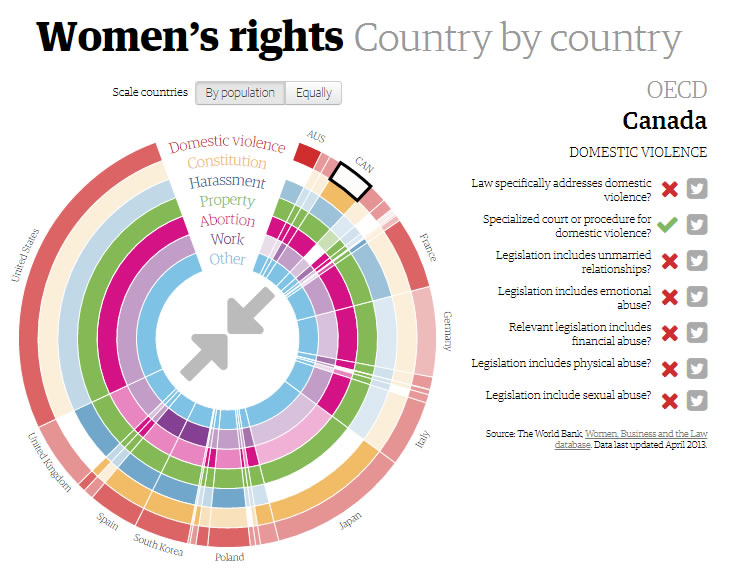 https://www.theguardian.com/global-development/ng-interactive/2014/feb/04/womens-rights-country-by-country-interactive
Conversations that involve issues of fairness such as racism and sexism can be very controversial and can prompt any number of responses.
What are you thinking right now? Click through the following slideshow.
In an effort to make the justice system fair and impartial, new laws have been introduced and court cases have rendered verdicts that help to address racism and discrimination. The province of Ontario has made progress in this area of human rights. In 1962 the Province introduced the Ontario Human Rights Code:
Proclaimed in 1962, the first Code prohibited discrimination in signs, services, facilities, public accommodation, employment and trade union membership because of race, creed, colour, nationality, ancestry and place of origin. In the following half-century, many communities and individuals advocated and fought to have more prohibited grounds of discrimination added, such as sex, age, disability and sexual orientation, gender identity and gender expression. Systemic discrimination is also included now.
 Human Rights Screenshot
Take a few minutes to view Human Rights 101 Part A - About Human Rights for a bit more information.
Please complete the quiz at the end of the video to check your understanding.
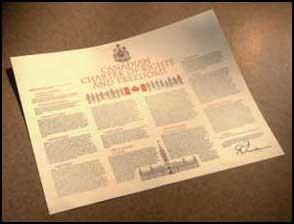
On the federal level there are also laws to ensure that people are treated fairly under the law. In 1982, with the entrenchment of the Charter of Rights and Freedoms within the Constitution Act, 1982, Canadians started to enjoy even greater protection of legal rights.
This means something that is very difficult to change; the process for altering the Constitution is different from other laws.
|
For example, Section 11(d) ensures that: “Anyone accused of breaking the law is presumed to be innocent until proven guilty. This means that the prosecution must prove beyond a reasonable doubt that the person committed the offence, before he or she can be found guilty. The trial must also be conducted fairly before a court which is unbiased and independent of political or any other influence (s. 11(d)). A fair trial ensures that the rights of the accused are properly protected.” “Section 7-14 : Legal Rights” Canadian Heritage. Government of Canada. |
As you heard in the Ontario Human Rights Commission video, Canada has built our laws upon international laws or standards.
The right to be innocent until proven guilty is an important right captured in the International Declaration of Human Rights. Watch Human Right #11 We're Always Innocent Till Proven Guilty.

You are aware of some legal developments that have helped to make the Canadian judicial system more fair. You might be asking: What legal cases have contributed to the development of a fair system?
Before you read the following case, please look at the flow chart and click on each green box for a brief explanation of the Ontario Court process. Note the bolded sentence; it will help you to understand the movement of the case through the different levels of court.
Tips
Cases can be difficult to understand. What do you do when a task is a bit challenging? How do you make sure that you are understanding the big ideas?
- Take your time. It is okay to read something more than once.
- Take care of your learning needs; make sure you have sufficient, uninterrupted quiet time to complete your task.
- Double check your understanding of the terminology (see the activity below).
- Connect with your classmates and teacher.
- Consider checking with another source for more information.
R.v. Brown
Please read the case R v. Brown below prepared by the Ontario Justice Education Network. You may wish to read the discussion question (pages 6, 7 and 8) before you read the case.
|
Pre-reading the questions is one literacy strategy that you might find useful in your post-secondary studies. |

How did you do with the reading? There are some legal terms that might require a second glance. Try your hand at the terminology activity below. Drag each word onto its definition.
 Introduction
 Learning Goals and Success Criteria
 Learning Skills
 Rubric 1