
Under the Influence
Reading

MINDS ON
Reading With Purpose
There are certain things that good readers do before reading, during reading, and after reading, that they're probably not even aware of.
ReadingStrategies
 My Focus
Which of the above skills do you think you already do well? Which skills do you think you could try that you're not already doing when reading? Choose at least one skill that you could focus on in this unit to improve your reading.
Substance Use, Addictions, and Related Behaviours
The skill focus for this unit is reading, but the content focus will be learning about substance use, addictions, and other related behaviours so it's important for us to understand a few key ideas. Click on each of the 3 key ideas below to learn more.
1. Resiliency
2. Risk Factors
There are certain factors that make a person more likely to become involved in abusing substances, getting involved in unhealthy activities such as compulsive gaming and gambling, and developing unhealthy behaviours such as an eating disorder. These are known as risk factors. Some risk factors include:
- Family members who abuse drugs or alcohol
- Becoming involved in substance use at an early age
- Physical trauma or abuse
- Distance from parents/ guardians
- Unclear rules at home
- Friends who encourage use
- Conflict with family or friends
- Bullying
- Low grades
- Peer pressure
The good news is there are also factors that make a person less likely to abuse substances, become addicted, or struggle with related unhealthy behaviours. These protective factors include:
- Strong self-esteem and self-confidence
- Strong family values
- Supportive family
- Strong, supportive social network
- Parents who monitor their children; what they are doing and who they are with
- Participating in extracurricular activities
- Ability to cope with stress
- Rules and expectations at home
- Positive relationships with friends and family
- Friends who are not involved with drugs or alcohol
- Having good grades
 Risk Factors and Protective Factors
While we cannot control all of these factors, we can control some of the risk factors we might be exposed to and we can increase some of the protective factors in our lives so we can build our resilience.
- Choose one risk factor and explain why you think the risk factor might make a person more likely to abuse substances or be involved in related unhealthy behaviours.
- Choose one protective factor and explain why you think the protective factor might make a person less likely to abuse substances or be involved in related unhealthy behaviours.
- Identify one way that a person can increase the protective factors and decrease the risk factors in their life to help them build their resilience.

ACTION
Reading
You will be developing your reading skills by choosing a text to read in each activity in this unit. Here's how it will work:
- Choose your text. You will have a few different options for this activity.
- Read your text, being sure to use effective reading strategies we learned about in the Minds On section of this activity.
- Complete the role you have been assigned. Each week you'll choose a different role.
Roles

Connector
Your job is to make connections between what you read and real life.The connections might relate to school, friends or family, home, the community, or they might relate to movies, celebrities, or the media. Feel free to connect incidents or characters with other books that you have read.

Summarizer
Your job is to prepare a brief summary of the text. The summary should include the main ideas or events to remember, major characters, symbols or other significant highlights of the passage. Include any important events and details.

Word Wizard
Your job is to record new or interesting words from the text you read. Record the sentence the word appears in and the definition. You need to pick at least 5 words.

Discussion Facilitator
Your job is to come up with three open-ended discussion questions about what you read. Here are some examples of these types of questions:
- How did you feel when you read _____________?
- If you were in that person's position what would you do differently?
- What do you think the consequences will be for ____________ in the future?
- How did your opinion about ________ change after reading this text?
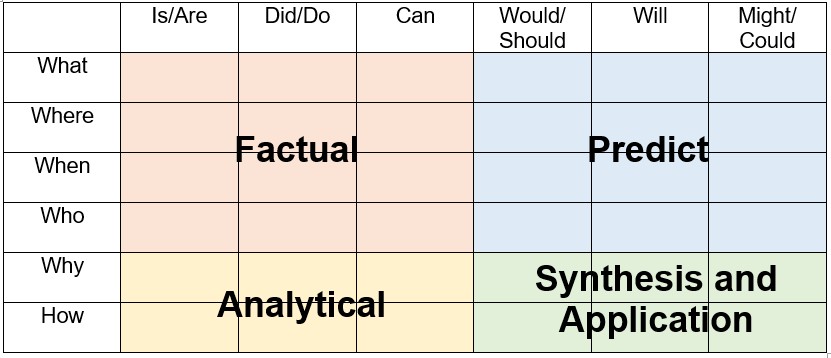
A useful tool to help develop good discussion questions is a Q chart. By matching up words on the top and side you can form different types of questions. The questions that fall in the synthesis and analysis quadrants are usually good discussion questions.
 Time to Practice
- Choose your text. This time because we're just practicing; read the text which is below.
- Read your text, making good use of effective reading strategies. This time because we're just practicing, as you read through the following text, you will be able to click on parts of the text to see examples of how someone would apply before, during, and after reading strategies.
MentorText
- Complete one of the roles listed. This time because we're just practicing, we're going to show you examples of each of the roles. Click on each of the icons below to reveal an example of how a student could have completed each role.
ReadingClubRoles
- Reflect on your reading and explain what conclusions you can draw and what questions you may still have after reading. Here is a template you can use for creating your response:
| Reading Response Template |
|---|
|
1. Identify the title of the text that you read.
|
|
2. Explain what the main idea was and provide two or three supporting details.
|
|
3. Evaluate the text. What did you like about it? What didn’t you like?
|
|
4. Pick one of the following to do:
|
|
5. Identify an example of a risk factor or protective factor that you saw depicted in what you read and provide evidence from the text to support your selection.
|
|
6. How might this text be useful for someone struggling with substance use, an addiction or related behaviours?
|
|
Additional Notes:
|

CONSOLIDATION
Reading Response
Using the Reading Response Template, write a response based on the mentor text you read in this activity. Make sure you use the Reading Response Self-Assessment Checklist (also shown below) to ensure you've met the expectations. You will be reflecting on your answers to the mentor text at the end of this unit so be as thorough as you can with your responses.
Reading Response Self-Assessment Checklist
| Item | ✓ |
|---|---|
|
I wrote my response as a proper paragraph with complete sentences. |
|
|
I checked my spelling and punctuation to make sure my teacher understands what I mean. |
|
|
I identified the title of the text that I read. |
|
|
I explained what the main idea was and provided two or three supporting details. |
|
|
I evaluated the text, explaining what I liked and didn't like. |
|
|
I did one of the following: I either explained one connection or identified a new or interesting word I learned. |
|
|
I identified an example of a risk factor or protective factor that I depicted in what I read. |
|
|
I explained how this text might be useful for someone struggling with substance use, addictions or related behaviours. |
Self-Assessment
Now that you have had a chance to practice what you're going to be doing while reading, it is a good idea to think about the reading skills and strategies you know and use and those that you want to develop to become a stronger reader.
Use this Learning Goals and Success Criteria Self-Assessment Checklist to review the learning goals and success criteria for this activity (they will be very similar throughout the rest of this unit).
Identify the success criteria you feel confident that you can meet and the ones you know you will work on to build so you can meet them by the end of this course. Check the appropriate column beside each of the success criteria.
 Learning Goals and Success Criteria
 Learning Skills and Work Habits