
How do games impact us?
High School as a Video Game

MINDS ON
 If I knew then what I know now...
Imagine your first day of high school.
What is something you wish you would have known that would have made that first day easier? Why you think this would have been helpful to know on the first day?

ACTION
Audience, Purpose, and Format
Writers change their tone, (definition:Tone refers to the author's attitude toward the subject matter. You can usually tell how an author feels about the subject of the writing by the author's use of words and phrases.) word choice, and format depending on the person they are writing for, and the reason why they are writing. Take a look at this text message from one friend to another friend:
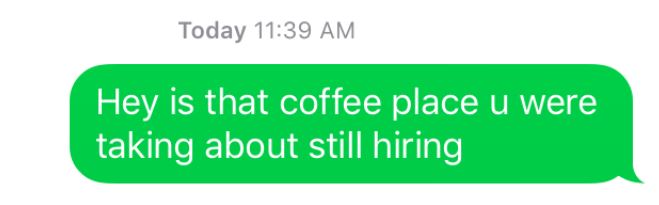
Right away you may have noticed some spelling and punctuation errors in the sentence. It should read, "Hey, is that coffee place you were talking about still hiring?" But does that really matter in a text message between friends? Some people might say it does matter, but in most cases, when we're communicating with friends over texts or instant messaging software, as long as our friends know what we mean, it's okay to use short forms and leave out some punctuation. It's not likely that a friend would consider it disrespectful if we didn't take the time to proofread our text messages!
In the above text message, we had the following audience, purpose, and format:
Audience: friend
Purpose: to find out if a job is available
Format: text message
What if, instead of texting your friend, you found out who the manager of the coffee shop was, and you contacted the manager to ask about the job?
Audience Purpose Format
Change the tone, words, and punctuation of the original text message to make them appropriate for the manager of a coffee shop where you'd like to work.
Indicate what format you would use for delivering the message and why you think it's appropriate.
Would you still text the manager?
Would you email?
Or do you think that it would be better to speak to the manager over the phone or in person?
The Writing Process
“
The first draft is just you telling yourself the story.
~ Terry Pratchett
Writing is a process.
A process has multiple steps. But maybe it's more accurate to call it a writing "cycle" because writers often revisit steps many times throughout the writing process.
Prewriting
In the prewriting stages, you generate as many ideas as you can think of. This is a lot like the first stage of the QFT process you did in the activity The impact of video games on us. Some people like to use a mind map for this stage of the process while others may like to create lists or even begin writing in full sentences. Here is your prompt to get your brain "storming":
Role: You are a grade 10 or 11 student.
Audience: You are writing for a student in grade 8 who is nervous about starting high school.
Format: An instruction manual.
Purpose: What a grade 8 student needs to know to make the transition to high school easier.
1) Return to the first discussion you participated in for this activity. Take a look at all the things you and your classmates wish you knew before starting high school and use these ideas to begin your prewriting (or brainstorming). You can do your prewriting by hand or on the computer.
There are also some free online tools that let you create mindmaps:
- Bubbl.us lets you create 3 free mindmaps. You can save your mindmap as an image file or html file to share with your teacher.
- Mindomo also lets you create 3 free mindmaps, but you have free access to this as an Ontario student, so ask your teacher how to log in.
2) Take a look at some of the instructions on the website Wikihow. Wikihow is a website that allows anyone to upload and edit instructions for just about any topic. That doesn't mean the people writing articles for Wikihow are experts, but it is a good resource for seeing how people write instructions.
You'll notice that all of the articles have a brief summary that contains an outline of the different parts of the instructions.
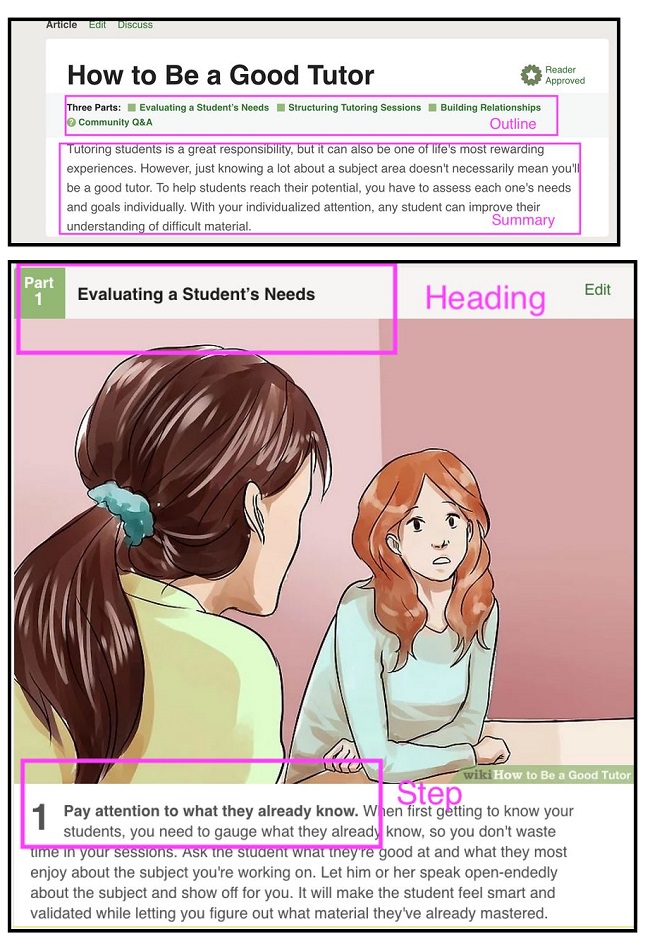
You've also probably noticed that some of the articles contain illustrations. You can include illustrations in your instructions if you would like to but this is not mandatory.
3) Create a list of possible headings and steps that you might use to organize your instructions.
Drafting
1) Have you ever suffered from "writer's block?" That's that feeling you get when you're staring at a blank page and you can't think of a single thing to write. Following the stages of the writing process can help you overcome writer's block by giving you "permission" to write down anything--it doesn't have to be perfect. It doesn't even have to make it into your final draft. It's just a starting place.
Here is a template that you can use to help you create an outline for your instructions.
2) Using the outline you created as a guide, as well as the examples on the Wikihow website, write the first draft of your instructions. If you plan on including illustrations, just do a rough sketch of the images for now.
 Drafting
Take a look at the following checklist after you have created your draft, and explain which of the checklist items you might need the most help with.
| Checklist Items | |
|---|---|
| I have created a clear title for my instructions; | |
|
I have included a list of the different headings I'm using in my instructions as part of my summary; |
|
| I have written a short (approximately 5 sentences) summary under the list of headings that explains who these instructions are for and how they will be helpful; | |
| I have organized my instructions using the same headings that appear in my summary; | |
| My headings make it easy for readers to locate important bits of information; | |
| I have used steps under my headings to break up my instructions into manageable chunks; | |
| My headings and steps have a logical order; | |
| I have written my instructions in complete sentences; | |
| I have carefully chosen the most accurate words to explain my ideas; | |
| I have used correct spelling, grammar, and punctuation. |
Revising and Editing
You will now revise your writing to make your instructions clearer and easier to follow for a grade 8 student. You will also edit your writing, making any necessary corrections to the spelling, grammar, and punctuation. As you are revising, consider the following:
- keep your audience and purpose in mind.
- If you were a nervous grade 8 student who had never been to high school, would the instructions be helpful? Would your tone (definition:Remember that "tone" refers to the author's attitude toward the subject matter.) help put that student at ease?
- It's okay to use some humour in your instructions but you have to be careful to make it clear that you're not making fun of the person reading the instructions.
- Are your words clear and precise? Would a grade 8 student be likely to understand them?
- If you are including illustrations, now is the time to draw your good copies of each of the images (remember, this part is optional).

CONSOLIDATION
Reflecting on Tone
How can your tone reveal your negative or positive attitude toward a subject or idea? Words that we use have both connotative and denotative meaning. In other words, a word can have a certain definition but can also have certain feelings associated with it. For example, I could say "I am capable of running for 30 minutes." Or I could say "I can tolerate running for 30 minutes." They both mean roughly the same thing, but the second sentence gives the impression that I don't like running. This is because capable means able to, while to tolerate means to bear or to endure. Clearly, word choice makes a difference!
Reflecting on Tone
Have a look at your set of instructions.
1) Identify two or three words that you think reveal your positive or negative attitude toward the subject you wrote about.
2) For each word, suggest a different word that you could have used to suggest a different attitude.
3) Explain what attitude your different words suggest.
 Learning Goals and Success Criteria
 Learning Skills and Work Habits