Sharon is 25 and lives in a small city in Ontario. At this point in her life, Sharon has had a number of life experiences in school, at home, in her community, and in the three part-time jobs that she has held at different times in recent years. Sharon wants a more satisfying job with better pay and more hours, and is actively looking for work. Like many, though, Sharon is still unsure about what she wants to do for a living. When asked at a recent interview to describe the experiences, strengths, and skills that would make her a good fit for the position, Sharon struggled to answer, finding it difficult to talk about her strengths and skills. Sharon has never really been asked to think about the experiences, strengths, and skills that will help her be successful in the workplace.
Throughout this course, you will use a process called the Inquiry Model to gain new knowledge, insights, and realizations. This will also help to make the content of this course personally relate to each learner. Take a few moments to become familiar with the Inquiry Model (link to the Inquiry section of the Toolbox) and understand how it is different from ‘research.’
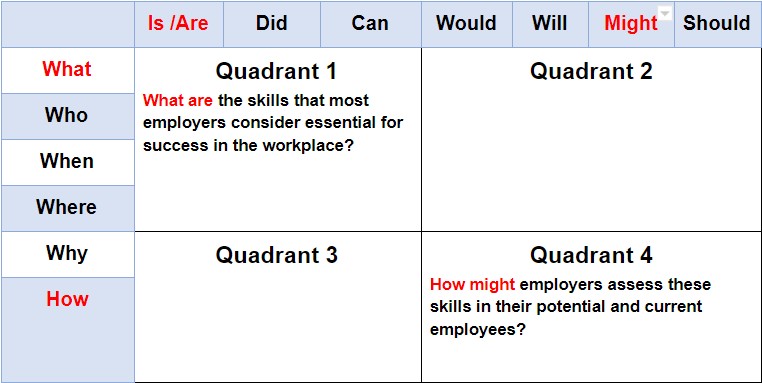
As you can see, the first stage of the Inquiry Model is to pose real questions. Consider the topic, ‘Success in the Workplace.’
Open a folder on your computer labelled Portfolio. Add your reflections, learning and questions as you move through this course.
Now that you know more about Essential Skills and Work Habits, construct a brief (300 word) writing, audio recording, or video, entitled “Skills, Habits, and Me.” In it, tell about an instance or situation in your life (at home, at school, at work, and/or in the community) when you had to demonstrate a number of the Essential Skills and Work Habits. Add the file to your Portfolio.
Having trouble thinking of something? Try doing an online search on Essential Skills and Work Habits in everyday life and the workplace. Or, you can visit these resources:
Government of Canada Success stories: Literacy and Essential Skills - A collection of real stories about Canadians who have experienced success in work and life after improving their essential skills
How do you choose an occupation with such a wide range of options and so many possibilities that interest you?
In this activity, you will use personal inventories to discover and assess your own strengths and preferences and discover occupations that align with your results.
Personal inventories guide you through the process of self-reflection with the goal of identifying your skills, strengths, and preferences. Often we have skills, strengths, and preferences that we either fail to see in ourselves or are unable to articulate. Self-awareness activities, such as personal inventories, are extremely valuable when identifying occupations for which we are perhaps best suited, and are also very powerful as we prepare to be interviewed for jobs.
There are many personal inventories available online and also through your community that will help you to identify your strengths and preferences, assess your aptitudes, and discover related occupations. To select one, you can:
contact Employment Ontario for information on local resources, supports, and services;
search out community employment resource centres;
consult your Guidance Counsellor; and/or
Once you have completed your investigation, construct a 500 word summary of your findings. Include the following in your summary:
Name the file, “My Personal Inventory and Potential Occupations.” Add the file to yourPortfolio.
In this activity, you learned about both Essential Skills and Work Habits and why they are so important. You also took time to reflect on your own experiences, strengths, skills, and preferences, and discovered potential occupations that might fit with these qualities. In a journal (written or digital), take some time to consider the three items below regarding skills and work habits: