
GWL3O
Unit 1: Looking Inward
Activity 4: Living the Dream


Naeem is 45. He is married to a realtor who, like most realtors, often works odd hours. Together, they have three children (two of whom are in high school and one who is in university). Naeem has a college diploma in Environmental Technology, and in recent years he has been working for a Conservation Authority. While Naeem initially enjoyed his work, he now finds that it’s not as fulfilling as it once was. At times, Naeem has trouble getting motivated at work, often feeling his daily tasks are somewhat mundane, repetitive, and unchallenging.
As a first step to making a change, Naeem has taken an interest in design and has even acquired and completed a few small contracts for local businesses and organizations. He really enjoys the creativity and innovation that design work demands, the diversity of the projects, working through the challenges that arise, and collaborating closely with clients to understand their visions and needs. However, Naeem knows he would have to go back to school to enhance his knowledge and skills, and also, to obtain official credentials if he were to ever pursue design as a career.
Our finest moments are most likely to occur when we are feeling deeply uncomfortable, unhappy, or unfulfilled. For it is only in such moments, propelled by our discomfort, that we are likely to step out of our ruts and start searching for different ways or truer answers.
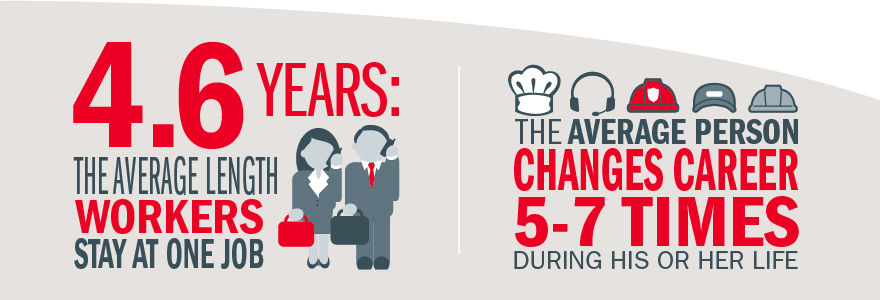
It is extremely common for people to change their careers numerous times in their lifetimes.
Thrivent
Naeem is not unique. In fact, as we learned previously, and as is illustrated in the infographic above, most people will change their careers several times through their working years.
Think About It: Changing Careers
What do you think are some of the motivating factors that may be causing Naeem to want to change his career? If Naeem were to take action and pursue a career change, what challenges might he encounter? What strategies and resources can he use to help overcome these challenges?
Think about yourself and/or others you know… What career changes have you (or they) been through? What were the motivations behind the career changes? What challenges arose as a result? What strategies and resources were helpful? What was the ultimate outcome?
Check out the following infographic to learn about the career paths of some very successful people. As you read, note the age at which they made a career change.

Many famous people didn’t start out on the career paths you might think they did. Check out what the famous people above once did for a living. Take a moment to investigate the career path followed by another famous person whom you admire.
Funders and Founders

Here is some of the simplest career change advice you will ever get. Simply ask yourself this question: "What work was I born for?" or What is the work that I MUST do?

The average person changes career 5-7 times during his or her lifetime.
Career Advice Online
Learn About It: Sean Aitken and The One Week Job Project
Sean Aiken is the creator of The One Week Job Project — an inspiring journey across North America in which he worked 52 jobs in 52 weeks to find his passion. He trekked more than 46,000 miles, slept on 55 couches, raised over $20,000 for charity, and tried every job he could: bungee instructor, advertising executive, stock trader, baker, NHL mascot, and more. He frequently speaks to audiences about what he learned from his One Week Job experience. This was also the catalyst which led him to develop an international program to empower others to discover their passion.

In the video, TEDxVancouver - Sean Aiken - 52 Weeks, 52 Jobs, Sean shares the inspiration and deeper meaning behind the One Week Job movement. He suggests that we’re experiencing "a revolution in work consciousness. A shift in how we as a culture view work and our relationship with it.” He believes that expressing our passions and unique gifts leads us to greater fulfillment both individually and collectively.
Take a few moments to watch Sean’s video detailing his incredible experiences and journey toward discovering his passion:
As well, read the brief article that appeared in The Toronto Star:
As you see, Sean delivers several key messages. For instance,
The people who are the most passionate about their work are the ones who are most connected to the meaning behind it. The actual job is not nearly as important as their relationship with it. They need to show up to work every day because they contribute their gifts and the works is made better because of it.
Interested in learning more about Sean Aiken? Check out SeanAiken.com.
Work With It: Finding the Work You Love
Create a graphic (poster, infographic, etc.), entitled ‘Finding the Work You Love,’ either by hand or computer. If using computer, here are some suggested programs:
- Microsoft Word
- MicroSoft Publisher
- Paint
- Google Draw
- Canva
- Poster My Wall
- Easelly
- Pikto Chart
- Venngage
Having trouble finding pictures? Try searching the Creative Commons for pictures that are not copyright protected. Google Images, Flickr, and Pixabay are excellent sources, too
Learn About It: Career Change Motivators

When a career change lies ahead, what might have led someone to this situation? And, what roadblocks may need to be navigated?
The following article, “Top Reasons People Change Jobs” talks about the top reasons people choose to switch careers, take some time to review the article. In the following interactive, drag the career change reason on top of the explanation, then click the Submit button to see if your choice is correct.
Some Final Thoughts on Career Change Motivators
In addition to the above, some people change careers because they may feel that, in their current job, they are not doing something that is meaningful to them. Also, some people may change careers to move from working for someone else to becoming an entrepreneur. Whatever the reason, any career change should always be approached by considering all the factors that are motivating the change, as well as any potential impacts created by the change. This takes very careful planning.
Learn About It: Managing Career Changes and Avoiding Common Pitfalls
Changing careers can be both exhilarating and daunting: it can present both exciting opportunities, as well as challenges. Using the proper strategies, however, a career change can be a smooth and seamless transition, offering minimal stress and great success.
In his article, “The 10-Step Plan to Career Change: How to Successfully Change Careers“, Dr. Randall S. Hansen presents a number of strategies, in a 10-step plan, that can guide and support people through the tribulations of a career change.
In another article written by Dr. Hansen, available below, he talks about 10 about common pitfalls that should be avoided when transitioning from one career to another.
If you wish to visit any of the links in this document, right click over the link and select open in new tab from the menu that appears. This way the content page will stay visible.
Learn about both the steps and pitfalls of successful career changes by clicking on each item in the following two carousels. As you do, jot down tips that resonate with you personally (i.e., those you feel can be helpful to you now, or in the future, if embarking upon a change of career). You will need these notes for the discussion that follows.
Learn About It: Career Prospects
It is difficult to accurately predict which occupations will be in demand in the future, and how many jobs will be created in these occupations. Economic conditions, technological developments, demographics, and consumer behaviour will continue to affect the labour market, the occupational composition, and the kinds of job opportunities that will be available. We do know that most new job creation is expected to be in occupations requiring considerable education and training.
More than 70% of all new jobs will demand higher education or skills training.
Take a moment to check out some of the most promising job prospects currently in Ontario, both those that require university degrees and those that require college education or apprenticeship training, Ontario Ministry of Labour, Training and Skills Development. Given what you have learned previously about yourself and your aspirations during this unit, are any of these careers of interest to you?
Learn About It: Postsecondary Education
No matter what your career plans are, any type of postsecondary education is always an investment in your future.
A college or university education gives you an edge in today's job market. A certificate, diploma or degree shows your knowledge and skills. It also shows you know how to learn, adapt, and manage your time. Private career colleges offer training that prepares you for a specific job.
Postsecondary education gives you:
- An academic foundation for good communication skills, the ability to solve problems and learn new assignments even when technology changes.
- Social skills to help you deal with changes in the workplace and be respectful of others.
- Opportunities to meet instructors and students from all over Ontario, Canada, and the rest of the world, helping you broaden your perspective.
- Networking opportunities. The mentors and peers you meet in school could help you land jobs in the future.
Work With It: A Poster to Inspire
We have all seen inspirational posters that typically have a single picture accompanied by a message of inspiration. Here is an example:

Motivational posters can deliver powerful messages through a picture and a brief message.
Your task is to use what you have learned about the myths and facts that surround postsecondary education. You will create your own poster that aims to dispel one or more myths about postsecondary education, either by motivating people or putting them at ease.
There are many free online programs that you can use to create a motivational poster. Here are a few but feel free to search out others or, if you like, create your poster by hand:
Having trouble finding pictures? Try searching the Creative Commons for pictures that are not copyright protected. Google Images, Flickr, and Pixabay are excellent sources.
Learn About It: Apprenticeships
Apprenticeships offer the opportunity to learn a skilled trade while on the job. Apprentices work under the direction of experienced workers and, best of all, get paid while they work. In addition, apprentices learn in a classroom, from instructors who know the trade.
Take some time to learn more about the Apprenticeship pathway, Employment Ontario: Start an Apprenticeship.
Given your current career aspirations, is the apprenticeship pathway a viable option for you to consider? For more information about apprenticeships, and how to become involved, check out this apprenticeship search.

Apprenticeships offer classroom instruction, hands-on learning, and on-the-job training. Apprentices get paid to learn as they work under the supervision and tutelage of a licensed tradesperson.
Work With It: Portfolio - Educational Requirements for the Occupations That Align With Who I Am
In Activity 3, you created a document entitled, ‘Who I Am and the Careers That Interest Me.’ Refer to that document and, specifically, the potential careers that aligned with who you are.
There are many tools and resources available to help you discover the training or educational requirements for various occupations, as well as suitable programs and the institutions that offer them. These tools and resources are available to you both online or via your school, community services, and counsellors.
One such online tool is the Search Job Profiles
Using this resource, or any other of which you are aware or can discover online, at school, or in your community, determine the training or educational requirements of the potential careers that aligned with who you are.
Compile your results into a chart, naming it ‘Requirements for the Careers That Interest Me.’ In addition to the results, provide some personal insights. Examples of these include, but are not limited to:
- What did you discover in your research that surprised you?
- What didn’t surprise you?
- What disappointed you?
- Did you find the research was beneficial to your life and career planning?

My Biggest ‘Aha’ Moment
In this activity, you learned about how often most people change their careers, what motivates these changes, and strategies that may be used to help manage these challenges effectively. You also learned a great deal about finding employment that is both meaningful and fulfilling to you in an occupation you can be passionate about. Lastly, you learned about the significance of postsecondary education, as well as the training or educational requirements that align with the careers that may interest you.
Throughout these tasks, it is hoped that you had at least one ‘aha’ moment - an instance when you discovered something personally significant with regard to yourself, careers in general, occupations that may interest you, or training and education.
Take some time to record in your portfolio one of the 'aha' moments you experienced in this activity.
 Introduction
 Learning Goals and Success Criteria
 Learning Skills and Work Habits
 Rubric 1