
MEL4E
Unit 3: Every Challenge Provides an Opportunity
Activity 4: Changing Perspectives - from Employee to Self-Employed


Jeff is now without a job and hoping to start his own small appliance repair business.
Watch the following video about what to do when you find yourself laid off:
Jeff has a spending plan. It is his budget. You can download the spreadsheet, and you can see the images from the budget below.
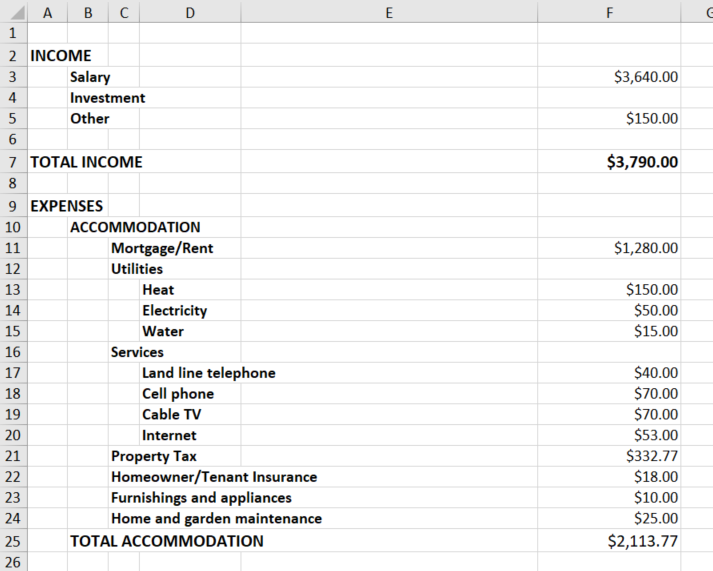
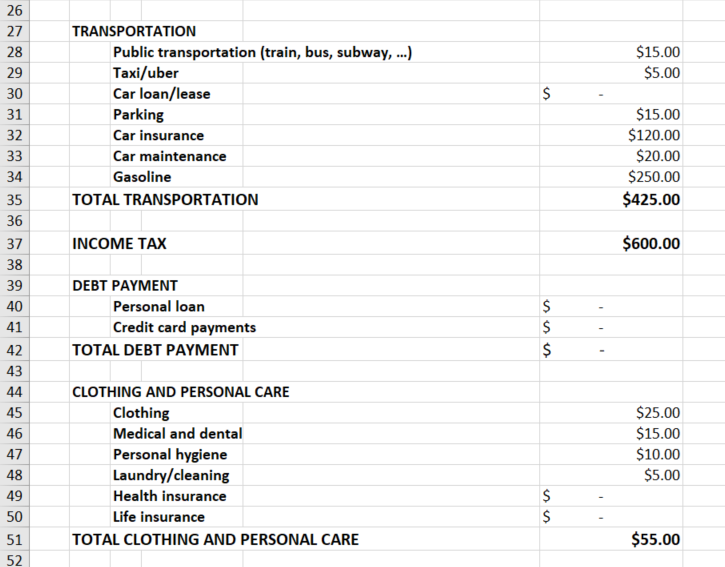
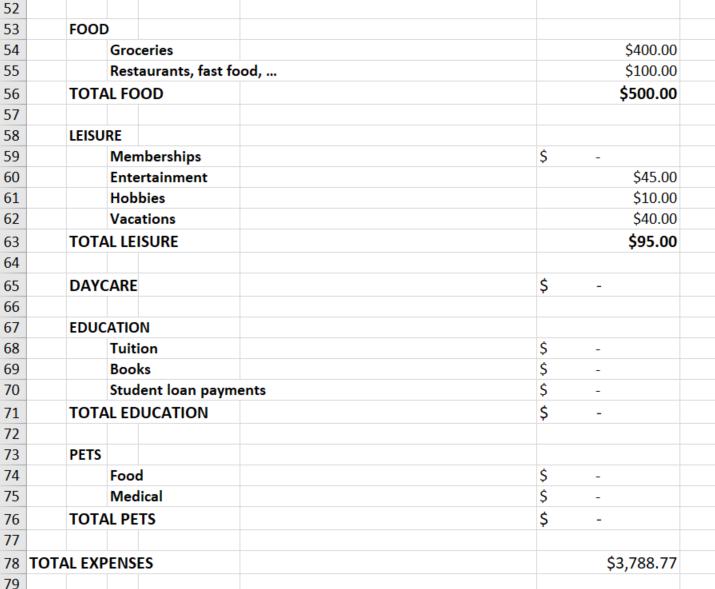
Jeff realizes that he will need to make adjustments in his spending habits, starting right now.
 Consider: Jeff's Budget
Take a few minutes to analyse Jeff’s current budget.
1. Which of his expenses are needs, things that he absolutely requires? Which ones are wants, things that he could do without, but would enjoy having?
2. Make five suggestions how Jeff might reduce his expenses by cutting back on the amount he has budgeted for his wants.
Some of Jeff’s expenses are discretionary, this includes his wants, while some are non-discretionary, this includes his needs.
Remember that non-discretionary expenses may be fixed or variable.
3. Is it possible for Jeff to save some money by spending less on things he needs? If so, how might he do that?

Jeff's Budget
Let's watch the video again, from the beginning of this lesson. Focus on the last few points that are made:
This is exactly what Jeff decided to do while he was working out all the details for setting up his repair business. He advertised that he was available to do small appliance repairs in his home by putting flyers up in his neighbourhood and by posting messages on his social media accounts. He hoped to make some extra money.
In the first two months, Jeff made about $700. Not great, but not bad, considering he had no expenses. He realized, though, that the people he did work for now might become regular customers in the future and they might recommend him to their friends and family. Because of this, the next thing he decided to do was set up a website for his future business so that people could leave comments about the high quality of his work. Why wait until his business was up and running?
 Enrichment
For more information about setting up a business website, go to the Canada Business Network, a government organization set up to help Canadian business owners to get the supports they need.
Jeff used some of his termination pay to get his business website up and running. He followed the advice he found at the Canada Business Network.
His costs were:
- Domain name: $10 per year
- Hosting his website: $10 per month
- Cost of designing his webpages: $2400
- Expected cost of keeping his website up-to-date: $400 per year.
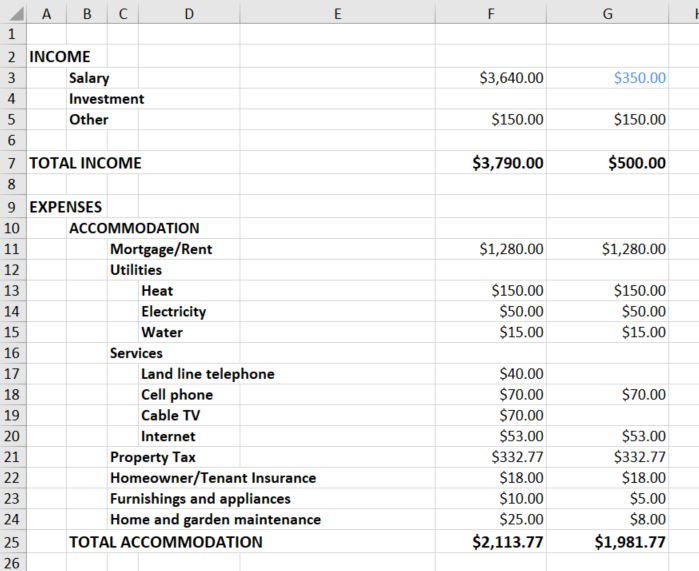
Jeff decided it was time to update his budget. Since Jeff did not yet have a business, he decided to put this new information into his personal budget spreadsheet. He decided to use a new colour to better keep track of income and expenses that related to the repair work he was now doing. He assumed that he could continue to have about $700 in income every two months.
Jeff had decided to discontinue his landline telephone and cable TV. He needed to reduce his expenses. He was using his cellphone for his customers, and he didn’t have much free time anymore, so why spend money he didn’t have on these things?
He did not have to drive to work anymore, but he reasoned that he would be using his car in different ways for his business. He did not know yet how much of his car expenses would be because of his business, so he left that part of his budget alone for now.
He had no idea how much he needed to set aside for income tax yet, so he left it blank for now. He would have to investigate that soon!
This is Jeff’s new budget spreadsheet, you can download it or see it below as images:

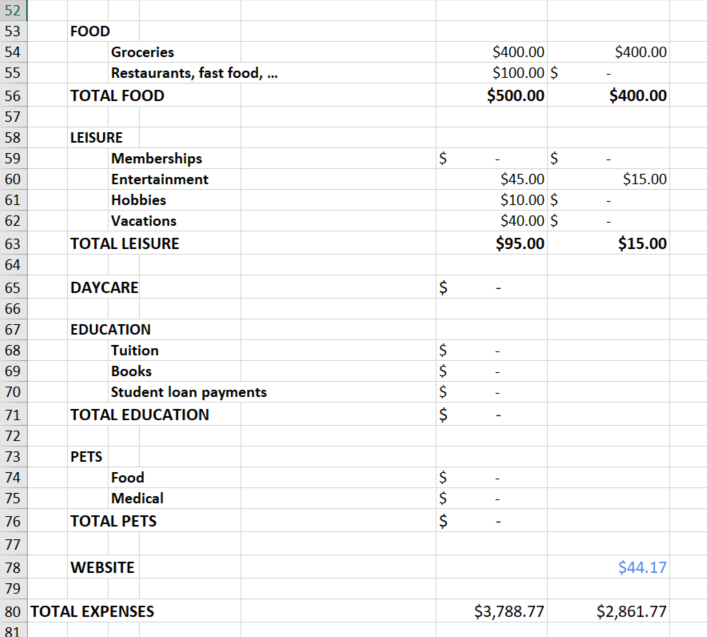
 Assignment: Jeff's Revised Budget
Budget changes:
- Make a list of all the other changes Jeff made to his budget spreadsheet (other than the ones listed above).
- Select two of the changes to reflect upon. Why do you think Jeff made each of these two changes?
- Were there other changes you think he should have made but didn’t? If so, which one(s) and why? If not, describe why you think he made the best choices.
Jeff’s Income Taxes
Because Jeff is now self-employed but he has not yet set up a corporation, his business is deemed to be a sole proprietorship. A sole proprietorship is one type of business. It is an unincorporated business that is owned by one person. It is the simplest kind of business ownership.
In fact, a sole proprietor may not feel like a business owner at all. The owner and the business are considered the same, from a legal standpoint, until the business is incorporated.
Jeff’s appliance repair business is a sole proprietorship right now.
 Questions
- Why is Jeff’s business a sole proprietorship?
AnswerJeff has not incorporated his business yet. There are many steps he has to go through to set up his business as a corporation.
Because Jeff is the owner of a sole proprietorship, he keeps all the money that the business brings in. He can also claim any losses, if there are any. Losses occur if the expenses associated with the business are greater than the income from the business. Income from a business is known as revenue.
How will being a sole proprietor affect Jeff’s income for tax purposes?
As a sole proprietor, Jeff will pay taxes the same way he always has. The income from his repair business is treated as his wages from the business and will become part of his overall income for the year.
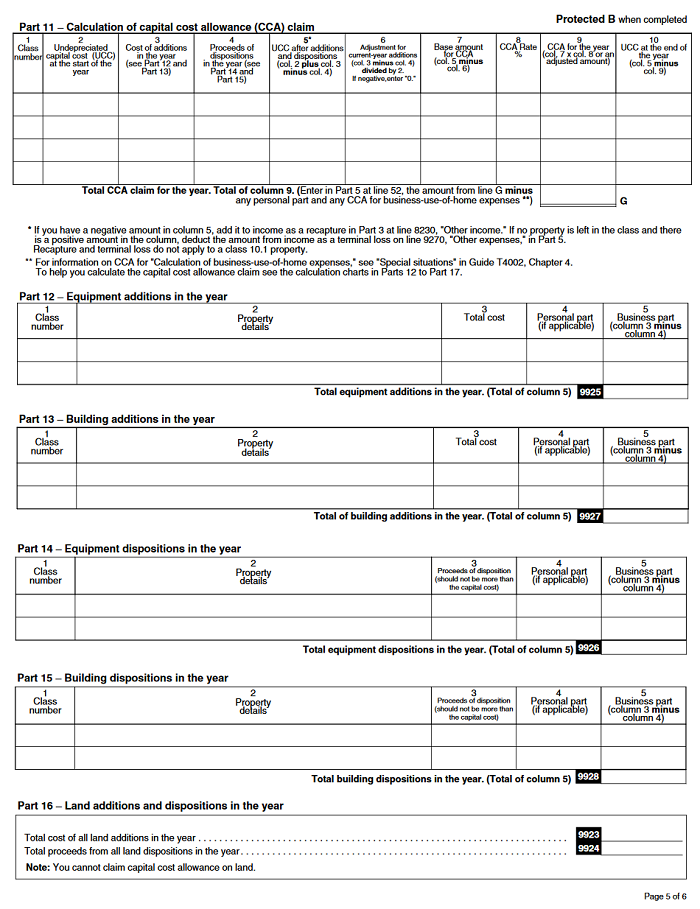
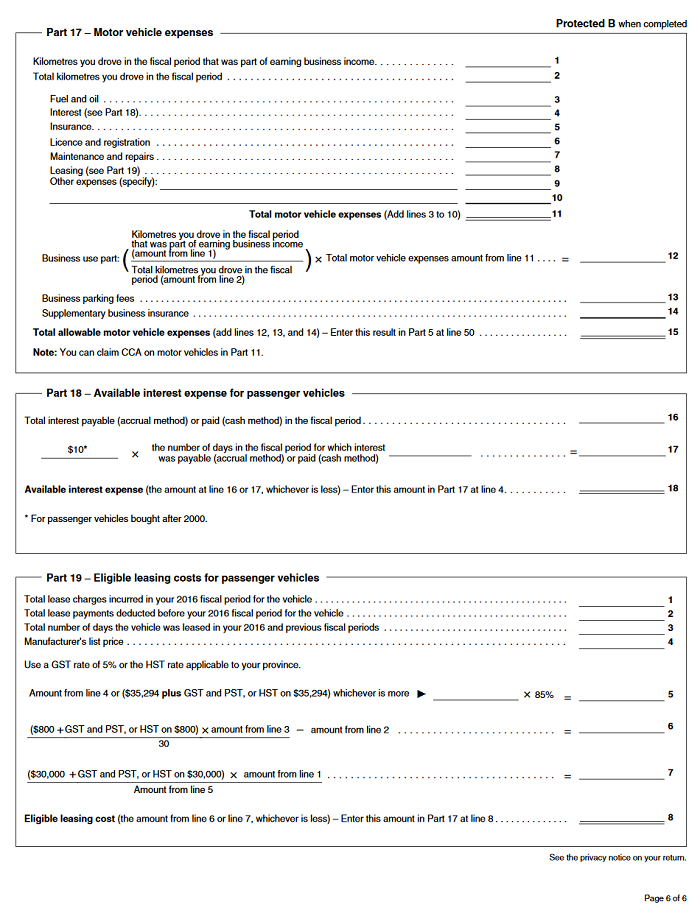
However, Jeff will also have to file financial statements or include Form T2125, Statement of Business or Professional Activities. Form T2125 helps business owners calculate their income and expenses for income tax purposes.
You can see a T2125 form below in the images, or you can open and/or download one here.


 Did You Know?
If you do not report all your income, you may be subject to a penalty of 10% of the amount of income that you did not report.
If Jeff later incorporates his business, then the money his business makes will not be part of income anymore. Corporate taxes are different from personal taxes.
Tax rates are not the same for individuals and for corporations. The rate for Canadian small businesses that have been incorporated is about 11%, far less than the minimum personal tax rate of 15%. For example, a small Canadian corporation that has to pay tax on $100,000 will have to pay about $11,000 in taxes, while an individual or sole proprietor will pay more than $30,000 in taxes.
Sole proprietor and deductions?
The Canada Revenue Agency allows self-employed individuals to claim many business expenses as deductions when they file their personal income taxes. These include:
- attorney and accounting fees;
- rent for business space (e.g., office or storage space);
- insurance;
- bank charges;
- car expenses if you use your car to do business (e.g., lease or loan payments, parking charges, vehicle maintenance); and
- equipment used for the business (e.g., computers and printers, tools).
What information will Jeff provide when filing his tax return?
Someone working from their own home can also deduct other expenses, which are called Business-use-of-home expenses. These include:
- part of their mortgage payment or rent;
- part of their utility costs;
- some repairs on their homes;
- upgrades required to operate the business;
- a portion of their property tax.
 Example
Example: Jeff currently uses one room of five in his condo to operate his business, so he can deduct 20% of his mortgage as a business expense.
He can claim 20% of the interest he pays on his mortgage.
This year, Jeff will pay $13 056 in interest on his mortgage.
Jeff reports $13 056 on Line 67 of Form T2125 and then completes the form.
Assignment: Jeff's Business Expenses
Above is a photo carousel that show's Jeff's Budget. You can also download the actual document.
- Look at the expense items in Jeff’s budget and look at the items listed in Part 5 of Form T2125 below.
- Compare the two lists.
- Identify and list five items that Jeff may be able to claim as business expenses when he files his income tax.
Self Employment and the Tax Form
Self-employment income is reported on Lines 135 to line 143 of the T1 Income Tax form. Jeff, because he is currently operating a business as a sole proprietor, will report his business income here.
Too many forms! Too much recordkeeping! I need help!
You may have started to realize that there are quite a few forms that Jeff has quite a few forms that he will need to fill out, and he will have to do a lot of recordkeeping.
Fortunately, there are guides, like this CRA Guide for Business and Professional Income that can help people understand the process.
Question
Take a moment to have a look at this guide. What chapter of the guide provides information about how to complete Form T2125?
AnswerChapter 2
 Introduction
 Learning Goals and Success Criteria
 Learning Skills and Work Habits
 Rubric 1