
Biological Processes and Interactions
Making Connections: Interconnected Biological Processes

MINDS ON
Revisiting Biological Processes
This Unit has examined many biological processes important to cells and living things. In all cases, the steps in a change depend on the interaction of components of that process. Changes lead to a balance between the internal and external environment. Life likes it just right.
At the end of this Activity you will complete a Check-In that will let you show the best details from your answer to “How do small steps lead to changes?” Your flowcharts and graphic organizers from this Unit should be the main part of your review. You can also try this progress check to see if you remember some important details. If there’s a particular topic that isn’t completely clear then refer back to the specific Activity where this was covered.
RevisitingBiologicalProcesses
Interconnectedness
The idea of how everything is connected to everything else is powerful. When doctors, for example, prescribe a medicine to help a patient they must think also about how the treatment will affect the rest of the body. At each level of organization of Biology multiple components interact together in biological processes. Indeed, the details about processes that we have studied in this course are not the complete story. For this reason people specialize in working on a smaller number of biological processes, learning deeply in the process.
In some of the Activities in this Unit we saw how researchers were often part of a team of scientists. Rosalind Franklin, for example, would not have been able to produce her famous X-ray crystallography image without the help of her colleague, Maurice Wilkins. Wilkins was able to produce samples of DNA in which all the molecules lined up, an important step in order to produce a clear image. We also saw how scientists working in different labs shared information through peer reviewed publications.
Similarly, many careers related to Biology are interconnected. Professional teams work to solve problems related to Biology with each person contributing a specialized role.
 How does understanding change?
Explore at least five different careers and occupations. For each career and occupation look for related occupations. Usually related careers and occupations are structured around solving a common problem. Can you identify what related careers and occupations have in common?
Changes 27. For each of the common problems you discovered, identify the Biology-related careers and occupations related to them. Be sure to identify at least 10 different careers and occupations in total.

ACTION
Teams in Biology
In Canada, there is a strong commitment to fields in Biology, especially centered around cities with universities, government agencies, and hospitals. Hundreds of notable Canadian researchers alone are pushing forward the scientific understanding of biological processes. Add to that the number of other careers related to Biology and it’s easy to see that there is a lot of exciting work to be done close to home.
Multiple Effects
Organisms are adapted to respond to their environment and recognize stimuli. Changes in the environment challenge our ability to maintain homeostasis. Negative feedback is the most common response to an internal or external environmental stimulus. Periods of growth and development lead to changes, as seen in the germination of a seed, the onset of puberty in humans, and the introduction of a new population in a habitat. Eventually, each change reaches a new homeostatic level and negative feedback establishes a balance.
All stimuli, in one way or another, put demands on a cell, organism or population. Good health allows for moderate challenges to homeostasis to be easily handled. When health is weakened, or when stimuli become stronger, these challenges are called stressors. It becomes more difficult for normal feedback processes to reestablish homeostasis. Species have evolved ways of handling these kinds of stressful situations by activating different pathways.
In many animals, the response to stressors is called a fight or flight response. It was originally used to describe how animals respond when threatened or when they feel threatened. We now understand that fight or flight is the first stage in how humans respond to stress. Rewatch this video from Unit 1, Activity 3 on Proteins. Look to see how different cell components and organ systems work together to create different responses.
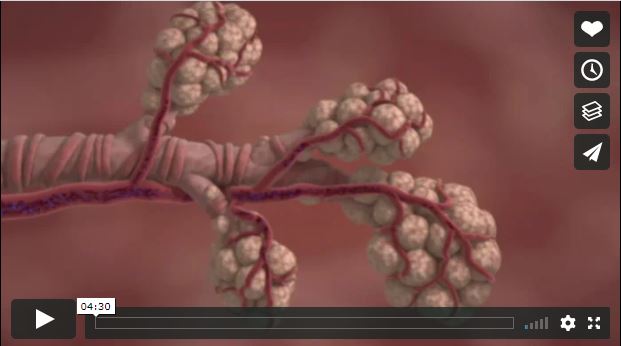
The endocrine and nervous systems coordinate this stress response. The main structures involved are the hypothalamus, pituitary gland and adrenal glands. An interesting way to show the steps in this response is an infographic, like the one shown below.
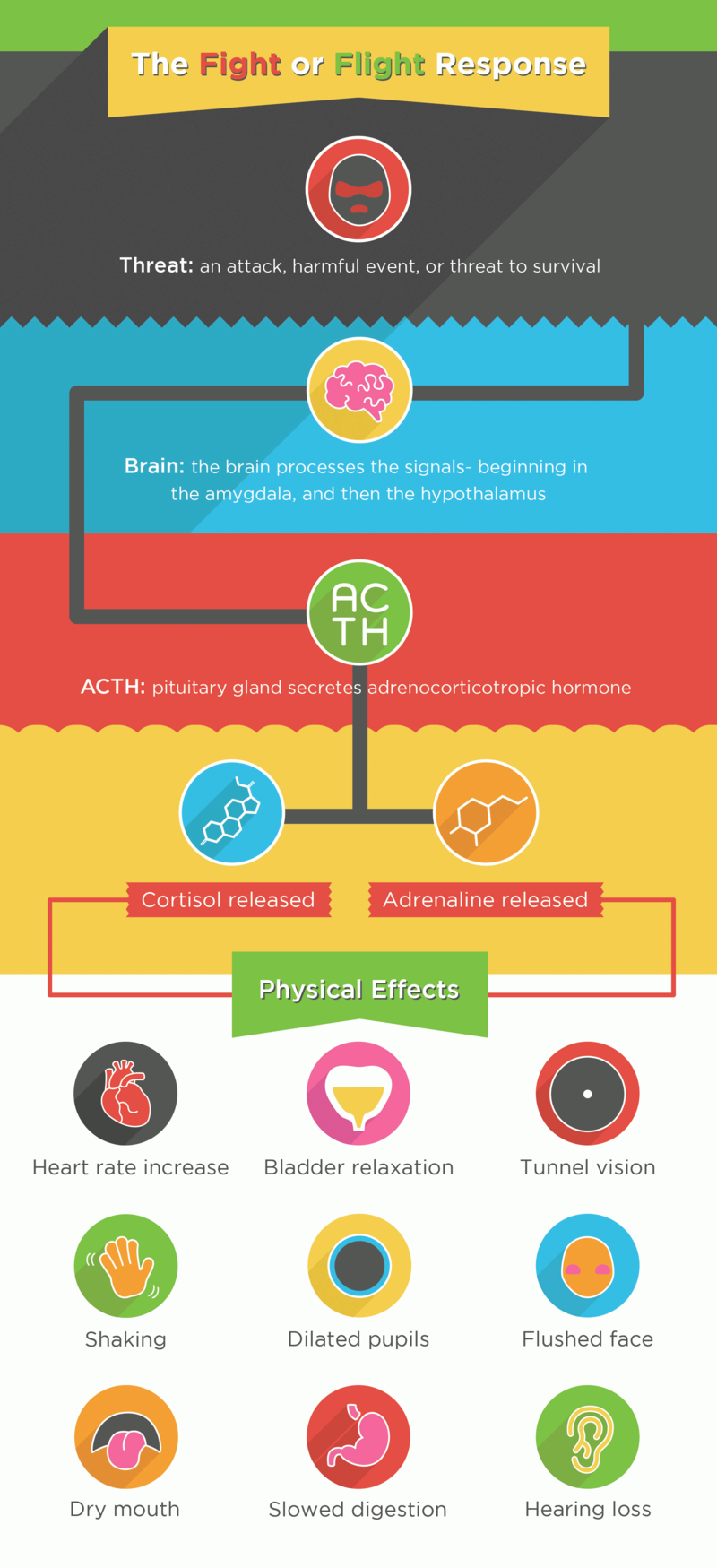
Notice how one signal from adrenocorticotropic hormone, ACTH, (definition:a hormone secreted, in response to stress, by the anterior pituitary gland and stimulates the adrenal gland (to secrete cortisol and adrenaline/epinephrine hormones).)becomes amplified by stimulating the release of cortisol (definition:a hormone secreted, in response to ACTH, by the adrenal gland and stimulates various tissues in the fight or flight response.)and adrenaline/epinephrine (definition:a hormone secreted, in response to ACTH, by the adrenal gland and stimulates various tissues in the fight or flight response.)by the adrenal glands. These two hormones have target receptors on a wide variety of cell types in different tissues. Aerobic respiration increases thanks to increased glucose transport from the flood of blood glucose which is moving faster through the blood. All these responses help provide the body with a quick burst of energy in the form of ATP to allow us to escape or overcome the stressor.
In addition to the physiological changes described in the infographic, the fight or flight response also affects our emotions and cognitive (definition:the mental process of knowing, thinking, learning and judging.)abilities in the brain. Similar to the physiological changes, changes occur to how our nervous system stimulate certain pathways while inhibiting others.
Fight or flight is a short term adaptation to a stressor. It is possible for real and perceived threats to persist leading to long term stress. The response to long term stress involves the steroid hormone cortisol instead of the peptide hormone epinephrine.
As you can see in the video, many of the effects of cortisol are useful at helping the body to overcome the stressor. Yet over a longer period of time, these changes to homeostasis weaken the body and make it less healthy. As a result, we become more sensitive to stressors, further challenging the body’s ability to return to homeostasis.
In the video we see that stress influences the length of telomeres at the ends of our chromosomes. Stress also affects the way gene expression is controlled through epigenetics. Watch the following video about how epigenetics can affect twins differently based on different environmental factors. Look to see if stress increases or decreases epigenetic tags.
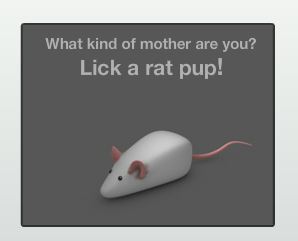
There seems to be a lot of truth to the benefits of calming the nerves. One of the genes that is related to how quickly people are able to respond to and recover from stress is the gene responsible for making the cortisol receptor, GR. The GR gene is affected by epigenetic regulation by feelings of comfort and nurturing. In the following interactive from the Genetic Science Learning Center, you can see how the amount of attention a mother rat gives its pups is related to the epigenetic control of GR gene expression. GR receptors in the brain lead to changes that inhibit the hypothalamus thereby stopping the stress response. More receptors in the brain from greater gene expression allow people to recover from stress more quickly. Click on the image below to try the interactive.

 Learning Goals and Success Criteria
 Learning Skills and Work Habits