
Communication
The Communication Process

MINDS ON
 Think About It
- Have you ever experienced a problem communicating with someone at some point? Why?
- Was there some sort of fundamental breakdown in the communication?
- Was the meaning misconstrued or misinterpreted?
- Was your message not fully understood?
- Did the message not get delivered?
- Was there a delay in the message delivery?
Communication problems are common daily occurrences in many areas of life - work, school, personal relationships, teams, clubs, even interactions with strangers on the street, or in a supermarket.
From a business point of view, communication problems can be costly and can decrease the overall productivity of an organization. They can also cause the breakdown of, or stress on, working relationships.
Conversations require a balance between speaking and listening.

ACTION
The Communication Process
“
Communication is simply the act of transferring information from one place to another.
Is this simple definition of communication enough, or is there much more to it? Consider the steps, interactions, people, involvements, and internal/external stimuli and factors that may or may not be a part of “the act of transferring information from one place to another.”
CommunicationProcess
Barriers to Communication
As discussed earlier, noise relates to potential distortions to the intended meaning of a message in the communications process. Communication noise can also be referred to as barriers - things that can create obstacles to effective communication. Think of specific elements of noise, and barriers that have led to ineffective communication in your past and in certain situations.
Now, review the most common communication barriers:
Barriers
Perception
Perceptions can clearly influence how people communicate and how they actually behave toward others. Think about the following perceptual tendencies that can cause adverse effects on, and to, working relationships:
- Stereotypes
- Halo Effects
- Selective Perception
- Projection
What do each of these perceptual tendencies actually mean?
 Perceptual Tendency
Create a document similar to below and separated into four sections - one section for each of the perceptual tendencies: stereotypes, halo effects, selective perception, and projection.
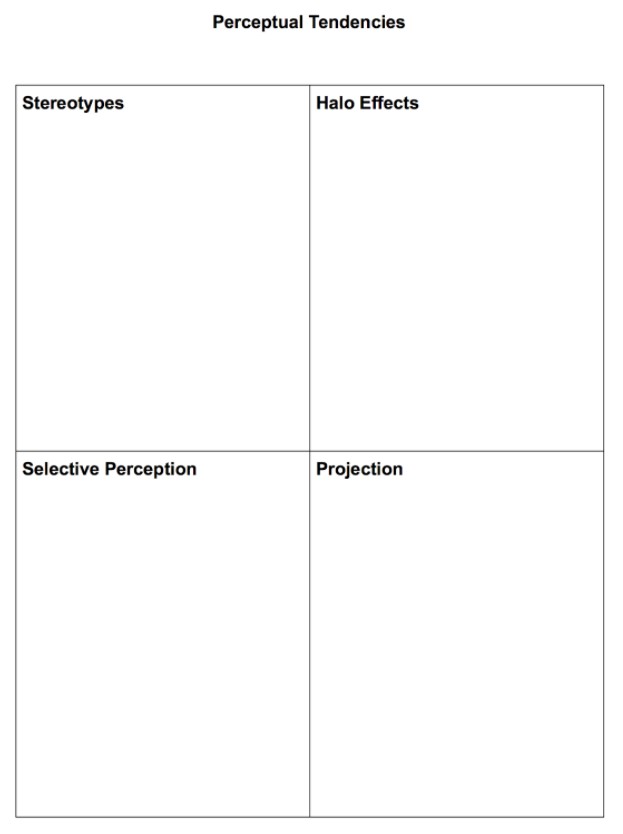
In each section of the page, provide some thoughts, insights, explanations to help explain each perceptual tendency. This may mean you perform some web-based research of your own before responding. In addition, add any outstanding questions you have to each section. Save this document to your Portfolio as you will come back to it again.
 Halo Effect
The halo effect is often used in business communication processes with consumers. The halo effect is quite often used in marketing, and namely in advertising messages. Examine the following print advertisement:

Based on your understanding of halo effects, how does this print advertisement develop an overall impression of the product? Describe the halo effect you perceive from viewing and reading this advertisement.
The McGurk Effect
Watch the following video: Try The McGurk Effect! - Horizon: Is Seeing Believing? - BBC Two.
What does the McGurk Effect tell us about perception? Can you think about a situation where a sensory perception barrier, like the McGurk Effect could cause a problem, or lead to communication problems in the workplace?
Improving Communication Skills
 Communication Case Study: Enterprise
After you have read the case study, respond to the following questions:
- Describe the key stages in the communications process.
- Explain the main methods that Enterprise uses to overcome potential barriers to its communication strategies.
- Analyse the benefits of Enterprise using a multi-channel approach to communicate its messages.
- Evaluate the effectiveness of Enterprise's internal communications strategies.
If you want to view any links in this pdf, right click and select "Open Link in New Tab" to avoid leaving this page. (View the original article.)
 Learning Goals and Success Criteria
 Learning Skills and Work Habits