
Thinking like a Social Scientist
Putting on the Glasses and Looking Through the Lenses

MINDS ON

ACTION
Primary and Secondary Sources
Did you know that there are two different classifications of information in the research world? They are called primary and secondary sources. It is important that you understand the differences (and similarities) between the types of sources because being able to differentiate between them is an important part of developing your research and inquiry skills.
Watch this short video to learn the difference between primary and secondary sources.
Primary_and_Secondary_Sources
Now that you are familiar with the differences between primary and secondary sources of information, you will notice that specific references will be made to them throughout the course. For example, the next task will require you to select and review secondary source material (encyclopedia entries), so that you can learn more about the three disciplines - psychology, sociology, and anthropology.
Once you have located information (from any source) it is crucial that you take a moment to reflect on the credibility of the source (e.g., Can you trust the source?), and the validity of the information (Is it sound and acceptable?) before you decide to use it in your studies. One protocol for assessing the quality of the information you have found is to put it to the test - the CRAAP test, that is.
Spend some time familiarizing yourself with the Information Evaluation Criteria (CRAAP) in the following interactive presentation:
CRAAP
Citing Your Sources
The last thing you want after all your effort is to be accused of stealing someone else’s work. This is otherwise known as academic dishonesty. However, if you don't cite (definition:Document the source(s) you used.) your sources properly then that could happen! Different subject areas have different formatting styles. For example, you may have used MLA in some of your language courses in the past, but for this course, you will need to know how to format your references or citations in APA format.
As you move through the course, you will likely find that The Purdue Online Writing Lab website is a very valuable resource. It will probably offer answers to all of your citation and reference questions! You may want to ‘bookmark’ this page in your browser.
 Looking Through The Lenses
It is time to put on your ‘shades!’ You will look through three different lenses to learn more about each one of them. This will help you deepen your knowledge and understanding of the subjects and their respective areas of study. (As you read about the ‘ologies,’ remember to use your metacognitive skills to reflect on your understanding!)
Task:
At this point, you have a basic understanding of the three different disciplines - psychology, sociology, and anthropology. Your task now is to locate relevant sources about them so that you learn more specific and detailed information about each one - at an introductory level. Don’t forget to reflect on your learning style when you choose the secondary sources you would like to use (e.g., you might choose to read or listen to podcasts, articles, or videos).
You will read a considerable amount of text as you learn more about the three disciplines. Trying to understand a large amount of information (regardless of the form - video, podcast, or writing) can be overwhelming. Remember, there are tools available (e.g., online readers) to help you, but you can also access the built-in reader for this course.
For example:
- if you learn by reading, you could search for articles, infographics, or images, etc.;
- if you learn by listening, you could search for podcasts, audio recordings, etc.; and/or
- if you learn by watching, you could search for videos.
Once you think you have a great source, use the CRAAP protocol to evaluate its credibility and reliability. You may need to choose another source if it doesn’t pass the test! Read to help you evaluate the sources you are using.
To help you sort the research into meaningful units, you will use a summarizing strategy. Summarizing is an effective strategy to help you:
- locate and determine essential ideas;
- combine or synthesize important details that support the main concept(s); and
- focus on keywords and important ideas.
Here are the steps you can take to effectively summarize the information that you read.
- Read/watch/listen to the text selection.
- Ask yourself:
- What are the main ideas?
- What are the crucial details necessary for supporting the ideas?
- What information is irrelevant or unnecessary?
- Use keywords or phrases to identify the main points from the text.
Choose a place (e.g., your own notebook, a Word document) to record the following.
- The name of, and the link to, each source you are summarizing.
- An analysis of the CRAAP protocol for each source (use the self-assessment rubric provided in the link to help you with this).
- A summary of the information from each source (using the three summarizing steps).
- An APA formatted reference entry for each source.
- TIP: It would likely be helpful for you to create a folder on your desktop and name it ‘Class Notes." This will help you keep your files organized.
Task: Frayer Models
An effective tool or strategy to help you understand new concepts and broaden your subject-specific vocabulary is called The Frayer Model. The Frayer Model is used to build meaning through associations and connections with a word or concept.
As a class, you will collaborate and use your collective knowledge (that you gathered in the previous task) to build Frayer Models for each of the disciplines.
Frayer_Models
A Tool For Questioning: The Question Matrix
‘There is no such thing as a silly question.’ Have you ever heard that expression before? It is true that all questions are important, but when you are looking for deeper understanding some questions are better than others.
As your brain continues to grow and develop, you may notice that you are naturally asking more questions. Knowing how to ask good (and relevant) questions is an important skill to have because asking effective questions is an important part of the research and inquiry process.
A ‘Q-Chart’ or Question Matrix can be a valuable tool to help you develop purposeful and ‘deeper’ questions.
Let’s take a look at this Question Matrix:
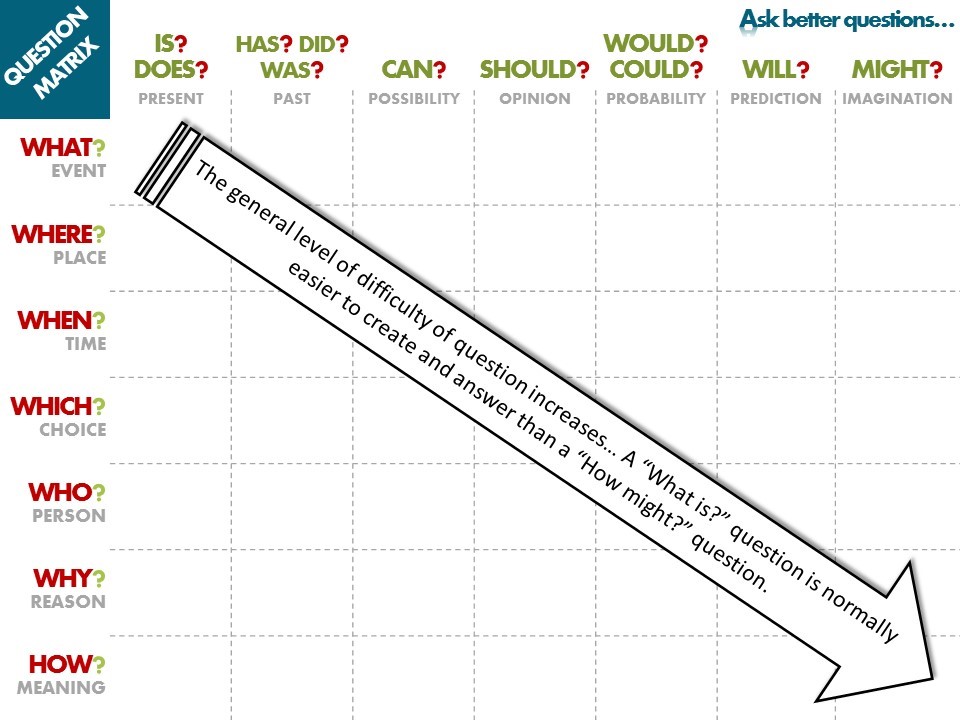
It is important to realize that there are different types of questions that can be asked. Here are some examples of the different categories of questions:
- close-ended questions have a definite answer (e.g., ‘yes’ or ‘no’), whereas open-ended questions may not have a right or wrong answer - so long as the response is justified;
- factual questions require you to simply answer with a fact (as opposed to an opinion); and
- recall questions rely on your memory for an answer (e.g., true/false questions on a test).
Would it be better to ask open or closed-ended questions when investigating the social sciences? Well, that’s a tricky question - no pun intended! There is a time and a place for each type of question. That's the important thing to remember. Sometimes there are advantages to asking closed questions - when you need a quick, definite answer, for example. Whereas, other times an open-ended question will likely yield the results for which you're hoping. For instance, if you were an anthropologist wanting to learn about a different culture, you would likely be dissatisfied if the only question you asked was, ‘Do you celebrate holidays in your culture?’ A more open-ended question, such as ‘What might you consider to be the most important holiday in your culture?” will result in a more detailed, deeper response. The response to this question will allow you to learn much more about another culture!
Refer to the Question Matrix and you will also notice that the ‘thinner’ or literal-level questions (e.g., ‘What is’ and “How does’), are on the top left corner of the chart. The deeper, or ‘thicker’ questions (e.g., ‘Why would’ and ‘How might’) are usually in the bottom right corner of the chart. These deeper questions will result in more descriptive responses.
Let’s generate some questions together. Look at the Question Matrix with the image overlaid on it. Choose one cell in the matrix and add your question to the matrix on a ‘sticky’ note. An example has been provided for you.
Question_Matrix
A Framework For Questioning: Questioning Circle
The Question Matrix is a great tool to help you generate questions, but using a framework(definition:a guiding structure) will help you learn how to make specific connections between text(s), yourself, other text(s), and the world. It is important to point out that the term text refers to sources of information in any form (e.g., articles, videos, podcasts, images, etc.), not just ‘books.’
The Questioning Circle framework (created by Kelly and Christenbury), is visually represented by three circles that overlap. These circles are meant to illustrate three specific areas of knowledge:
- the text (or subject, itself);
- the personal (you, the reader); and
- the world (or other texts or resources that are related to the original text).
Read through this visual representation of the Questioning Circle. Stop and notice where and how connections are made between the text, the reader (i.e., self), other text(s), and the world. Be sure to note that these connections are represented in the form of questions. (Adapted from: Wilhelm, J (2007) Engaging Readers and Writers with Inquiry. Scholastic.)

You will need to be able to generate specific, relevant questions and apply the Questioning Circle framework in order to complete your consolidation task. Therefore, it is time to check in and reflect. Ask yourself the following questions.
- Do I have a solid understanding of how to use the Question Matrix tool?
- Do I understand how the Questioning Circle can help me make connections between the text, myself, other text(s), and the world?
If the answer to either of these questions is ‘no,’ what should you do? Problem solve! Use the opportunity to ask a peer, ask your teacher, or maybe revisit the text itself to re-read it.

CONSOLIDATION
At this point, you should feel confident in your (initial) ability to understand the differences between psychology, sociology, and anthropology. You should also have a better idea of how to ask different types of questions, and how to evaluate sources.
Video Analysis
- Choose one of the two videos below to watch. Before you watch the video however, you need to put on your ‘shades’ - not literally, of course! You need to ‘read’ or ‘view’ the video through the lenses of the different disciplines.
- What questions, wonderings, and/or observations would psychologists have as they watched the video? Sociologists? Anthropologists? To help with each perspective, you might consider using the See,Think,Wonder strategy that you used at the start of this activity.
- Capture your thinking!
- Record your questions, wonderings, observations, and connections somewhere (e.g., your notebook, a word processing file, an audio file, or a brainstorming tool) so that you can reflect on them later - and use them to generate some potential inquiry or research questions.
- After you have watched the video and recorded your thinking, you will use your tools and strategies (i.e., the Questioning Matrix and the Questioning Circle framework) to generate two questions that a researcher from each discipline would ask. Record your questions in a file (e.g., a Word document).
- Your questions must be deep or, reflective, (i.e., located towards the bottom-left area of the Question Matrix), and they must make (self/text/world) connections.
Use these Success Criteria to help you reflect on the quality of your questions.
A successful question:
- shows your understanding of the differences between the social sciences;
- is open-ended (i.e., it cannot be answered with a one-word response);
- is deep or reflective as shown in the bottom-left corner of the Question Matrix (e.g., it could spark other questions, it would require further inquiry or research to answer it); and
- includes self/text/world connections that are relevant and have the potential to deepen social science thinking.
Save your questions to your Portfolio.
Your (video/text) choices:
This video explores, in part, the significance of having innovation, creativity, and entrepreneurial skills in today’s world.
This video explores, in part, the importance of learning to learn and being self-aware. It connects with those important inquiry questions - Who am I? What do I want to become? What are my opportunities? What is my plan for achieving my goal(s)?
 Learning Goals and Success Criteria
 Learning Skills and Work Habits