
Psychology
Social Thinking and Social Influences

MINDS ON
On July 9th, 2017 in Florida a 31-year old man drowned while a group of teens stood by and videotaped his struggle. The teens posted the video to social media where you could hear them laughing. The man, Jamel Dunn died without help from these or any bystanders.
Consider these questions:
- How do the people around us influence our behaviour and emotional development? (heading1)
- How does our behaviour change in different settings or situations? (heading1)
You will explore different topics that relate to, and explain, these questions as you work through this activity.
Let’s start this activity by exploring how people’s surroundings, or the context they are in, can influence or change the way they behave.

ACTION
Social Thinking
Generally speaking, humans are social creatures. For example, we follow news stories to know what is going on in society and the world around us, we stay connected through social media, and we organize ourselves (e.g., jobs, sports, and hobbies) in proximity to other people. Being around others seems to be a reality in most people's lives - even if we are introverts.
It is not surprising then that many psychologists have scientifically studied (using the Social Science Inquiry Method) how our context (our surroundings and environment) has an influence on how we think about each other, how we influence each other, and how we relate to each other.
Consider the following questions.
-
When students miss a lot of school is it because they are lazy? Are they ill? Is it a case of them having to help out their families?
-
What causes people to do horrible things to other people?
-
Why wouldn’t some people help others when they really need help (consider Jamel Dunn’s situation, for example)?
There is a concept (or idea) in psychology called the attribution theory, which was suggested by Fritz Heider. This theory suggests that we can explain human behaviour by either thinking that:
- it is the situation or the context that caused the behaviour; or,
- it is the personality of the person or people involved in the situation that explains how people behave.
For example, consider the case of Jamel Dunn. Why didn't the people who saw him struggling in the water call for help? Was it because of their personalities (i.e., Were they mean people? Did they enjoy seeing Jamel suffer?) or was it because of the situation (i.e., Were they actually unable to swim out to help him? Did the fact that they were with friends change how they were individually thinking?).
We could consider another example of the attribution theory, as well. Think about aggressive students in a class (or aggression in any other context). Are the students aggressive because they have aggressive personalities, or, are they aggressive because their home lives are not stable and secure?
 Freud, Maslow and Aggression
Reach back into the previous activity (Unit 2, Activity 2) when you learned about Freud and Maslow. What might each of these theorists say about aggression? In two or three sentences, explain how Freud might explain aggression in students. And then, in two or three sentences, explain how Maslow might explain aggression in students.
Stop and think about this for a minute: How often do we make the mistake of blaming bad choices and actions on people’s personalities (e.g., we assume they are bad or evil people), rather than thinking it could be the situation or context that could explain their poor choices or bad behaviour? When we do this we are making a fundamental attribution error.
The Bystander Effect and the Diffusion of Responsibility
Unfortunately, Jamel Dunn’s situation isn’t the first time that people who may have been in a position to help, didn’t. In 2005, a 21 year-old named Matthew Carrington collapsed, and eventually died because of water intoxication. In a horrible hazing event at a fraternity house in California, Matthew Carrington was forced to drink water until he eventually passed out. People who were at the hazing event watched Carrington act differently (oddly) after he was forced to drink all that water. Even though his behaviour was not normal, no one called 911. Much like the case of Jamel Dunn, many people believe that Matthew Carrington’s death could have been prevented.
Watch or listen to this video to learn more about Matthew Carrington’s situation. Warning: some of the content in this video may be disturbing for some viewers.
One of the most notable examples of this - people watching someone suffer but no one doing anything about it - happened in 1964. On March 13, 1964, a 28 year-old named Kitty Genovese was stabbed to death right outside her apartment building in New York City. Much like Dunn and Carrington’s situation, many people heard Kitty Genovese call for help, but no one came to her aid.
Many people, especially social scientists, were curious why so many people heard Kitty scream, but not one of them called the police. Two psychologists named Bibb Latané and John Darley (1968) called it The Bystander Effect - when people see something happen but no one does anything about it. Unfortunately, the Bystander Effect happens all the time (a quick media search will return many, many examples of it).
Latané and Darley designed experiments to try to explain why people don’t help. After conducting their experiments they suggested that people didn’t help because of a concept called Diffusion of Responsibility; If there is more than one person present, then people think that someone else will be the one to take the leadership role and do the right thing.
As you watch these videos, you may notice that many of the research methods used in the studies involve the experimental method or approach. Why do you think these psychologists would choose that approach? Would they rather explain behaviour, or describe it (e.g., using research methods such as surveys, or case studies)? If you said explain it, then you are right. Remember, psychologists aren’t able to say for certain if behaviour is caused by something else unless they use an experimental research approach.
So then, which factors do influence whether or not someone will stop and help? In this video, you will see some specific factors that do seem to influence whether or not bystanders are willing to help. But remember to think critically! This is just one experiment in one country.
Before you watch or listen to the video, stop and make a prediction to answer the following questions. Which factors do you think might have an influence on whether or not people help each other out? Does gender matter? Does age matter? Does someone’s socio-economic status (i.e., how much money she/he has) matter? Watch or listen to the video to see whether or not your predictions are right.
Is the Bystander Effect a topic that interests you? Read these tips if you would like to learn more about how to avoid committing it.
Social Influence
What other factors in our surroundings influence our development and behaviour?
You can likely look around you and notice examples of social influence to be able to answer that question. Media, advertising, social media memes, fashion trends - these are all examples of how context influences our behaviour and maybe the choices we make to ‘fit in’ with those around us.
This great video will give you an overview of some famous experiments that have been done to study social influence and the issues that are connected to social conformity - how we change to fit in with people around us. Watching or listening to this video will really help you understand all the different studies that will be covered in this section of the activity.
Now you have the opportunity to learn more about or, research, the experiments performed by these three psychologists - Stanley Milgram, Solomon Asch, and Philip Zimbardo. Before you do, however, create an organizer like this one in your notes:
| Name of Psychologist | Psychological Concept | Source used and a description of how you assessed it (i.e., describe the CRAAP criteria that you used to assess it) | Describe the experiment (in point form)
*Remember to fill in the CRAAP test template for each resource you use. |
What did the researcher learn from this experiment? | What did you learn from reading about this experiment? | What are some ethical concerns about this study? |
|---|---|---|---|---|---|---|
| Stanley Milgram | Obedience | |||||
| Solomon Asch | Conformity and Group Pressure | |||||
| Philip Zimbardo | The Power of the Situation | |||||
| What similarities did you notice between the different findings from the studies? | ||||||
 Psychological Research
Complete this organizer in your notes as you research Stanley Milgram, Solomon Asch, and Philip Zimbardo and their experiments (and what they learned from them).
Social_Influences
Group Influence
How does our behaviour change in the presence of others?
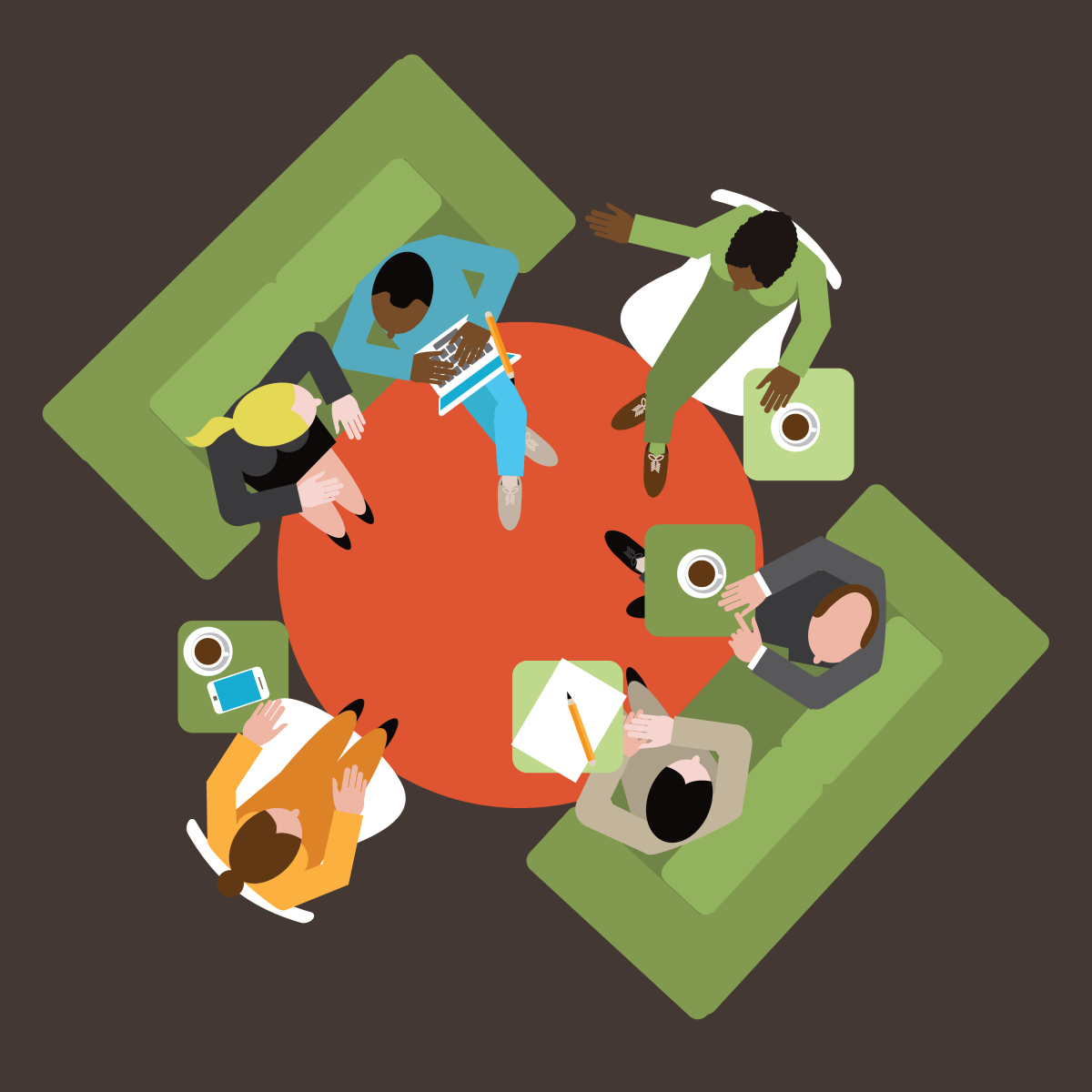
At this point in this activity, you have hopefully learned a lot about how social settings and contexts influence human behaviour. Now, let’s look at groups and how groups can influence the way we think and act. You’ll learn about three key concepts which you likely have experienced in the past.
The definition of a group is quite wide - a group can be two people, or it can be many people (e.g., families, teams, committees). That's quite a range, isn’t it? Regardless of the number of people in the group, psychologists have been able to determine that our behaviour changes when other people are present.
Have you ever noticed that you are able to do something (e.g., practicing guitar, skateboarding, typing quickly) slightly better if you have an audience - a group, of even just one more person? Or, is the opposite true - you’re less likely to complete the task well if someone else is watching you?
The reality is that both can be true! When other people watch us complete activities, it gives us energy - which can be either good or bad. If we are good at the task to begin with, then having a group around us actually seems to help us perform better (Are you a sports fan? The term ‘home-field advantage’ is explained by this concept!). However, the opposite is true, as well. If we aren’t great at a task and someone is watching us, then our performance is actually known to get worse.
This concept is called social facilitation, and it is another example of how people around us can influence our behaviour.
Do we always perform our best when we are with and around others? Unfortunately not. Have you ever been in a group that is working towards a common goal (e.g., an assignment at school) and a group member slacks off? Social loafing is a term that refers to people who do less in a group setting than they would do if they were personally accountable - or had to do a task on their own.
As we’ve seen, being around other people arouses us, which can improve our performance (social facilitation) or decrease our performance because we think our other group members will pick up our slack (so we don’t feel responsible). But what happens if those two variables (we are in a group and we don’t feel responsible) come together? The result is a concept called deindividuation. When people are in a group and they don’t feel responsible, they can often do bad things and make poor choices (e.g., food fights, riots, etc.). They experience a loss of self-awareness. Incidentally, you're correct if you are thinking, 'hmmm...this concept seems like it might explain Zimbardo’s Prison Experiment or the Bystander Effect, as well!'
Describing Your Experience
Think about your experiences, and you can likely recall a time when you observed someone else’s behaviour (or your own) change in the presence of other people. Provide an example of one of these concepts: social loafing, social facilitation, or deindividuation. Explain your example, as well. Your response should be two or three sentences long.
Mental Health
Remember that the two big questions we are trying to address or answer in this activity are, “How do the people around us influence our behaviour and emotional development?”, and, “How does our behaviour change in different settings or situations?”
A very important issue to consider when we are trying to answer these questions is mental health. The term ‘mental health’ refers to how we are progressing with our psychological and emotional development.
Do you remember learning about the biopsychosocial model to explain behaviour in Activity 1?
Here is a diagram to help you refresh your memory (just in case you have forgotten):
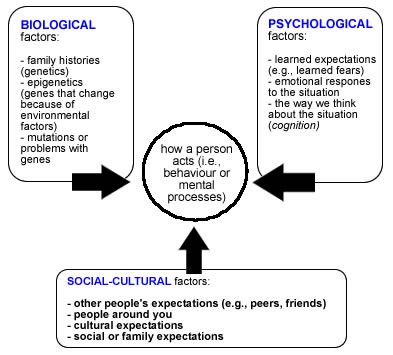
We can use the biopsychosocial model to explain how our mental health (our psychological and emotional health) changes when the expectations in our surroundings or environment change.
Let’s consider an example: anxiety.
Anxiety is a term that describes when we feel worried, nervous, or uneasy about things in our environment (e.g., an event, friends, family) because we don’t know what the outcomes may be. Often times, when we have a lot of anxiety it can lead to depression. Everybody experiences anxiety in their lives.
So, what factors around us contribute to our levels of anxiety?
The biological element: We have a variety of tiny chemicals that run through our bodies called neurotransmitters. Each neurotransmitter causes us to act or think differently. For example, a healthy level of a neurotransmitter called serotonin helps to regulate our mood. When we have an imbalance of it (or when our levels are off) then we may experience the symptoms of depression.
When it comes to anxiety, there are a variety of neurotransmitters involved - gamma-aminobutyric acid, serotonin, and norepinephrine. When our levels of these chemicals are unbalanced, then we will likely feel anxiety or anxious.
The social-cultural element: Our social situation can also affect our level of anxiety. When people around us (e.g., family or friends, cultural expectations) have expectations about how we should think or act this puts a lot of pressure on us. This, in turn, changes the amount of anxiety we have and feel.
The psychological element: Take a minute to recall the concept of conditioning - operant and classical - and how it explains our behaviour. Psychologically, we condition ourselves to respond to stress in our environment, as well. If we have a bad experience with something that causes us a lot of stress (e.g., a bad relationship with someone) then the next time we are in that situation we may experience more anxiety because we tell ourselves that we will have the same results or outcomes. Every time we think this way, we strengthen our worrying or nervousness. Little by little, these negative thoughts make our anxiety worse and worse. It is very important to deal with these feelings. We have to unlearn or de-condition ourselves!
The Biopsychosocial Model
Choose an article to read or listen to. After reading or listening to the article, apply the biopsychosocial model to explain how and why the person’s behaviour changed. Your response should be 2- 4 paragraphs long.

CONSOLIDATION
 Factors Influencing Behaviour
Remember the guiding questions for this activity, “How do the people around us influence our behaviour and emotional development?”, and, “How does our behaviour change in different settings or situations?”
Take a few minutes to think about how you would answer those questions. To be able to do that, you might think about the different individuals, concepts, and theories that you learned about in this activity:
- Stanley Milgram
- Solomon Asch
- Philip Zimbardo
- Bystander Effect
- Diffusion of Responsibility
- Conformity
- Obedience
- Social Facilitation
- Social Loafing
- Deindividuation
- Mental Health and the Biopsychosocial Model
Answer these questions in your notes and save your answers in your Portfolio. You will use your answers in another activity in this unit.
- What four images can you find that illustrate the theories and concepts you learned about in this activity?
- How does each image connect to the guiding questions?
 Learning Goals and Success Criteria
 Learning Skills and Work Habits